"KOSPI 7000 Is Not Far Off... Further Gains Possible on Semiconductor Earnings" [KOSPI Breaks 6,000]
- Input
- 2026-02-25 18:12:25
- Updated
- 2026-02-25 18:12:25
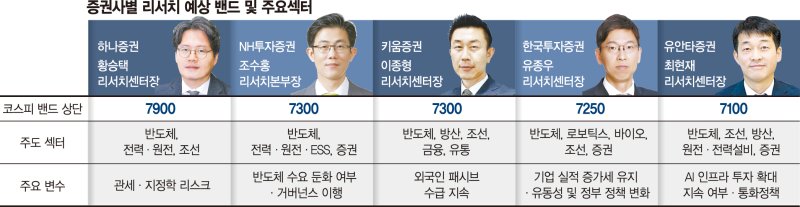
On the 25th, Financial News surveyed the heads of research at five brokerages—Hana Securities, NH Investment & Securities, Kiwoom Securities, Korea Investment & Securities, and Yuanta Securities Korea—on their stock market outlook. All of them raised the upper end of their projected KOSPI trading band to the 7,000 level.
Hana Securities currently has the most bullish view, setting the upper band for the KOSPI at 7,900. It is followed by NH Investment & Securities and Kiwoom Securities at 7,300, Korea Investment & Securities at 7,250, and Yuanta Securities Korea at 7,100.
They also leave room to revise these bands higher if corporate earnings growth accelerates.
Hwang Seung-taek, head of research at Hana Securities, said, "The KOSPI is likely to maintain its upward trajectory. Depending on how much corporate earnings improve, there is a chance we will raise our band further," adding, "However, uncertainties stemming from Donald Trump—such as tariffs and the Iran issue—could act as variables."
Jonghyung Lee, head of research at Kiwoom Securities, also noted, "The price-earnings ratio (PER) is only in the low 10 times range, which is merely around its historical average, so valuation pressure remains limited." He advised, "As long as the trend of upward revisions to operating-profit consensus, led by semiconductors, continues, it is appropriate to assume the market’s direction is tilted to the upside."
Rising expectations for earnings at Samsung Electronics and SK hynix on the back of the spread of artificial intelligence (AI), along with stronger shareholder-return policies following amendments to the Commercial Act, are reinforcing the bullish view on the index. Choi Hyun-jae, head of research at Yuanta Securities Korea, projected, "Starting with the KOSPI breaking 6,000 in the first quarter, the index will move on an upward path and settle into the 6,000 range through the second and third quarters." He added, "If earnings expectations for large-cap semiconductor names like Samsung Electronics and SK hynix continue to be revised up, we can fully consider raising the index band further."
Cho Suhong, head of research at NH Investment & Securities, commented, "Last year’s amendment to the Commercial Act laid the groundwork for improving corporate governance issues." He went on, "The period when these changes will become visible is the shareholder meeting season next month, when we may see opportunities to resolve the so-called ‘Korea discount’ through shifts in corporate and shareholder behavior."
The research heads again picked semiconductors as the leading sector this year, as they did last year, while stressing that investors should also pay attention to shipbuilding, defense, nuclear power, biotech, and securities stocks.
Yoo Jong-woo, head of research at Korea Investment & Securities, explained, "Following high-bandwidth memory (HBM), prices of standard dynamic random-access memory (DRAM) and NAND flash memory are also continuing to rise, so investors should maintain their semiconductor exposure while increasing allocations to other promising sectors." He added, "Investors should also look at growth names in robotics, biotech, and shipbuilding, as well as securities stocks, where earnings are starting to improve."
For the relatively weaker KOSDAQ market, the dominant view is that it will also trend higher, supported by government measures to revitalize the market and increased capital inflows.
Lee noted, "Secondary battery stocks, which make up a large portion of the KOSDAQ, have weak share-price momentum due to sluggish electric vehicle demand, so investors need to approach the market from an individual stock-picking perspective." He also warned, "Unlike the KOSPI, the KOSDAQ faces a heavier burden from margin financing, which could cap the upside for share prices." Choi added, "For the index to break through its upper range in a sustained way, we will need qualitative improvements in fundamentals, such as successful license-out (LO) deals by top-cap biotech new drug developers on KOSDAQ or a dramatic turnaround in the secondary battery industry." He advised, "Investors should be selective and focus on stocks that combine solid earnings momentum with strong demand from foreign and institutional investors."
[email protected] Seo Min-ji and Bae Han-geul Reporter