Foreign Investors, the ‘Big Players’ in KOSPI, Hit Record High Market Cap of 1,800 Trillion Won
- Input
- 2026-02-25 18:08:03
- Updated
- 2026-02-25 18:08:03
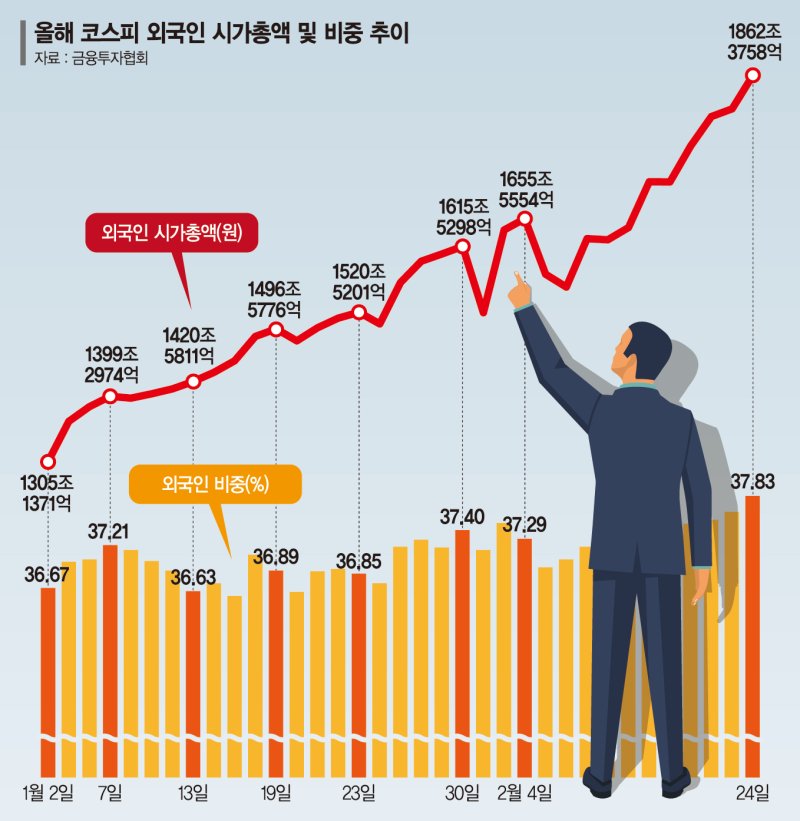
According to the Korea Financial Investment Association (KOFIA) on the 25th, foreign investors’ market capitalization in the KOSPI market stood at 1,862.3758 trillion won as of the 24th, the highest level on record. It first broke through the 1,800 trillion won mark on the 20th at 1,802.8690 trillion won and has risen for three consecutive trading days since then. Foreign investors’ market cap hit a previous record of 845.9882 trillion won on August 19 last year and has been on a steady uptrend, swelling by 1,000 trillion won in just half a year. Their share of total KOSPI market capitalization was 37.83% as of the previous day, closing in on the all-time high of 39.26% recorded on February 14, 2020.
The sharp rise in the KOSPI index has been the main driver. From February 2 to the previous day, the KOSPI jumped 41.66%, and over the same period, foreign investors’ market capitalization surged 42.69%, from 1,305.1371 trillion won. Although foreign investors have recorded net selling of more than 11 trillion won in the KOSPI market this year, the impact has been limited because their total holdings now exceed 1,000 trillion won in market value.
Lee Sang-heon, a researcher at iM Securities, said, "This year, the KOSPI has climbed from the 4,200 level to around 6,100, a gain of nearly 2,000 points," adding, "Market capitalization directly reflects the value of the shares held. Even if some of those shares are sold, market cap can still increase if stock prices rise by more than the amount sold."
Brokerage analysts expect foreign inflows to expand further. The domestic stock market is becoming more favored in global markets. On top of that, stock market support measures such as mandatory cancellation of treasury shares are seen as leaving additional room for the index to rise.
Han Ji-young, a researcher at Kiwoom Securities, noted, "Despite the recent favorable stock market environment, the fact that foreign investors are continuing net selling is cited as a potential risk factor," but added, "However, most of the net selling has been concentrated in large-cap sectors such as semiconductors and automobiles, which led the early-year surge, so it is more appropriate to view it as profit-taking."
He went on to say, "Since the beginning of the year, the Republic of Korea has attracted the second-largest inflows into the global exchange-traded fund (ETF) market after the United States, and inflows of foreign passive funds that simply track the index are accelerating," adding, "Considering valuation attractiveness and at least a neutral foreign flow environment, the drivers for further upside in the index have not yet been exhausted. In addition, it is a timely moment to expect stronger shareholder returns, including mandatory cancellation of treasury shares."
On the other hand, some are concerned that foreign investors will continue to take profits, as the domestic stock market has risen sharply in a short period, creating valuation pressure. Lee observed, "Right now, it is individual investors’ ETF funds that are pushing the index higher. For individuals, this is a relatively easy market where they can focus on existing leading stocks such as semiconductor names," adding, "Foreign investors, by contrast, see parts of the market as expensive based on indicators such as the rise in our ROE, so their selling pressure is likely to persist for the time being."
[email protected] Reporter Lim Sang-hyuk Reporter