"No Constitutional Court Above the Supreme Court" — Judiciary in Collective Revolt as Democratic Party Pushes Three Judicial Reform Bills
- Input
- 2026-02-25 17:02:34
- Updated
- 2026-02-25 17:02:34
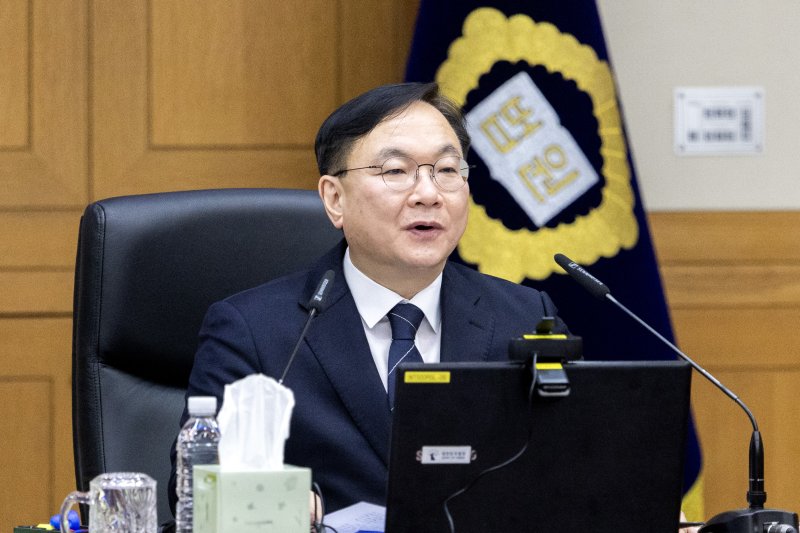
[The Financial News] The heads of the Judiciary have effectively made clear their opposition to the "three judicial reform bills"—the offense of distorting the law, the constitutional appeal system, and the expansion of Supreme Court justices. While they prefaced their stance by saying public opinion must first be heard, their underlying message was that the bills are potentially unconstitutional and could harm the public, so deliberations in the National Assembly should be halted. However, the Democratic Party of Korea (DPK), which holds a majority of seats in the National Assembly, remains determined to push the bills through, setting the stage for a significant backlash.
According to the legal community on the 25th, Minister of the National Court Administration and Supreme Court Justice Park Young-jae and 43 presidents of courts at all levels across the country held an extraordinary session of the National Conference of Court Presidents that day in the main conference room of the Supreme Court Building in Seocho District to discuss these issues.
Before the meeting, Park stated, "Each of these bills would not only bring about major changes to the essential role and function of the courts in safeguarding the constitutional order and protecting the rights of the people, but also directly affect citizens who seek relief through the courts." He added, "In the deliberation process on these bills, it is necessary to reflect the views of the Judiciary, which is directly responsible for trials."
Previously, Chief Justice of the Supreme Court of Korea Cho Hee-dae, the highest-ranking member of the Supreme Court of Korea, had repeatedly voiced concern about the three judicial reform bills in briefings with reporters on his way to work. Cho remarked, "These are grave matters that could amount to constitutional amendments," and warned that they are "issues where the harm could directly fall on the people."
The proposed constitutional appeal system is often described as creating a de facto four-tier court structure. It is designed to revise the current system, under which Supreme Court of Korea rulings are final and cannot be altered, by allowing the Constitutional Court of Korea to review whether a Supreme Court of Korea decision is consistent with the Constitution. The idea stems from the criticism that "the Judiciary, as an unelected power, exerts political influence." The judicial power abuse scandal under former Chief Justice Yang Sung-tae and the case in which the Supreme Court of Korea unusually and swiftly remanded a Public Official Election Act violation case involving Lee Jae-myung when he was a presidential candidate served as catalysts. However, critics argue that introducing a four-tier system is less a judicial reform than a reconfiguration of power that effectively places the Constitutional Court of Korea above the Supreme Court of Korea, and a political attempt to bring the Judiciary under control. They warn that a reform ostensibly aimed at preventing the politicization of the Judiciary could paradoxically lead to political power capturing the courts.
In fact, court presidents nationwide are reported to have voiced strong opposition and concern over both the constitutional appeal system and the new offense targeting distortion of the law. A senior judge at a court in the greater Seoul area commented, "The constitutional appeal system will, in effect, increase the rate at which parties challenge trial outcomes and delay the final conclusion of lawsuits, which will significantly inconvenience the public." The judge also pointed out, "If the offense of distorting the law is enacted, many judges will feel constrained in applying the law, and because there is no clear definition of distortion or specific standards, the bill does not meet the principle of legal clarity."
Within the Democratic Party of Korea as well, opinions are reportedly divided over the offense targeting distortion of the law. Some warn that as the system becomes more complex, it could end up working to the advantage of vested interests with money and power, rather than ordinary citizens. Others, however, argue that the measure is unavoidable if the country is to overcome deep public distrust of the Judiciary.
Lee Heon-hwan, a professor at Ajou University Law School and former head of the Constitutional Research Institute, argued, "From the standpoint of constitutional theory, there is no problem at all with introducing a constitutional appeal system, and calling it a 'four-tier court system' is a flawed argument." He explained, "When the exercise of judicial power infringes on an individual's fundamental rights, the constitutional appeal system is a procedure to restore those rights."
He went on to say, "In Germany, less than 1% of constitutional appeal cases are upheld," noting, "Cases where the law is applied incorrectly are extremely rare, but the system exists to correct even one wrong judgment out of a hundred."
[email protected] Lee Hwan-joo, Choi Eun-sol Reporter