Action Plan to Become a Top Three Global AI Power Kicks Off in Earnest... Targeting No. 1 in Physical AI by 2030
- Input
- 2026-02-25 10:44:47
- Updated
- 2026-02-25 10:44:47
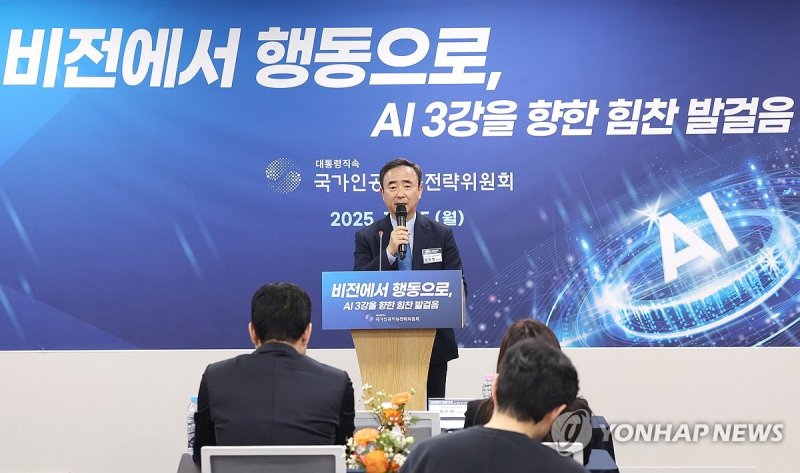
The National AI Strategy Committee held its second plenary meeting on the 25th in Jung District, Seoul, where it reviewed and approved the "Korea AI Action Plan." The plan is structured around three policy pillars: creating an AI innovation ecosystem, driving a nationwide AI-based transformation, and contributing to a global AI basic society.
To build an AI innovation ecosystem, the government will promote policies to establish an AI "highway" and secure next-generation AI technologies.
The goal is to expand data centers equipped with advanced Graphics Processing Units (GPU) and domestic AI semiconductor–based infrastructure, so that anyone can use AI computing and data resources to develop innovative AI technologies and services. By 2030, Korea aims to become the global No. 1 in physical AI by securing core technologies and data, and by building a virtuous cycle in which AI accelerates scientific discovery.
To secure top-tier AI talent, the government will establish mandatory AI education across elementary, middle, and high schools, while also strategically attracting global experts. It will develop world-class, homegrown general-purpose AI models and create specialized models tailored to key industries such as healthcare and biotechnology.
The legal framework will be updated so that copyrighted works can be used for AI training without legal uncertainty. The government plans to invigorate the market for copyrighted content while allowing rights holders to exercise a right to refuse AI training. Works without an explicit refusal will be subject to a "use first, compensate later" approach.
For a nationwide AI transformation, the industrial, public, and regional sectors will all be shifted toward AI. The government will establish the "Manufacturing AI 2030 Strategy" with the goal of becoming the world’s No. 1 manufacturing power by 2030, while also preparing a Korean-style AI full-stack export strategy. It will support AI use by public officials and build an integrated AI-based civil service platform.
The government also plans to leverage private-sector capabilities to enhance the resilience of public systems. In addition, it will promote balanced national development by creating a wide-area AX Innovation Belt and K-AI Specialized Pilot Cities, based on the Five Mega-Regions and Three Special Self-Governing Provinces Policy as regional growth engines. The plan includes building a support system for AI-based content creation and shortening the timeline for introducing AI into national defense.
In the area of contributing to a global AI basic society, the government will establish the "AI Basic Society Promotion Plan" to ensure that AI supports people’s daily lives across labor, welfare, education, and more. Building on the AI initiative adopted at APEC South Korea 2025 in Gyeongju last year, Korea will actively promote the K-AI Initiative agenda and lead technological and normative coalitions at forums such as the UN and the AI Summit.
Lim Moon-young, Standing Vice Chairperson of the National AI Strategy Committee, stated, "With the approval of today’s AI Action Plan and other key policies, the direction of our government’s future AI initiatives has been designed in much more concrete terms." He added, "I expect each ministry to faithfully implement the finalized AI Action Plan, and the committee will spare no effort in providing the necessary policy coordination and support."
[email protected] Lee Gu-soon Reporter