"Even in Gangnam, nothing has sold for a year...Take non-apartment housing out of the regulations"
- Input
- 2026-02-25 18:41:57
- Updated
- 2026-02-25 18:41:57

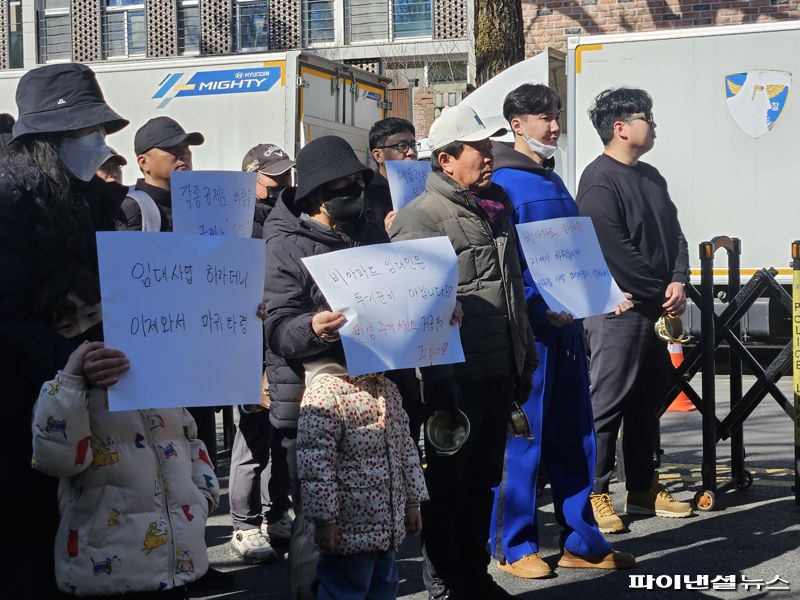
On the 25th in Hyoja-dong, Jongno District in Seoul, the Korean Landlord Federation held a protest against the government’s plan to tighten loan repayment rules for multiple-home owners. At the site, an officetel landlord identified by the surname Yang said, "Even in Gangnam, if it’s not an apartment, there is no demand and nothing sells, so imagine how much worse it is in other areas." He continued, "Most landlords did not start out with ample cash on hand. If loan extensions are cut off, the burden will ultimately fall on tenants, and there is nothing we can do about it."
About 100 people gathered for the rally. Landlords renting out multi-family housing and officetels held placards reading slogans such as "Apartments and non-apartment housing are different" and "Is providing basic housing services a crime?"
They say they took to the streets because if the government goes ahead with stronger loan repayment pressure on multiple-home owners, which it is reviewing as a way to stabilize apartment prices, the non-apartment rental market could suffer a chain reaction. Financial authorities are now seriously considering restricting loan extensions for owners of two or more homes, including registered landlords.
The landlord registration system was introduced in 1994 to help stabilize tenants’ housing. The Moon Jae-in administration expanded tax and financial incentives in 2017 to encourage registration, but the registered apartment landlord program was abolished in 2020 amid criticism that it was fueling multiple-home ownership. Today, most registered rental properties are non-apartment units such as studios, villas, and officetels.
One landlord who said he rents out eight units in a multi-family building in Songpa District in Seoul complained, "Multi-family housing has many units, so you can’t sell the whole building in one go, and taxes are levied separately on each unit." He added, "If you regulate us by the same standards as apartments, there is no exit." A 71-year-old landlord from Busan Metropolitan City said, "The government told us to register, so I have been operating within the formal system for 14 years, keeping rent increases within the 5% cap," and argued, "Now saying they will block loan maturity extensions is basically telling landlords to go under."
Their biggest concern is the impact on the youth rental market. Non-apartment housing is where many one- to two-person households, young people just starting their careers, and the elderly—groups with relatively low incomes—tend to live. One participant from Gwanak District asked, "There are 160,000 young residents in Gwanak District alone. While it takes three to four years to build new public rental housing, where are they supposed to go in the meantime?"
They argue that if loan repayment pressure becomes a reality, jeonse listings will shrink, conversions to monthly rent will accelerate, and housing costs will rise. There is also concern that if some landlords cannot return deposits on time, properties will be forced into auction, directly harming tenants.
They warn that the fallout could spread to the financial sector and guarantee institutions. If jeonse deposit guarantee defaults increase, the burden of subrogation payments on the Korea Housing & Urban Guarantee Corporation (HUG) and the Korea Housing Finance Corporation (HF) will grow. Because many non-apartment loans are small in size but numerous in number, some point out that a wave of non-repayment could erode the value of banks’ loan portfolios. Kang Hee-chang, head of the Korean Landlord Federation, said, "For decades we have been the government’s partners in supplying private rental housing, but if problems arise, we will be branded as multiple-home owners who wasted taxpayers’ money and become targets of a witch hunt."
Experts advise that instead of blanket regulations on all multiple-home owners, the government needs more fine-tuned policies that distinguish between different types of landlords. Kim Deok-rye, a research director at the Housing Industry Research Institute, noted, "When a policy affects landlords, its impact inevitably reaches tenants as well, for up to four years." She added, "You cannot lump all landlords together as if they are the same." She went on to stress, "The right approach is to protect those who have been operating within the formal system, while regulating cases where people bought homes without any real intention of providing rental housing."
After the rally, the federation held an official meeting with the Senior Presidential Secretary for Economic Growth and Affairs Office at Cheong Wa Dae to convey its concerns about regulations such as limits on extending loans for non-apartment landlords.
[email protected] Choi Ga-young Reporter