[Editorial] Sharp Drop in Housing Price Expectations Calls for Sustained Stabilization Measures
- Input
- 2026-02-24 18:39:02
- Updated
- 2026-02-24 18:39:02
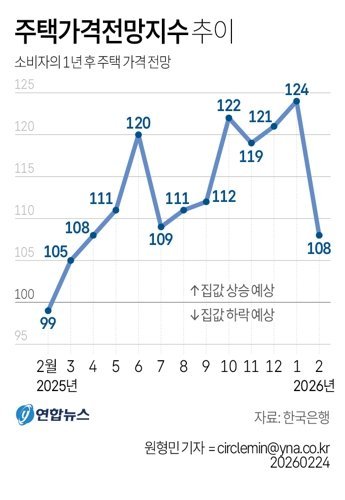
This cooling of expectations appears to be partly linked to the government’s repeated messages about stabilizing the real estate market. President of South Korea Lee Jae-myung announced on January 23 that the temporary suspension of heavier capital gains tax on multiple-home owners would end, and since then he has repeatedly stressed his commitment to market stability. He has urged owners of multiple homes to sell non-owner-occupied properties and has called for an end to the practice of routinely extending loan maturities for such borrowers, thereby setting out the policy direction in relatively clear terms.
On the 24th, President Lee Jae-myung again shared a related news article and remarked, "Some say you should not go against the market, but there is also a saying that you should not go against the government." His point was that while owning multiple homes is a matter of personal choice, those involved must bear the risks and responsibilities that come with normalizing an abnormal market. By invoking the "normalization of the Republic of Korea (ROK)" and likening it to efforts to normalize the stock market, he also noted that gains and losses alike are each individual’s responsibility. He thus reiterated his determination to correct a market overheated by speculation.
There are, in fact, early signs of change in the market. According to data compiled by a real estate platform, as of the 24th there were about 68,000 apartment listings in Seoul, more than 20% higher than a month earlier.
Listings are surging ahead of the resumption of heavier capital gains tax and tighter lending regulations. In some popular areas, there have even been transactions concluded at prices several hundred million won below previous record highs. The shift in expectations is beginning to show up in actual deals on the ground.
However, it is difficult to say with certainty that this trend will lead to structural market stability. After heavier capital gains tax on multiple-home owners resumes on May 9, listings from such owners could shrink again. If this happens without a sufficiently strong supply base, a renewed "lock-in" of properties could emerge. There are still many variables, and it is premature to take the improvement in sentiment indicators as a guarantee of a benign medium- to long-term price trend.
Policymakers must also closely examine how measures focused on increasing listings will affect the jeonse rental market. Some predict that jeonse demand will fall as multiple-home owners sell their properties, but the real estate market cannot be explained by simple arithmetic. Given the diversity of household circumstances—such as financial capacity, job changes, and school districts—jeonse demand is likely to remain strong. If the government pushes ahead with real estate policies while overlooking this, it could inadvertently heighten housing insecurity for tenants.
Stabilizing the real estate market is a goal shared by most citizens. Yet the recent break in price-rise expectations is no reason for complacency. Depending on changes in real estate policy and the timetable for tax reforms, the market could become volatile again at any time. As long as uncertainty over supply and demand persists, prices will remain sensitive even to small shocks.
Rather than being satisfied with short-term shifts, the government should raise predictability by presenting concrete figures for housing completions and land supply plans over the coming years. Only when there is a realistic supply roadmap that consumers can trust will market stabilization gain lasting traction.