KOSPI Market Cap Nears 5,000 Trillion Won
- Input
- 2026-02-24 18:34:18
- Updated
- 2026-02-24 18:34:18
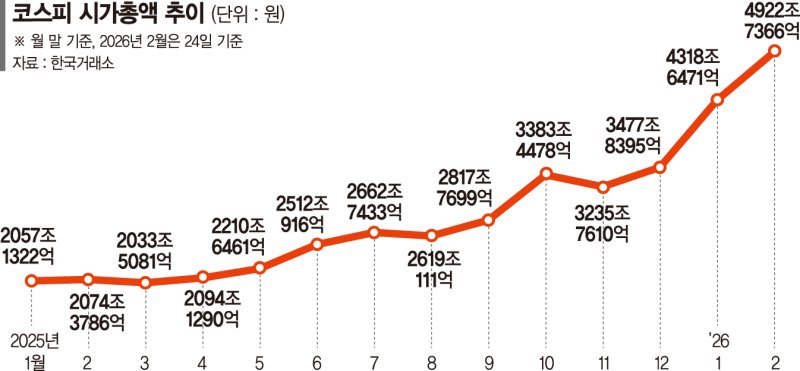
According to the Korea Exchange on the 24th, the KOSPI’s market capitalization at the close of trading that day stood at 4,922.7366 trillion won. This is a 13.99% increase from 4,318.6471 trillion won at the end of last month. If the current level rises by only about 1.6%, the index will be able to cross the 5,000 trillion won mark. Given that the market cap jumped 24.18% in a single month last month, some analysts expect the KOSPI to surpass 5,000 trillion won as early as this month.
The stock market boom that began last year has driven a sharp expansion in the KOSPI’s market capitalization. On January 4, 2021, the KOSPI’s market cap closed above 2,000 trillion won for the first time, and it took about four years and nine months to break 3,000 trillion won on October 15 last year. It then exceeded 4,000 trillion won on the 16th of last month, just three months later, and is now on the brink of 5,000 trillion won in less than two months.
The surge has been driven largely by the swelling valuations of Samsung Electronics and SK hynix, the top two stocks by market cap. On this day, SK hynix’s market capitalization topped 700 trillion won for the first time, and the combined market cap of Samsung Electronics and SK hynix reached 1,900.1935 trillion won.
Samsung Electronics and SK hynix now also account for a larger share of the overall KOSPI. At the end of 2024, their combined weight in the index was around 22.62%, but it has risen from 34.04% at the end of last year to 38.60% currently.
Brokerages expect semiconductors to remain the leading sector this year, following last year’s rally. As earnings forecasts for Samsung Electronics and SK hynix are revised upward, many anticipate that the KOSPI will continue its upward trend.
This year’s operating profit forecasts for Samsung Electronics and SK hynix have climbed as high as about 250 trillion won and 220 trillion won, respectively. On the back of these earnings expectations, Samsung Electronics closed at 200,000 won and SK hynix at 1,005,000 won on the day, both marking record highs.
Seol Tae-hyun, an analyst at DB Securities, said, "Considering the distribution of earnings forecasts by securities firms for Samsung Electronics and SK hynix for this year and next, the likelihood of further upward revisions to profit estimates is gaining weight," adding, "The earnings trajectory of these flagship semiconductor companies will be a key determinant that not only drives index volatility but also redefines the KOSPI’s trading band for the year."
Brokerages are also raising their projected KOSPI trading bands. Hana Securities has offered the most bullish view, setting the upper end of its KOSPI target at 7,870. NH Investment & Securities and Kiwoom Securities forecast 7,300, Korea Investment & Securities projects 7,250, and Yuanta Securities Korea sees 7,100, with expectations increasingly centered above 7,000.
Han Ji-young, an analyst at Kiwoom Securities, noted, "This year’s KOSPI operating profit consensus stands at about 580 trillion won, up roughly 35% from the beginning of the year, and it is likely to be revised up further to the low-to-mid 600 trillion won range," and added, "Although the index level itself faces some burden after a short-term spike, it is important to view positively the fact that the forward price-earnings ratio (PER) remains around 10 times, which is close to its historical average, indicating limited valuation pressure."
Abundant liquidity is another factor supporting the market’s rise. Heo Jae-hwan, an analyst at Eugene Investment & Securities, explained, "The key drivers of stock price gains are corporate earnings and liquidity," pointing out, "From the start of the year through the 11th, bank deposits fell by 34 trillion won, while equity fund inflows increased by 46.7 trillion won and customer deposits at securities firms rose by 10 trillion won."
[email protected] Seo Min-ji Reporter