Share Cancellations Accelerate, Cutting KOSPI Share Count for Third Straight Quarter
- Input
- 2026-02-24 18:34:16
- Updated
- 2026-02-24 18:34:16
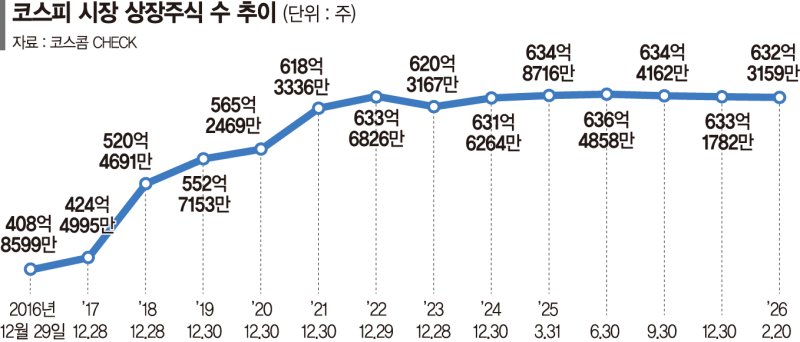
According to KOSCOM CHECK on the 24th, the number of shares listed on the KOSPI as of the 20th was 63.23159 billion. This is about 400 million fewer shares than the 63.64858 billion recorded on June 30 last year, marking a decline for three consecutive quarters. So far this year alone, the number of listed shares has fallen by 86.23 million.
This pattern contrasts with the trend of the past decade. The number of KOSPI-listed shares rose 54.9%, from 40.88599 billion in 2016 to 63.36826 billion in 2022. It dipped slightly to 62.03167 billion in 2023, but then climbed again to 63.16264 billion in 2024.
Typically, the number of listed shares increases when rights issues and initial public offerings (IPOs) are active, while the pace of treasury share cancellations remains slow. According to the Korea Exchange, over the past five years domestic listed companies have canceled only about half of the treasury shares they purchased, in value terms. From 2020 to 2024, listed firms bought back a total of 45 trillion won in treasury shares, but canceled only 25.5 trillion won worth.
The shift began in the second half of last year, when the government and ruling party started pushing the Third Amendment Bill to the Commercial Act, which centers on mandating the cancellation of treasury shares. The bill explicitly classifies treasury shares as "capital." It requires companies to cancel treasury shares already held within 18 months of the law taking effect, and to cancel newly acquired treasury shares within one year. Anticipating the new rules, companies with large treasury share holdings have stepped up cancellations. As a result, listed companies canceled 21.4 trillion won worth of treasury shares last year, surpassing the value of treasury share purchases (20.1 trillion won) for the first time on record.
Analysts say the previously unrelenting increase in the number of listed shares has contributed to the undervaluation of the Korean stock market. KOSPI earnings per share (EPS), calculated by dividing total net profit of listed firms by the number of listed shares, is a key indicator of market profitability. The more shares there are, the larger the denominator becomes, mechanically lowering EPS. Kim Jong-young, an analyst at NH Investment & Securities, said, "While the total number of KOSPI-listed shares has increased by about 2% per year on average, net profit has grown 10.5% annually, so EPS growth has lagged behind profit growth due to share dilution."
With the Third Amendment Bill to the Commercial Act having passed the full session of the National Assembly Legislation and Judiciary Committee on the 23rd and now awaiting a plenary vote, market experts expect the mandatory cancellation of treasury shares to reduce share counts and give the stock market additional momentum.
Lee Sang-heon, an analyst at iM Securities, explained, "When return on equity (ROE) rises, the price-to-book ratio (PBR) goes up, and when PBR rises, the index moves higher." He added, "ROE is calculated by dividing net income by equity. If the cancellation of treasury shares becomes mandatory, equity will shrink, pushing ROE higher and ultimately supporting index gains." He went on to say, "From now on, the market will interpret share buybacks as a signal of future cancellations, creating an environment in which companies can further strengthen their shareholder-return policies."
[email protected] Park Ji-yeon Reporter