Semiconductor leaders hit record highs, leaving KOSPI just 31 points shy of 6,000
- Input
- 2026-02-24 18:26:47
- Updated
- 2026-02-24 18:26:47
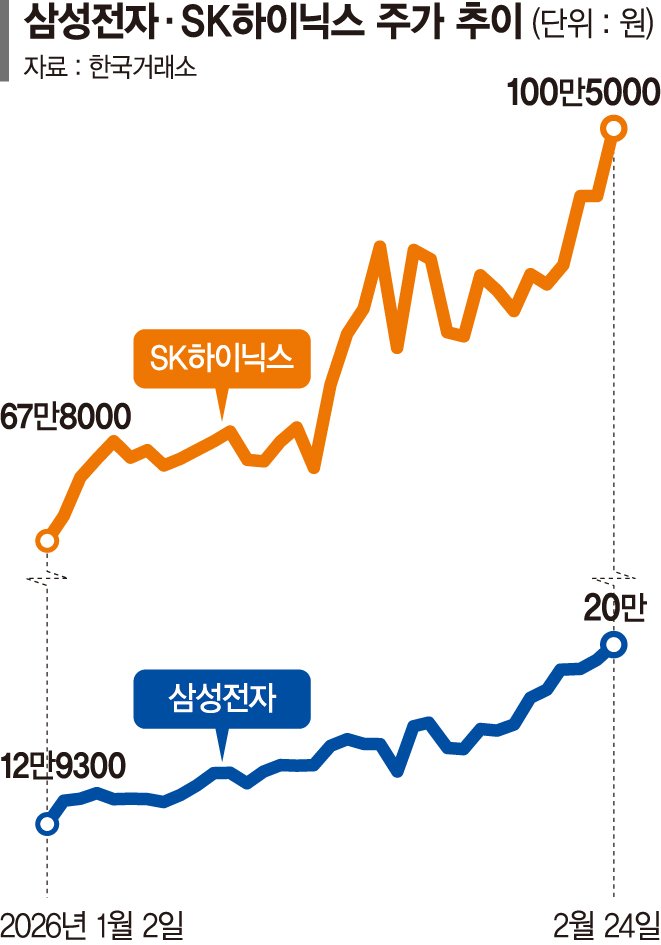
On the 24th, the KOSPI closed at 5,969.64, up 123.55 points (2.11%) from the previous session. In the main board market, institutional investors bought 2.5086 trillion won worth of shares, driving the index higher. In contrast, individuals and foreigners sold 2.3459 trillion won and 244 billion won, respectively.
Samsung Electronics jumped 3.63% to close at 200,000 won, setting a new all‐time high. SK hynix also gained more than 5% to finish at 1,005,000 won, entering the 1 million won price range for the first time in its history.
Given the weight of these two stocks in the index by market capitalization, their rally did more than simply lift individual names; it acted as a powerful engine pulling up the overall index structure. Brokerages interpret this rally as a clear signal that an "AI memory structural supercycle" is now in full swing.
Han Dong-hee, an analyst at SK Securities, said, "We are raising our target price for SK hynix to 1.6 million won," adding, "Low inventories at suppliers, structural demand for AI memory, and stronger pricing power due to limited capacity expansion are far exceeding earlier expectations."
Park Jun-young, an analyst at Hanwha Investment & Securities, also noted, "The key investment point for Samsung Electronics is the recovery of competitiveness in High Bandwidth Memory (HBM)4 and the resulting explosive earnings growth driven by its overwhelming memory production capacity."
Another pillar of the index’s rise was foreign fund flows. Analysts say foreign capital, which had recently been taking profits, is returning with a focus on semiconductors, opening up the upper band of the index. On this day alone, foreign investors bought about 320 billion won worth of SK hynix shares.
In particular, expanding investment in artificial intelligence (AI) servers worldwide and continued data center build‐outs by U.S. big tech companies are pushing up demand for high‐value‐added memory centered on HBM, lifting earnings forecasts.
Market participants view this rally not as a short‐term event but as a structural re‐rating in valuations. As memory pricing power shifts toward suppliers, profit levels are likely to be structurally higher than in past cycles.
Many believe it is only a matter of time before the KOSPI breaks through the 6,000 level. However, the key to firmly holding above 6,000 will be the sustainability of the earnings momentum. While earnings upgrades are concentrated in semiconductors, the widening performance gap between sectors is becoming a burden. Interest rate uncertainty and global macro risks have also not been fully resolved.
The KOSPI’s 12‐month forward earnings per share (EPS) continues to trend upward as estimates are revised higher, led by semiconductors. Experts say that with AI server investment expanding and HBM prices rising at the same time, memory makers’ profit levels have moved up a notch compared with previous cycles.
Against this backdrop, whether foreign buying returns in earnest is seen as a crucial variable. Recently, net purchases centered on semiconductors have resumed, strengthening the index’s upward momentum. If global passive funds increase their allocation to the Korean market, the pace of the index’s move to a higher trading range could accelerate further.
There are, however, no shortage of risk factors to watch. The pace of interest rate cuts by the Federal Reserve System (the Fed) and concerns over a global economic slowdown remain sources of volatility. If disinflation falls short of expectations, the interest rate path could be recalibrated.
Sector concentration is also a concern. The current index rally is overwhelmingly driven by semiconductors. If the leading stocks undergo a short‐term correction, index volatility could increase. After the 6,000 level is breached, profit‐taking pressure may also emerge.
An industry official said, "In the end, it is semiconductors that determine the upper bound of the index," adding, "The fact that the two leading semiconductor stocks hit record highs simultaneously means the market’s leadership is clear. This raises the likelihood of the index moving to an even higher level."
A market official commented, "The KOSPI is not just rebounding; it has entered a phase of structural improvement," and predicted, "If earnings estimates for semiconductor companies are revised up further, attempts to firmly settle above the 6,000 level could unfold quickly."
[email protected] Reporter Choi Doo-sun Reporter