Special Act on Investment in the United States Stalled by Partisan Strife With Two Weeks Left Until Deadline
- Input
- 2026-02-24 17:15:58
- Updated
- 2026-02-24 17:15:58
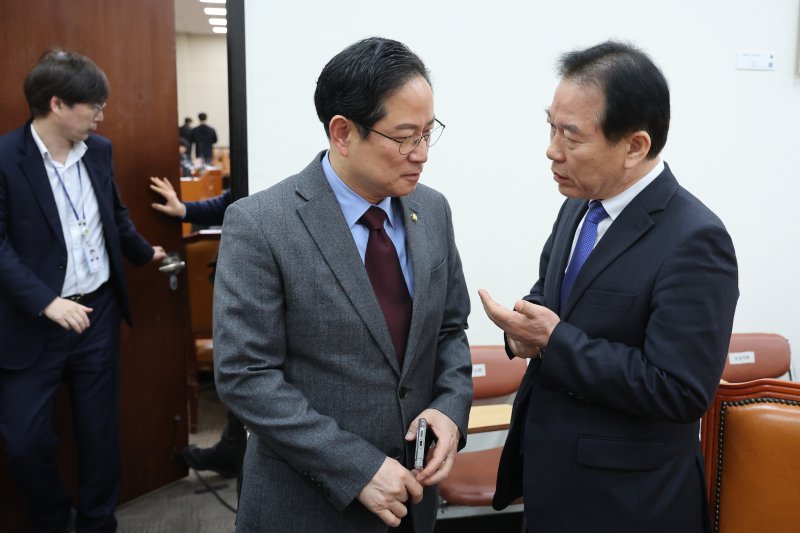
Jung Tae-ho of the Democratic Party of Korea, who serves as the ruling party floor secretary on the National Assembly’s Special Committee on the Special Act on Investment in the United States (the Special Committee on the U.S.–Korea Strategic Investment Management Act), criticized committee chair Kim Sang-hoon of the People Power Party on the 24th for adjourning the full session, calling it "deeply regrettable." Jung argued, "Holding the special act hostage for political reasons is the same as holding the country’s future hostage," and urged that "the committee must operate normally, separate from domestic political strife," calling for its work to resume.
Earlier, the ruling and opposition parties agreed to pass the Special Act on Investment in the United States by consensus by March 9 and formed a special committee for that purpose. However, after the first meeting collapsed on the 12th when People Power Party leader Jang Dong-hyeok skipped a luncheon at Cheong Wa Dae (the Blue House), the committee suffered a second breakdown on the 24th as the parties again failed to agree on how to form the bill review subcommittee. The People Power Party insists on an even 3-to-3 split between the parties, while the Democratic Party of Korea argues that the subcommittee should reflect the parties’ seat distribution in the Assembly. The People Power Party also claims that by postponing the handling of the special investment act to early March and prioritizing the three judicial reform bills (the offense of distorting the law, an increase in the number of Supreme Court Justices, and a constitutional complaint against court judgments), the DPK is trying "to use us as a mere prop to maximize its own interests."
Park Soo-young, the opposition floor secretary on the Special Committee on the U.S.–Korea Strategic Investment Management Act, told reporters that day, "They are forcing through these so-called 'judicial regression bills' in a one-sided manner, barely convening the subcommittee and still pushing them through," adding, "If that is the case, they can just ram through the Special Act on Investment in the United States however they like. There is no reason for us to go out of our way to cooperate." He went on, "Saying they will handle the judicial reform proposals in such a unilateral way obviously means they can also push through the special investment act unilaterally," and pointed out, "If this law is truly important and urgent, they need to change how the National Assembly is run."
[email protected] Song Ji-won Reporter