U.S. Cites "Evidence of Underground Nuclear Explosion at China’s Lop Nur in 2020"; Beijing Flatly Denies
- Input
- 2026-02-24 08:40:29
- Updated
- 2026-02-24 08:40:29
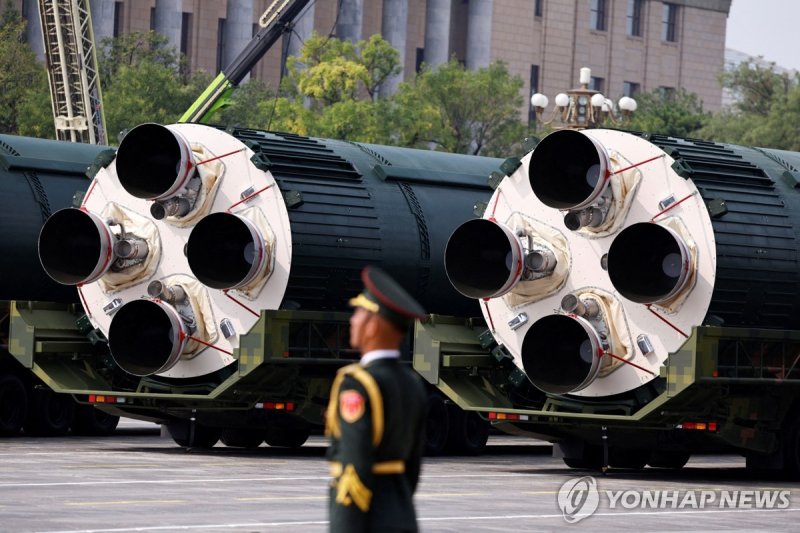
The United States has declassified new information related to suspected underground nuclear testing by China six years ago, and is using it to press China and Russia to join nuclear arms control talks. With the New Strategic Arms Reduction Treaty (New START), the last remaining nuclear arms control pact between Washington and Moscow, now expired, fears are mounting that a nuclear arms race could reignite.
According to the Associated Press (AP) on the 23rd local time, Christopher Yeo, U.S. assistant secretary of state for arms control and nonproliferation, told the Conference on Disarmament in Geneva on the 22nd that a magnitude 2.75 seismic event was detected on June 22, 2020, at China’s underground nuclear test site in Lop Nur in western China. He said the assessment was based on data from an international monitoring station in neighboring Kazakhstan.
Yeo stated, "When we compared past explosions and earthquakes, the signal was consistent with a single explosive event," adding that it was "different from a typical mining blast." He argued that China is making it harder for the international community to monitor its test activities and noted that Beijing has rejected a proposal to allow the installation of a seismic monitoring station at a distance from its test site similar to that near the Nevada Test Site in the U.S.
Yeo also pointed to the limits of New START, saying, "The treaty did not address Russia’s non-strategic nuclear weapons, estimated at up to 2,000 warheads, and, above all, it failed to account for China’s unprecedented and opaque nuclear buildup." He warned, "China could reach parity with the United States in nuclear forces within the next four to five years."
The State Department assesses that China’s nuclear warhead stockpile has grown from just over 200 in 2020 to more than 600 today, and could exceed 1,000 by 2030. Secretary of State Marco Rubio recently remarked, "The United States will not stand still while Russia and China expand their nuclear forces."
China reacted immediately. China’s ambassador in Geneva attending the Conference on Disarmament declared, "We firmly reject these groundless accusations," condemning them as an attempt to "distort and smear China’s nuclear policy." He added, "The U.S. claims are nothing more than a pretext to justify resuming its own nuclear testing."
Beijing stressed that it supports the goals of the Comprehensive Nuclear-Test-Ban Treaty (CTBT) and has honored the pledge by the five recognized nuclear-weapon states to halt nuclear testing. It also argued that China’s nuclear arsenal is far smaller than those of the U.S. and Russia, and dismissed calls for China to join trilateral arms control talks as "unfair and unrealistic."
Debate is continuing within the U.S. as well. Tong Zhao, a fellow at the Carnegie Endowment for International Peace (CEIP), noted that "if China did in fact conduct a nuclear explosive test, its credibility as a responsible nuclear-weapon state would be severely damaged."
Former President Donald Trump had previously hinted at the possibility of resuming nuclear testing. In a recent speech at the Hudson Institute, Yeo said, "The United States would return to testing on an equal footing," while drawing a line by clarifying that this would not mean a return to atmospheric nuclear tests as in the past.
The U.S. is urging China and Russia to participate meaningfully in multilateral disarmament processes. Yeo appealed to the countries attending the Conference on Disarmament, saying, "We ask you to encourage nuclear-weapon states such as China and Russia to engage in multilateral processes."
#USChinaNuclearTensions #LopNur #NuclearTestAllegations #NewSTART #NuclearDisarmament
[email protected] Kim Kyung-min Reporter