"Forecasts Now Reach 185 Trillion Won" — Market Recalculates SK hynix Earnings Outlook
- Input
- 2026-02-24 06:15:00
- Updated
- 2026-02-24 06:15:00
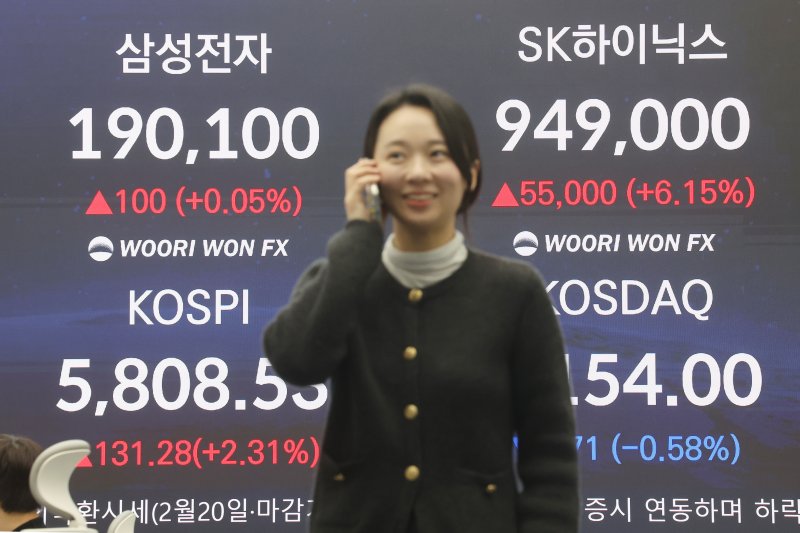
On the 24th, The Financial News compiled this year’s operating profit forecasts for SK hynix from 10 major domestic securities firms, based on reports released between January 30 and February 23. Mirae Asset Securities presented the highest estimate at 185 trillion won. Daishin Securities, NH Investment & Securities, and Heungkuk Securities projected around 170 trillion won. Korea Investment & Securities, Hyundai Motor Securities, KB Securities and others forecast in the 140–150 trillion won range, while Kyobo Securities projected 122 trillion won.
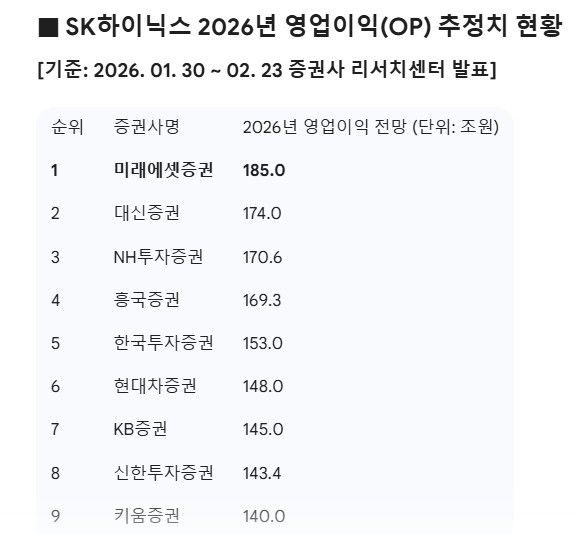
In a report released the same day, Mirae Asset Securities analysts Young-gun Kim and Sehoon Jung announced that they were raising their forecast for SK hynix’s full-year operating profit from 147 trillion won, first presented on January 30, to 185 trillion won. In just a little over 20 days, they lifted the estimate by 38 trillion won, or 25%, an increase almost equivalent to last year’s entire operating profit.
That day, NH Investment & Securities analyst Ryu Young-ho also said the firm was raising its forecast from 146.9 trillion won to 170.5 trillion won, an upward revision of 24 trillion won, or 16%, at one stroke. A day earlier, Daishin Securities analyst Hyungkeun Ryu had likewise revised his 2026 operating profit forecast for SK hynix from 142 trillion won to 174 trillion won, a 22% increase. One after another, brokerages are upgrading their earnings projections.
Prices for dynamic random-access memory (DRAM) and NAND flash memory continue to rise. On top of that, the possibility of price hikes for HBM3E high-bandwidth memory and a growing shipment share of HBM4 have been cited as key drivers. Mirae Asset Securities analysts Young-gun Kim and Sehoon Jung noted, "The uptrend in memory prices is stronger than expected, and we expect the rise to continue into the second half of the year."
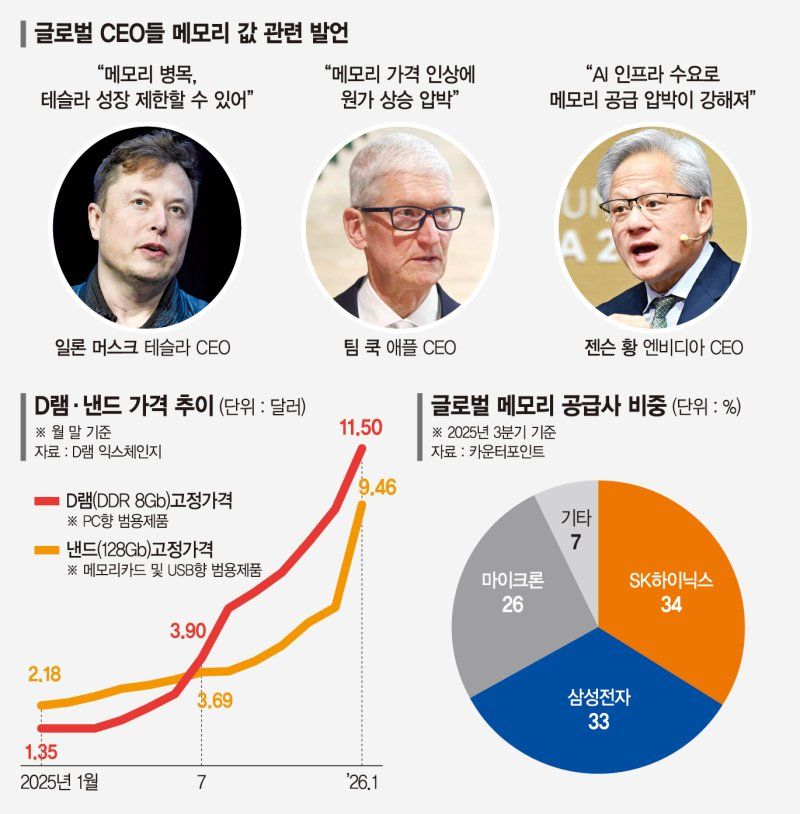
Elon Musk, Tim Cook and other Big Tech chief executives have gone so far as to describe the situation as a potential semiconductor supply chain crisis. During a recent visit to the United States, Chairman Chey Tae-won met with Big Tech leaders and said, "I’m sorry we can’t provide as many memory semiconductors as you want. Right now, we are not in a position to supply customers with all the memory they request," underscoring the severity of the shortage. This year, supply of memory chips for AI is expected to fall short of demand by about 30%. However, with talk of an AI bubble still lingering, some experts caution that investors must closely watch Big Tech’s AI-related earnings and investment moves, as well as the semiconductor industry’s inherent volatility. Chey’s remark that "100 billion dollars in profit could turn into 100 billion dollars in losses" is seen as reflecting this risk.
[email protected] Eunhyo Cho Reporter