Laughing and Crying Over IPOs: "Please, Just Give Me a Double-and-Limit" [MZ Money Diary]
- Input
- 2026-02-24 06:00:00
- Updated
- 2026-02-24 06:00:00

[The Financial News] #. Kim Ha-neul, a 28-year-old office worker living in Mapo District, Seoul, checks the IPO subscription schedule every month when her salary comes in, along with her savings plans. Last year, she put 400,000 won into the IPO of a semiconductor equipment company and was allocated one share. When the share price rose about 15,000 won above the IPO price on the listing day, she sold it. Kim said, "I basically earned about a month’s worth of transportation costs," adding, "It’s not a big amount, but it feels like I’m developing my investment instincts."
By contrast, 24-year-old university student Park Ji-hoon had a different experience. After seeing posts on social networking services (SNS) claiming that "this stock is guaranteed to go up," he joined the subscription. He received one share, but the price fell below the IPO price right after listing. Park lamented, saying he had assumed "IPO shares always go up once they list."
Youth presence visible in IPO subscription statistics
The strong interest of young people in IPOs also appears in some subscription statistics. In a public offering for Company A held in early 2022, people in their 20s accounted for about 20% and those in their 30s about 28%, leading to an analysis that the 20s–30s age group made up roughly 48% of general subscriptions.
A key reason young investors are drawn to IPOs lies in changes to the system. Under the equal allocation system introduced in 2021, more than half of the general subscription shares are distributed evenly among subscribers. In the past, the more deposit money you put down, the higher your chances of receiving a larger allocation. Now, once you meet the minimum subscription quantity, you enter a lottery for allocation. This structure allows even newcomers with limited funds to participate.
The structure is easier to understand with numbers. If the IPO price is 10,000 won and the minimum subscription unit is 10 shares, the subscription amount is 100,000 won. With a 50% deposit requirement, the actual cash you need is 50,000 won. If many people subscribe, you might receive only one share. In that case, if the price rises to 20,000 won, you gain 10,000 won. If it falls to 8,000 won, you lose 2,000 won. The amounts are small, but the profit-and-loss structure is the same as for regular stocks.
Double-and-limit or a drop... IPO prices can swing 60–400% from the offer price
Since June 2023, the daily price limit on listing day for newly listed stocks has been expanded to 60–400% of the IPO price. If the IPO price is 10,000 won, the share can trade between 6,000 won and 40,000 won on the first day. As the potential upside has grown, the possible downside range has widened as well.
Subscription competition also affects potential returns. Popular IPOs can see competition ratios in the thousands to one. A 3,000-to-1 ratio means that for each share available to general investors, there are subscription requests for 3,000 shares. If the pool for equal allocation is limited, some investors may receive only one share or none at all. Even if the share price surges, actual profit depends on how many shares you were allocated.
Supply and demand right after listing is another variable. If institutional investors have a low commitment to lock-up periods or if a large number of shares are freely tradable, selling pressure can concentrate and shake the price. This helps explain why some stocks spike on the first day and then quickly fall. In the end, IPOs are not a structure that automatically guarantees profits.
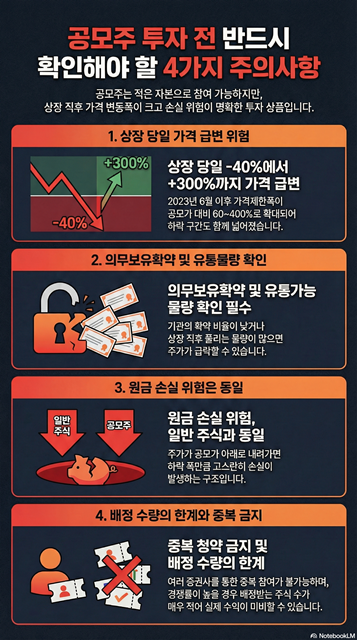
Competition, supply–demand, and other variables that determine returns
In addition, for companies that filed their securities registration statements on or after June 20, 2021, multiple subscriptions have been restricted. The previous practice of using several brokerage accounts at once to increase allocations is no longer allowed. Investors must subscribe through only one brokerage firm.
Experts advise checking several factors together: how the IPO price was set, the results of institutional demand forecasts, the ratio of shares under lock-up commitments, and the volume of shares that can be traded immediately after listing. They also stress the importance of setting a target return and a maximum acceptable loss in advance.
For people in their 20s and 30s, IPOs offer a relatively low barrier to entry. With a small amount of money, they can become shareholders of newly listed companies. However, simply taking part in a subscription does not guarantee profit. Outcomes vary depending on allocation size, competition, and supply–demand conditions. IPO investing is a method that carries opportunity and risk side by side.
[email protected] Han Seung-gon Reporter