[Editorial] The Construction Industry Crisis Is Not Just a Construction Problem
- Input
- 2026-02-23 19:17:29
- Updated
- 2026-02-23 19:17:29
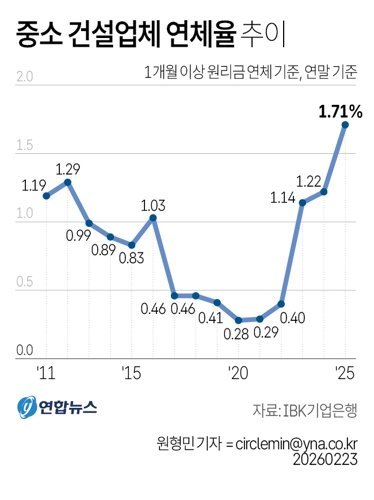
The problem is not limited to rising delinquencies; the number of builders shutting their doors because they cannot withstand the slump is also surging. As of January, 416 small and mid-sized construction firms filed for closure, an increase of about 25% from the same month a year earlier. Of these, 64% were based in the provinces, far outpacing the capital region. The entire construction sector is under strain, but the shock is clearly hitting regional areas harder.
Warning signs such as declining construction investment and shrinking order backlogs have been appearing one after another, and the severity of the crisis on the ground is now being confirmed in concrete figures. At the root of the problem lies a slump in the real estate market. Outside the capital region, demand for new housing pre-sales has plunged, leading to a buildup of unsold units, which in turn has resulted in delays to new project starts and a scaling back of developments.
This has been compounded by a deterioration in financial conditions. As funding has become harder to secure, smaller firms with weaker cash flows are taking the first hit. On top of that, a downturn in key regional industries such as petrochemicals has reduced orders for factories and plant construction, shrinking the pipeline of work. A chronic slump is deepening as weak private investment coincides with limits on the volume of public-sector projects.
This construction-industry crisis is not just a problem for builders. The growing insolvency of regional SME construction firms is a signal that downward pressure on the Korean economy as a whole is intensifying. Construction is a core domestic-demand industry closely linked to employment, self-employed businesses, and materials and equipment suppliers. When regional firms collapse, local jobs disappear and consumption contracts. That, in turn, triggers a vicious cycle of decline for small merchants and the service sector.
In regions where key industries are already struggling, a pattern is becoming entrenched in which an industrial downturn triggers a construction slump, which then spreads into a broader regional recession. If the rise in unsold homes and the credit squeeze drag on, there is also a risk that these insolvencies could spill over into the financial sector.
Korea Development Institute (KDI) recently projected this year’s growth rate at 1.9%, lower than the government’s forecast, and pointed to a contraction in construction investment as a major reason. This indicates that weakness in the construction sector is already having a significant macroeconomic impact. It cannot be ruled out that a downturn that began with regional SME builders will end up eroding the overall strength of the economy.
The difficulty is that the government has made stabilizing the real estate market its top priority, which makes it hard to move aggressively to stimulate construction. Under a tight monetary stance, further constraining liquidity could depress regional real estate even more, yet if stimulus is expanded with the regions in mind, housing prices in the capital area could once again become unstable. The situation carries a real risk of slipping into a policy dilemma.
The government needs to craft a carefully calibrated response that takes into account the very different conditions in the capital region and the provinces. It should refrain from easing regulations that would stoke housing demand in the capital area, while at the same time pursuing temporary financial support to help clear unsold units in the regions and ease liquidity strains. Public social overhead capital (SOC) projects should be selected based on local demand and their broader economic impact, and structural reforms to phase out noncompetitive firms must proceed in parallel. A balanced approach that separates the goal of supporting construction activity from the goal of stabilizing housing prices is urgently needed.