[Editorial] Upgrading Korea–Brazil Ties to a Strategic Partnership: South America Is a Land of Opportunity
- Input
- 2026-02-23 19:17:27
- Updated
- 2026-02-23 19:17:27
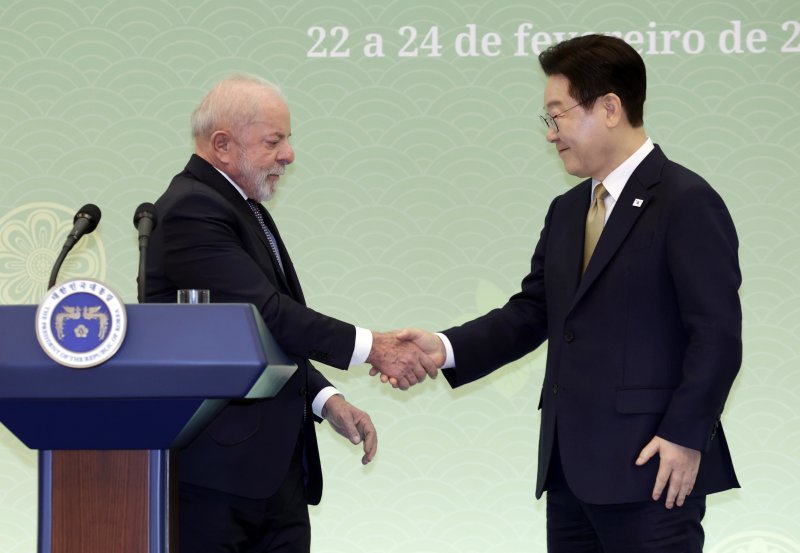
Cooperation with Brazil should be viewed as part of a broader strategy to engage with the Global South. Korea has been looking to the Global South to find a third option beyond the economic and diplomatic order dominated by the United States of America (U.S.) and China. Brazil is the largest economy in South America and a key country representing the Global South.
First, Korea can use Brazil to help correct its heavily concentrated export structure. Korea’s exports are excessively dependent on the U.S. and China, so whenever relations between the two powers sour, Korean exports suffer. Each time tariff barriers rose under the Trump administration, Korean shipments to the U.S. were hit. When domestic demand in China weakens, it inevitably hurts Korean companies’ exports to China. In particular, because China’s national strategy is to foster its own industries, Korean firms’ exports to China have been highly volatile.
To break through this structural problem of a shrinking pool of export destinations amid great-power rivalry, Korea must strategically cultivate a third major market. Brazil, as the gateway to the entire LAC market, is ideally positioned to become a forward-looking economic partner for Korea. Just as Korea has built economic networks with Europe and Southeast Asia, it should systematically construct a trade strategy in LAC with Brazil as the central hub.
Another attraction is the possibility of securing critical minerals—Korea’s weak link—from Brazil. China controls a large share of key minerals such as lithium, cobalt, and nickel, heightening supply risks. In this context, the strategic value of Brazil’s resource endowment is extremely high. If Korea can secure a stable supply of critical minerals through Brazil, it can reduce its dependence on China.
The core of the new economic cooperation, in particular, is that it aims to expand into an industrial alliance. Brazil possesses abundant critical resources, while Korea has advanced manufacturing capabilities in batteries, semiconductors, and hydrogen technologies. If Korean companies invest in developing Brazil’s rare earth and nickel mines and carry out primary processing on-site, the synergy between the two countries could be maximized.
Furthermore, if cooperation in resource development leads to Brazil being stably integrated into Korea’s battery and electric vehicle supply chains, a virtuous cycle could emerge. That would complete a sustainable model of industrial cooperation between the two nations.
For the summit agreements to be realized in the corporate arena, continuous institutional support from both governments is essential. The four-year action plan must not remain mere rhetoric; its implementation and monitoring mechanisms should be spelled out in detail, and cooperation channels among trade and investment support agencies must be activated in a substantive way.