With car prices soaring, new-car purchases by people in their 20s and 30s hit a 10-year low
- Input
- 2026-02-24 06:00:00
- Updated
- 2026-02-24 06:00:00
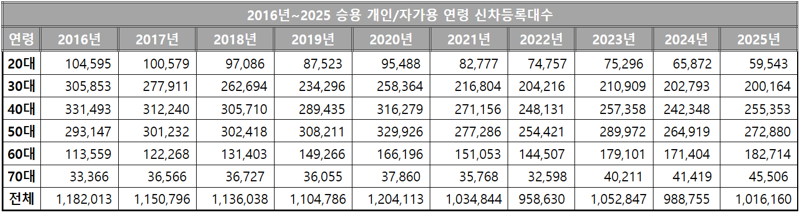
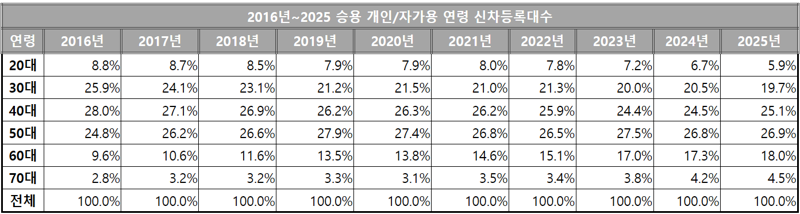
According to the Kaizyu Data Research Institute on the 24th, the number of new passenger cars registered by people in their 20s last year (for privately owned vehicles) was 59,543. This represents 5.9% of the total 1,016,160 new passenger car registrations.
The share of new car registrations by people in their 20s reached 8.8% in 2016. Over the past five years, however, it has declined from 8.0% in 2021 to 7.8% in 2022, 7.2% in 2023, and 6.7% in 2024, before dropping to 5.6% this year. This is the lowest level in the 10 years since the institute began compiling these figures in 2016.
The share of new passenger car registrations by people in their 30s has also fallen to a 10-year low. Last year, people in their 30s registered 200,164 new passenger cars, accounting for only 19.7% of the total. Compared with 2016, when their share was 25.9%, this is a decline of 6.2 percentage points.
By contrast, both the number and share of new passenger car registrations by people in their 60s and 70s have been steadily rising. Last year, people in their 60s and 70s registered 182,714 and 45,506 new cars, respectively. Compared with 2016, that is an increase of 69,155 units for those in their 60s and 12,140 units for those in their 70s.
In terms of market share of total sales, the proportion for people in their 60s rose from 9.6% in 2016, 10 years ago, to 18.0% last year, increasing steadily every year. The share of new car registrations by people in their 70s also climbed from 2.8% in 2016 to 4.5% last year. For both age groups, the share of new car registrations is at its highest level in a decade.
The decline in new car purchases among people in their 20s and 30s is attributed to the burden of higher car prices and the spread of a sharing culture. As society increasingly moves away from viewing cars as essential possessions, more people in their 20s, who feel the strain of rising new car prices, are turning to vehicle-sharing apps to use cars only when needed.
In a report released last December, the Korea Automobile & Mobility Association (KAMA) stated, "With household debt hitting an all-time high and the concept of car ownership weakening among people in their 20s and 30s, new demand is expected to be constrained," adding, "Concerns persist that changes in the population structure, such as the increase in single-person households, will continue to limit demand for new cars."
In contrast, analysts say that demand for vehicles among people in their 60s and 70s remains strong because cars are still needed for mobility. Although authorities are actively encouraging older drivers to voluntarily surrender their licenses to prevent traffic accidents, economic activity is increasingly extending into these age groups as the population ages.
[email protected] Reporter Kim Dong-chan Reporter