613,000 won at large firms vs. 3,070,000 won at small firms: Wage gap widens further
- Input
- 2026-02-23 12:00:00
- Updated
- 2026-02-23 12:00:00
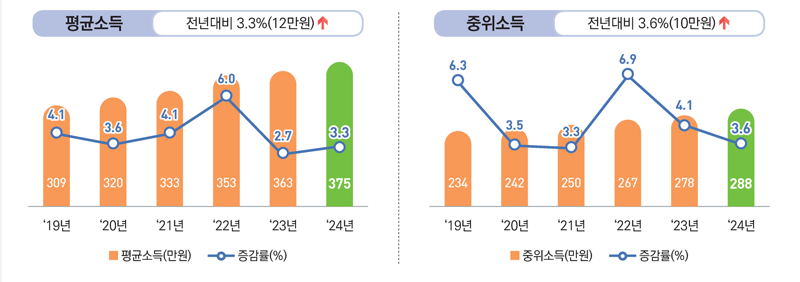
The wage gap between large companies and small and medium-sized enterprises (SMEs), as well as between men and women, has widened, The Financial News reported. As of 2024, the average monthly income of wage workers was 3,750,000 won, up 3.3% from the previous year. While the overall average rose by 120,000 won, wages at large companies increased by 200,000 won, compared with just 90,000 won at SMEs. Male workers also earned 1.5 times more than female workers.
This trend appears to be entrenching the concentration of young workers in large companies and in Seoul and the greater metropolitan area, along with the avoidance of regional areas and SMEs. Such wage disparities are cited as a key factor deepening the "polarization of wealth" between wage earners and others, between regular and non-regular workers, between large firms and SMEs, and across generations and social classes.
By company size, the 2024 statistics released by KOSTAT on the 23rd show that average monthly income was 6,130,000 won at large companies and 3,070,000 won at SMEs. The income gap between the two groups has now widened to roughly a twofold difference. The disparity has grown compared with 2023, when the figures were 5,930,000 won for large companies and 2,980,000 won for SMEs.
In percentage terms, income growth from a year earlier was similar: 3.3% at large companies and 3.0% at SMEs. In absolute terms, however, wages at large firms rose by 200,000 won, while those at SMEs increased by only 90,000 won. Because the total wage levels differ so much, even similar growth rates have widened the pay gap between large companies and smaller ones.
Both men and women working at large companies recorded the highest average incomes. Male workers there earned 6,950,000 won, and female workers 4,400,000 won, far above their counterparts at SMEs, where men earned 3,440,000 won and women 2,470,000 won.
In 2024, the average monthly income of wage jobs was 3,750,000 won, an increase of 3.3% (120,000 won) from the previous year.
Choi Jae-hyeok, Head of Administrative Statistics Division at KOSTAT, explained, "The median income in 2024, which is the value exactly in the middle when incomes are arranged in order, was 2,880,000 won, up 3.6% (100,000 won) from a year earlier."
Four years earlier, in 2020, the average income was 3,200,000 won and the median income 2,420,000 won. A simple calculation suggests that wages have risen by roughly 460,000 to 550,000 won over the past four years.
Looking at the distribution by income bracket, the largest share of workers, 20.9%, earned between 1,500,000 and 2,500,000 won per month. The next largest group, 20.1%, earned between 2,500,000 and 3,500,000 won, followed by 12.2% earning less than 850,000 won. The shares of those earning between 3,500,000 and 4,500,000 won (11.7%) and those earning 10,000,000 won or more (4.3%) recorded the largest year-on-year increases, each up 0.4 percentage points.
Average income also varied widely by organizational type. Workers at corporate entities earned 4,280,000 won on average, the highest level, while those at sole proprietorships earned 2,270,000 won, the lowest. Compared with a year earlier, wages at sole proprietorships rose 4.1% (90,000 won), and those at corporate entities increased 3.5% (150,000 won).
Although average income increased across all industries, the gaps between sectors were substantial. The Financial and Insurance Industry recorded the highest average income at 7,770,000 won. It was followed by the Electricity, gas, steam and air conditioning supply sector at 6,990,000 won. At the other end of the spectrum, the Accommodation and food service activities sector had the lowest average income at 1,880,000 won.
The wage gap between men and women was also significant. Male workers earned an average of 4,420,000 won, 1.5 times the 2,890,000 won earned by female workers. Year-on-year, wages for both men and women rose 3.6%, but in absolute terms, men’s wages increased by 150,000 won and women’s by 100,000 won.
By income bracket, the largest share of male workers, 18.7%, fell in the 2,500,000 to 3,500,000 won range, while the largest share of female workers, 27.9%, earned between 1,500,000 and 2,500,000 won.
By age group, workers in their 40s had the highest average income at 4,690,000 won. They were followed by those in their 50s at 4,450,000 won, those in their 30s at 3,970,000 won, those in their 60s at 2,930,000 won, and those in their 20s at 2,710,000 won. In terms of year-on-year growth, workers aged 70 and older saw the largest increase at 5.8% (90,000 won), followed by those in their 40s at 3.9% (180,000 won).
The longer the length of service, the higher the average income. Workers with at least 20 years of service earned an average of 8,480,000 won, those with 10 to less than 20 years earned 6,080,000 won, those with 5 to less than 10 years earned 4,300,000 won, and those with 3 to less than 5 years earned 3,690,000 won. In terms of growth, the largest year-on-year increase was among workers with 2 to less than 3 years of service, whose wages rose 4.3% (140,000 won).
[email protected] Jung Sang-geun Reporter