‘Death by Delivery’ Recognized as an Industrial Accident, Sparking Government Debate on Systemic Reform
- Input
- 2026-02-23 09:14:51
- Updated
- 2026-02-23 09:14:51
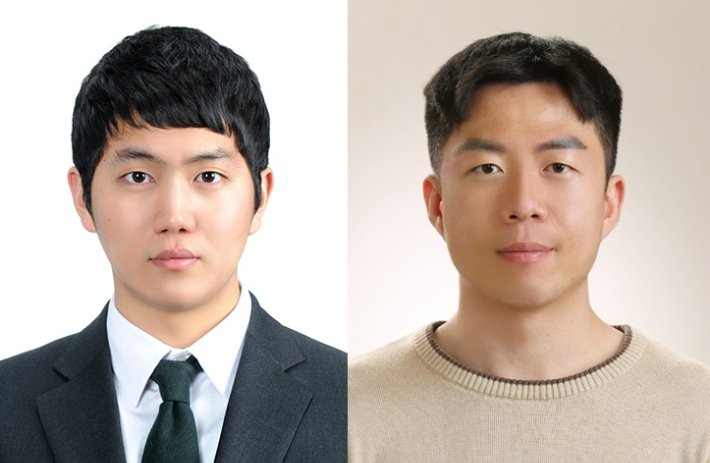
Financial News Jeju – Reporter Jung Yong-bok】 The Jeju Christian Broadcasting System (Jeju CBS) investigative series “Coupang, Death by Delivery” exposed in concrete detail how platform work structurally drives overwork, leading to official recognition of the case as an industrial accident and prompting government discussions on institutional reform. Observers say the reports reframed what could have been treated as a simple traffic accident into a problem rooted in the structure of the industry.
The series was selected as the regional reporting winner in the 425th Monthly Journalist Award organized by the Journalists Association of Korea, chaired by Park Jong-hyun.
The coverage drew attention for reconstructing the death of Coupang early-morning delivery driver the late Seungyong Oh not as a mere traffic accident, but as a consequence of an overwork-inducing platform system. Through a series of reports, it detailed a system of overwork created by the combination of speed-based competition, a multi-layered subcontracting structure, and a multi-round delivery regime.
Jeju CBS reporters Ko Sang-hyun and Lee Chang-jun obtained and reported evidence that Oh had been subjected to excessive delivery workloads right up until the accident, including evaluation sheets used by an agency to pressure drivers on delivery performance. By also shedding light on the working conditions of his fellow drivers, they framed the incident not as an individual tragedy but as a structural problem in the industry.
In particular, the two reporters conducted immersive on-the-ground reporting by accompanying delivery workers on their routes. Their experiential coverage showed how platform companies’ speed-centered operating models and risk-shifting practices actually function in the field, a strength that has been widely noted.
The award ceremony will be held at 11 a.m. on the 19th floor press conference room of the Korea Press Center in Seoul on the 26th.
■ Industrial accident recognition and government debate: Platform work regulations put to the test
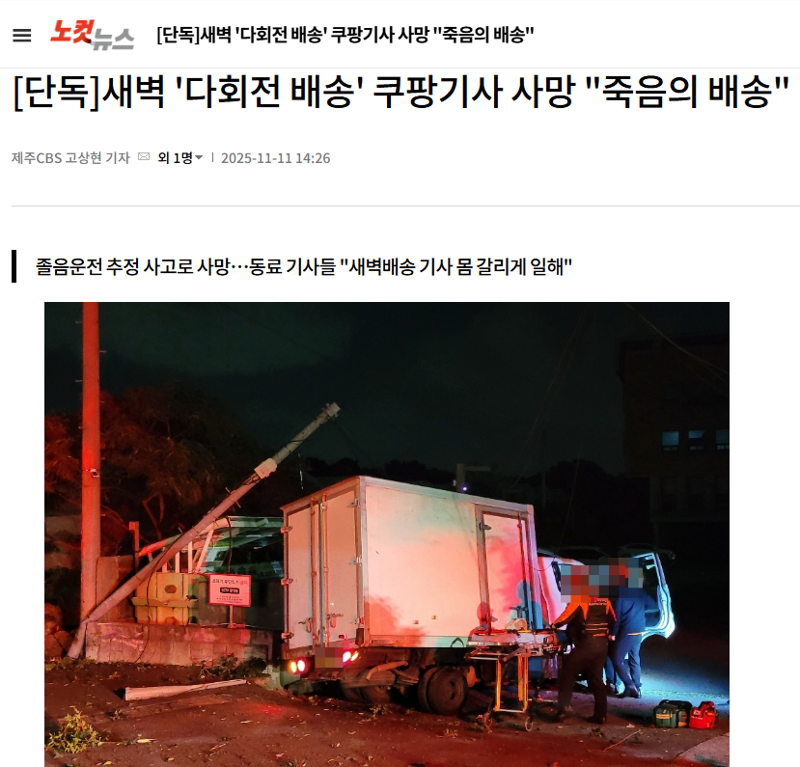
Following the reports, the death of the late Seungyong Oh was officially recognized as an industrial accident. Minister of Employment and Labor Kim Young-hoon visited Jeju to offer condolences to the bereaved family, and the government has begun discussions on institutional reforms to prevent similar accidents from recurring.
Jeju Special Self-Governing Province is also conducting a fact-finding survey on late-night work more broadly. The series is being evaluated as a case in which the issue of worker safety in the rapidly expanding platform industry was successfully elevated to the level of a policy agenda.
Experts note that as the platform industry enters a growth phase, the balance between labor safety and cost structures could become a key factor determining the sector’s long-term sustainability.
■ Consecutive awards after ‘misconduct allegations involving a senior judge’: Expanding structural investigations
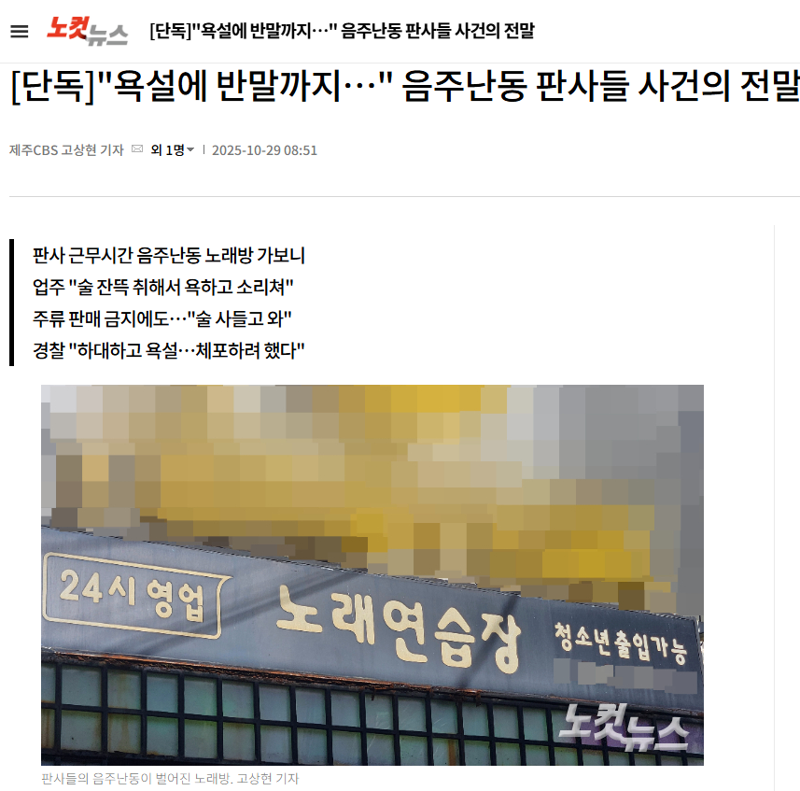
This latest award is not an isolated achievement. With their exclusive investigative series on “misconduct allegations involving a senior judge,” reporters Ko Sang-hyun and Lee Chang-jun previously won the 422nd Monthly Journalist Award and the grand prize at the 7th Jeju Journalists Award organized by the Jeju Journalists Club, chaired by Ko Hong-cheol.
Most recently, the same series was also selected as a winner of the 57th Korea Journalist Award, organized by the Journalists Association of Korea.
That coverage tracked, in a series of reports, allegations of drunken misconduct, entertainment hospitality, and unlawful trials involving senior judges, bringing questions of responsibility within the judicial power structure into the public arena. By expanding the story beyond mere exposure of wrongdoing to highlight systemic and institutional problems, it embodied the essence of investigative journalism.
The Korea Journalist Award is presented by the Journalists Association of Korea to reporting by member outlets nationwide that contributes to journalism’s normative duties, such as monitoring public power and analyzing social structures, over the course of a year. It applies strict standards regarding public interest, fact-checking, and structural impact.
From scrutinizing judicial power to now probing the structure of platform work, the two reporters’ investigations are being seen as a continuous project in structural investigative reporting that targets systems rather than isolated incidents. By carrying out back-to-back investigations into complex agendas involving power and industrial structures, they have expanded the scope of what regional journalism can do.
Ko Sang-hyun of Jeju CBS said, "It was a case that could easily have been dismissed as a simple traffic accident, but it became an opportunity to expose a system that drives overwork." He added, "I hope institutional reforms will be implemented in a meaningful way so that the same tragedy is not repeated."
[email protected] Jung Yong-bok Reporter