BOK Turns Upbeat on Semiconductors, Hinting at Growth Forecast Upgrade
- Input
- 2026-02-23 14:00:00
- Updated
- 2026-02-23 14:00:00
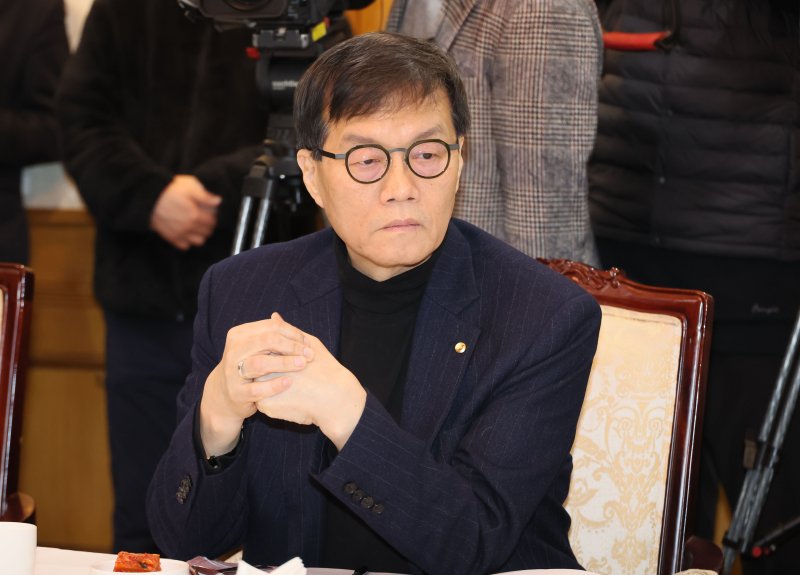
■Growth forecast seen rising into the 2% range?On the 23rd, the BOK stated in a business report submitted to the National Assembly Planning and Finance Committee that "upside risks to this year’s annual growth have somewhat increased compared with the November 2023 forecast, due in part to a stronger-than-expected recovery in the semiconductor cycle." Appearing before the committee the same day, BOK Governor Rhee Chang-yong also said, "Supported by solid consumer sentiment, domestic demand is recovering, and exports are continuing to grow on the back of robust semiconductor demand, so the growth rate will be significantly higher than last year’s 1.0%."
The BOK currently projects economic growth of 1.8% for 2024. To achieve that, quarterly growth of about 0.4–0.5% is required. However, as semiconductor performance has recently improved further, markets increasingly expect the Monetary Policy Board on the 26th to revise the forecast up to around 1.9–2.0%. Through this latest report, the BOK effectively lent support to those expectations.
Regarding the semiconductor cycle, the BOK noted that "High Bandwidth Memory (HBM) and other high-performance, application-specific chips in which Korea has a competitive edge are leading the upturn, while prices of general-purpose semiconductors are surging on the back of demand for data storage and server replacement, reinforcing the expansionary trend." It added, "At least through this year, the sector is expected to maintain a solid performance above its long-term trend."
At the same time, the BOK cautioned that "uncertainty remains high regarding U.S. tariff policy and the pace of AI investment." It also pointed out that persistently elevated construction costs are forcing builders to protect profitability, while ongoing negotiations over cost increases between project owners’ associations and contractors are acting as a constraint on already weak construction investment.
■High exchange rate, but solid confidence in the economyOn the elevated US Dollar–South Korean Won exchange rate, the BOK maintained its view that the level is largely out of line with the fundamentals of the Korean economy. It explained that the won’s surge to the 1,480-per-dollar range late last year, and its confinement to the 1,450–1,460 range so far this year, have been driven mainly by supply–demand factors such as continued overseas equity investment by Koreans and net selling of Korean stocks by foreign investors.
The BOK stated, "Korea’s external borrowing conditions and domestic foreign-currency liquidity remain sound," adding, "The government has also been able to issue Foreign Exchange Stabilization Bond at low spreads, indicating that foreign investors’ confidence in our economy is solid."
As evidence, it cited the fact that the credit default swap (CDS) premium on Foreign Exchange Equalization Fund Bonds fell from 37.3 basis point (bp) at the end of 2023 to 21.9 bp a year later, and further to 21.8 bp at the end of January. A CDS is a derivative that allows an investor to receive principal from a counterparty if a bond defaults; the lower the perceived default risk, the lower the premium, or insurance cost.
On the domestic stock market, the BOK assessed that the likelihood of a shift into a sustained downward trend is limited. However, it flagged potential variables such as a global stock correction stemming from concerns over AI companies’ profitability and valuations.
[email protected] Kim Tae-il Reporter