[Editorial] The Widening Technology Gap Between South Korea and China: A Change in the Culture of Science Trivialization Is a Must
- Input
- 2026-02-22 19:14:49
- Updated
- 2026-02-22 19:14:49
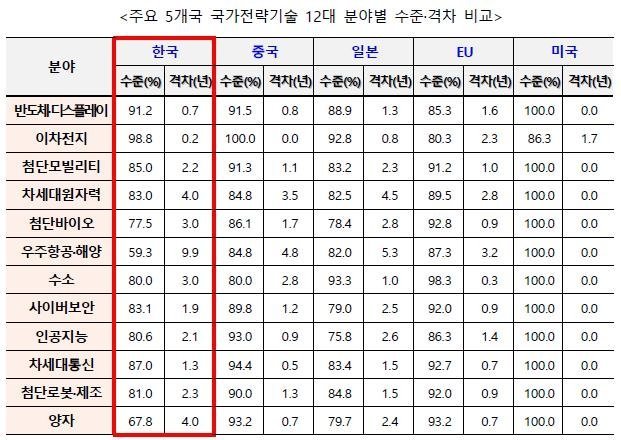
According to the report, Korea's technological gap with the United States, the world's leading technology power, is 2.8 years in 2024. The gap with China is 2.1 years, putting Korea 0.7 years ahead. Korea was first overtaken by China in 2022, with a gap of 0.2 years, but this gap has widened further by 0.5 years. The 11 evaluation areas include space, aviation, and marine; machinery and manufacturing; materials and nano; life and healthcare; and information and communications technology (ICT) and software (SW).
Given that China has been pouring national resources into advanced technological innovation and development, these results are not surprising. The question is whether our government and companies have been even half as committed to technological innovation as China. Of course, on the surface, Korea is still undoubtedly a technological powerhouse. When considering the technological level of each country as 100% of the US, the EU was at 93.8%, China at 86.8%, Japan at 86.2%, and Korea at 82.8%. This is relatively better than Japan and Europe, which showed declines.
However, our comparison partners are always countries that are ahead of us. We must make every effort to approach the US, the world's leading powerhouse, to maintain this level. In the rapidly advancing fields of advanced science and technology, even a moment of distraction can lead to falling behind in the competition. This can be seen by looking at Japan and Europe, once powerhouses in electronics and communications.
In the secondary battery sector, where Korea held the sole top spot in 2022, there was a 0.9-year gap, but by 2024, China had overtaken Korea and taken the top spot with a 0.2-year gap. Korea also lost to China in semiconductors and displays, where it had previously held second place.
Even more serious is the fact that China is achieving technological innovation at a breakneck pace in artificial intelligence (AI) and robotics. Now is the time for us to learn from China. Of course, catching up with China in terms of investment capacity is difficult due to the difference in economic scale. China is launching a financial offensive, pouring more than ten times our budget into a single sector.
There are clear areas where China excels, and thus, policy directions that we should benchmark. There is a climate where science and technology are considered paramount. This can be established as a national policy. This includes socially favoring scientists and engineers and providing them with top-tier compensation.
Talented and intelligent young people are still hesitant to pursue science and engineering, preferring to become doctors or pharmacists. What does this mean? Even if they graduate from science and engineering departments, they won't be treated better than doctors once they enter society. The government should provide generous funding to scholars and students who teach and study science and technology. This should be generous, even to the point of being excessive. No one would criticize this.