[Kim Kwan-woong’s Pick] Trump Shatters the International Order... Summoning the Ghosts of Imperialism
- Input
- 2026-02-22 19:06:27
- Updated
- 2026-02-22 19:06:27
Financial News, Hanoi (Vietnam) — “The U.S. no longer feels like the U.S. It seems like the American era is coming to an end.”
This is the common view many experts express as they watch the series of events unfolding in the U.S. these days. But what exactly made the U.S. “the U.S.” in the first place, and why does today’s America no longer feel that way?
The U.S. is the most overwhelming empire in human history. In ancient times there was the Roman Empire, and in the modern era Spain, the Netherlands and the United Kingdom of Great Britain and Northern Ireland (UK) all displayed imperial traits. Yet no country has ever so perfectly met the conditions of an empire as the U.S. did. Rising to global prominence with the launch of the Bretton Woods system (BWS) in 1945, the U.S. became the guarantor of global security and free trade. In 1991 it even brought down the Union of Soviet Socialist Republics (USSR), which had divided the world in two, and emerged as the sole hegemonic power. Even then, President George H. W. Bush declared that he would pursue not “Pax Americana” but “Pax Universalis.” In other words, although it was the world’s only hegemon, it would not put its own interests first, but would seek shared prosperity for the world’s citizens. That benevolent hegemony was what made America feel like America.
That America has been thrown into disarray under Donald Trump. Shouting “Make America Great Again (MAGA),” Trump returned to power in 2025 and is shaking the global order from top to bottom. His tariff policy spares no ally, and he has even exposed territorial ambitions toward Canada, a neighboring ally, and Greenland, part of the free world. It is “Only America First.” This behavior is alarming U.S. allies such as the UK and other European NATO members, as well as South Korea and Japan.
■ The U.S. turns its sword on allies... and alliances start to scatter
Two photos Trump posted on his social media in January sparked enormous controversy worldwide. One was a fabricated image of Trump standing in Greenland, a territory of Denmark, with the Stars and Stripes flying behind him, once again signaling his oft-expressed desire to annex it. Another image showed a map with the territories of Canada and the Bolivarian Republic of Venezuela covered by the U.S. flag. Although it used a photo from a summit with European leaders last August, it went beyond discourtesy to sovereign states and was perceived as an immediate threat.
These two images starkly revealed how Trump views America’s allies. In reality, he went so far as to tell the Canadian prime minister that Canada “could become the 51st state of the U.S.,” and then imposed 100% reciprocal tariffs on the country.
Relations with the UK, Washington’s closest ally, are also not what they used to be. The rupture began when Trump, who has been clashing with Europe, suddenly belittled NATO’s role in the Afghanistan war. The UK, which as part of NATO suffered the second-highest number of casualties after the U.S., was furious. UK Prime Minister Keir Starmer immediately demanded an apology from Trump, making his displeasure clear, and then visited China this January — the first trip to China by a British prime minister in eight years. Before that, Mark Carney, the prime minister of Canada, who has been on a collision course with Washington, also traveled to China to sit down with Xi Jinping.
Traditional U.S. partners in Asia — South Korea, Japan and Taiwan — are being treated no better by Trump. In addition to reciprocal tariffs, they have been pressed to promise massive purchases of U.S. products and to commit to huge direct investments. South Korea has pledged about 350 billion dollars, Japan 550 billion dollars, and Taiwan 500 billion dollars.
■ “Trump is helping China, not America”
Trump has returned even more hardline after the Biden administration. He still approaches every issue with a wheeler-dealer’s bargaining tactics, but now he applies them indiscriminately, even to allies. This is a complete departure from the Biden administration’s strategy, which used a sophisticated bloc-based approach within the free world to contain China. As a result, U.S. allies are now mired in deep confusion.
The Biden administration had sought to counter China by dividing the world into free and communist camps and then building blocs around advanced industries such as semiconductors under the banner of a Trusted Value Chain (TVC), effectively cutting China out of global supply chains. The Quadrilateral Security Dialogue (Quad), AUKUS (Australia-United Kingdom-United States security partnership) and the Indo-Pacific Economic Framework for Prosperity (IPEF) were all part of this effort. China reeled more from Biden’s meticulous containment strategy than from Trump’s tariff threats. During that period, many global companies — including Apple, Microsoft, Nike, Adidas, Tesla and Hyundai Motor Company — left China and shifted production to Southeast Asia and India.
In his second term, Trump has scrapped Biden’s bloc strategy and is relying solely on tariffs. Countries around the world warn that “cracks are appearing in the Western alliance that had been containing China, and in the end this will only benefit China,” and their concerns are growing louder.
In an editorial on April 5 last year, The Wall Street Journal (WSJ) ran the headline “U.S. Tariffs Make Xi Jinping’s Day,” mocking Trump by playing on the phrase “You make my day.”
On the same day, the British weekly The Economist published a cover story titled “Make China Great Again,” warning that the U.S. was being wrecked by nationalism and that China would seize the opportunity to claim the role of leader in the international community.
Those warnings are becoming reality. Core European members of the Western liberal camp are moving to repair ties with China, while Thailand, Indonesia and other Southeast Asian nations that had leaned toward the West are wavering again under Beijing’s charm offensive.
■ The U.S. hobbled by the bond market and losing talent through immigration policy
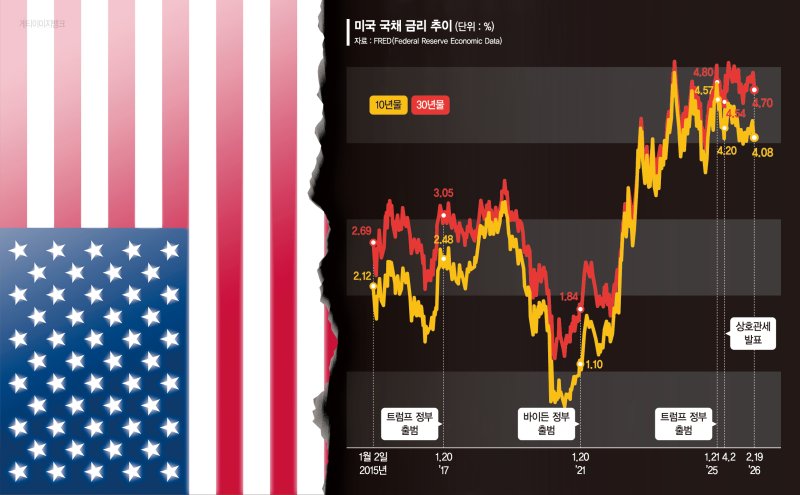
Trump’s tariff war shows no sign of stopping, even after the Supreme Court of the United States (U.S. Supreme Court) ruled it unlawful. In practice, Trump has already begun imposing provisional tariffs based on other statutes such as trade laws. Yet his tariff barrage is highly likely to boomerang on ordinary Americans. When Trump first raised the prospect of reciprocal tariffs last April, the first to react was the U.S. bond market. Long-term bond yields in particular spiked sharply. Rising long-term yields mean investors are pessimistic about America’s future and are refusing to buy its bonds. Higher bond yields push up bank lending rates, which in turn fuel inflation, dampen consumption and ultimately trigger a recession.
This is precisely what Trump fears most. His clash with Federal Reserve System (Fed) Chair Jerome Powell — which ultimately led to Powell’s indictment — and his choice of Kevin Warsh, who promised rate cuts, as the next chair were both aimed at forcing the Fed to cut rates preemptively to head off a tariff-induced recession.
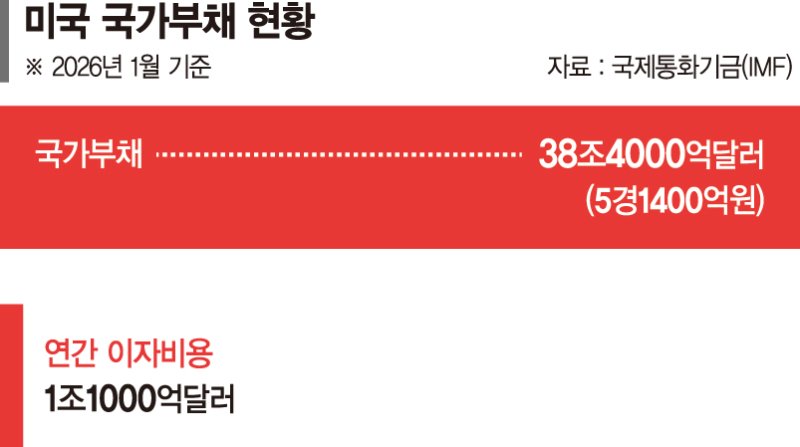
Behind Trump’s relentless push for lower interest rates lies America’s chronic national debt problem. As of January, U.S. debt stood at 38.4 trillion dollars, or about 124% of its gross domestic product (GDP). The debt ratio itself is not necessarily a problem, because the U.S. is a reserve currency-issuing country. The real issue is the interest bill. This year alone, the U.S. must pay 1.1 trillion dollars in interest — far more than the roughly 800 billion dollars it spends annually on defense. In this situation, a continued rise in bond yields would be nothing short of catastrophic. Some even warn that the burden of interest payments could one day force the U.S. to withdraw its military forces stationed around the world.
In this context, Trump has turned to stablecoins. On July 18 last year, the U.S. passed legislation bringing stablecoins into a legal framework and promoting their use. Stablecoins are pegged to the dollar and are designed so that every transaction is automatically linked to mandatory purchases of U.S. Treasury bonds. Since the market is no longer buying Treasuries on its own, the law effectively forces a certain amount of bond buying with each currency transaction. Trump hailed this as a stroke of genius and dubbed the law the “Genius Act.” Yet for a reserve currency-issuing country to foster a new form of money that could one day compete with the dollar is a risky gamble, and controversy continues.
His erratic immigration policy, derided as “visa dealing,” is no different. The U.S. has long been the place where the world’s top talent gathers. But Trump, in the name of “racial purity,” is driving out the top 0.1% of global talent. A society that once respected ability and embraced diversity is turning into an insular one that erects barriers and preaches purity. The openness, inclusiveness and tolerance that flowed from overwhelming political, economic and military confidence are disappearing. That is why people now say, “The American Dream is over.”
■ The age of empires ends — is a new age of imperialism beginning?
The power of an empire rests on respect — both the respect it commands from its neighbors and the respect it shows them in return. That was true of the Roman Empire. In 211 BC, Hannibal Barca, the hero of Carthage, crossed the Alps and ravaged Roman territory for 16 years, yet he ultimately failed to capture Rome and was driven back, largely because Rome’s allies stood by it in return for the trust it had shown them. Later, however, the Roman Empire collapsed under the weight of seigniorage, effectively destroying its own reserve currency. The UK, which had adopted the gold standard, fought two world wars and eventually succumbed to runaway inflation, surrendering its status as a reserve currency-issuing country to the U.S. and exiting the global stage.
An age of imperialism is one in which a single overwhelming empire disappears and multiple great powers form shifting blocs that compete with one another. While the U.S. wavers, China has rapidly built up advanced industries such as robotics and artificial intelligence (AI), rallied neighboring countries and begun in earnest to expand a multilateral trade network.
Russia, meanwhile, has followed its invasion of Ukraine with increasingly blatant threats against neighboring European states. Alarmed, NATO recently conducted a large-scale amphibious landing exercise in the Baltic Sea and has begun developing contingency defense plans that do not rely on U.S. support.
Germany and Japan, both Axis powers in World War II, are also changing. Since the war in Ukraine began, Germany has raised defense spending to more than 2% of GDP and launched a military modernization drive. Japan is doing the same, boosting defense expenditures to record levels and moving away from a purely defensive posture toward acquiring offensive capabilities — in effect, rearming.
As the U.S. falters, the specter of old-style imperialism is reappearing across Europe and Asia. The international order that had been tightly organized around American leadership for decades is beginning, little by little, to shift again.
[email protected] Kim Kwan-woong Reporter