[Global Report] Gambling or investment? An era when people bet on elections, interest rates and even wars
- Input
- 2026-02-22 19:04:04
- Updated
- 2026-02-22 19:04:04
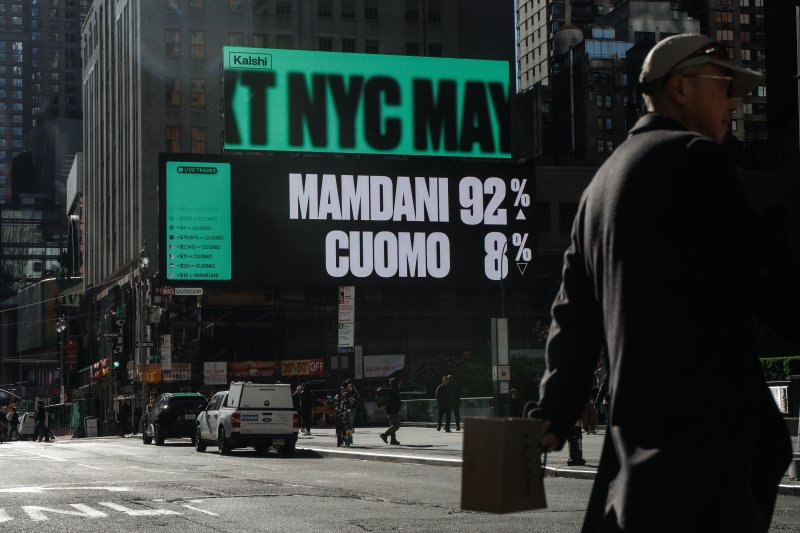

This year’s Super Bowl in the United States generated a wide range of talking points. Bad Bunny, who sings only in Spanish, headlined the halftime show, and artificial intelligence companies turned the ad slots into something like a competitive showcase. The U.S. audience was estimated at about 124.9 million viewers, with peak viewership hitting 137.8 million. Yet the biggest winners of all were the prediction market companies. Kalshi, one of the leading prediction market platforms, set a record on Super Bowl Sunday with more than 1 billion dollars (about 1.45 trillion won) in trading volume in a single day. It was the highest daily volume in the company’s history. Kalshi said that this represented a roughly 2,700% increase from the previous year.
■ A market for buying and selling the probability of the future
Prediction markets are growing at a remarkable pace in the United States. A prediction market is a trading venue where the probability of uncertain future events is expressed as prices, based on participants’ collective judgment and financial incentives. In other words, participants buy and sell shares tied to a future event—for example, “Will it rain in Seoul today?” Kalshi CEO Tarek Mansour said, “When people say, ‘We trust the market,’ what they mean is that they believe the market is the best mechanism for finding the right price,” adding, “In a prediction market, that price is not attached to a product, but to a ‘future possibility.’” He explained, “In the end, a large number of people put their money on the line, and those individual decisions are aggregated into a single probability—that is what a prediction market is.”
Prediction markets can cover virtually any topic across politics, the economy, culture and society. Examples include: who will become chair of the Federal Reserve System (Fed), whether the Fed will cut interest rates, whether the United States will use military force in Greenland, which team will win the Super Bowl, who will take the Grammy Award for Album of the Year, and whether a hurricane will make landfall in a specific region. The list of possible subjects is endless.
Prices reflect how the market assesses the likelihood that a given event will occur. For instance, a price of 0.20 dollars implies a 20% probability, while 0.90 dollars implies a 90% probability. Payouts are made when the event occurs and the value of the contract settles at 1 dollar. If a customer buys 100 contracts at 0.10 dollars each, investing a total of 10 dollars, that person will receive 100 dollars if the event happens.
To take a concrete example, if the Toronto Blue Jays are seen as very likely to win the World Series, the “Yes” contract might trade at 0.80 dollars. If the Blue Jays actually win, the buyer of that contract receives 1 dollar per share. Conversely, if the Blue Jays lose, the person who bought the 0.20‐dollar “No” contract receives 1 dollar per share.
■ The power of “money-on-the-line” forecasts in the 2024 election
Prediction platforms began to emerge in earnest in the late 2010s, but they only really entered the broader public conversation during the 2024 U.S. presidential election. Kalshi and Polymarket, which now effectively split the U.S. prediction market between them, correctly forecast the victory of Donald John Trump in 2024. At the time, legacy media outlets and polling firms were predicting a razor-thin race within the margin of error and sending mixed signals. On these two platforms, however, the probability of a Trump win was consistently priced higher.
On Kalshi, Trump’s probability of winning hovered around 55–57%, while on Polymarket it was about 58–60%. In other words, many people were literally putting their money on a Trump victory. Mansour called prediction markets “the most effective way to gather information and harness collective wisdom,” and added, “People don’t lie when money is on the line. To avoid losing, their predictions have to be right.”
Some estimates suggest that monthly trading volume in this sector jumped from under 100 million dollars in early 2024 to more than 13 billion dollars by the end of last year—an increase of roughly 130‐fold. According to the “2026 Digital Assets Outlook Report” published by The Block, the two major platforms in this space, Polymarket and Kalshi, together recorded more than 37 billion dollars (about 53 trillion won) in prediction trading volume in 2025 alone. Kalshi’s revenue is projected to rise from 1.8 million dollars in 2023 to 24 million dollars in 2024 and 260 million dollars in 2025.
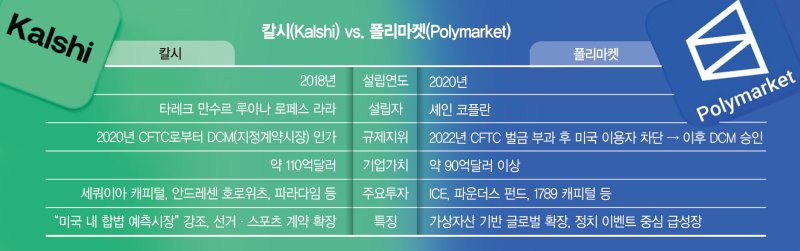
Bloomberg reports that Kalshi’s corporate valuation is about 11 billion dollars, while Polymarket is valued at more than 9 billion dollars. Kalshi has grown with large-scale backing from leading venture capital firms such as Paradigm, Sequoia Capital, Andreessen Horowitz and CapitalG. It is also expanding data partnerships with major broadcasters including Consumer News and Business Channel (CNBC) and Cable News Network (CNN), and has been broadening its influence and brand recognition through strategic partnerships with high‐profile figures such as NBA star Giannis Antetokounmpo.
Polymarket has brought in Intercontinental Exchange (ICE), the parent company of the New York Stock Exchange (NYSE), as a strategic investor that now holds an equity stake. This investment is widely seen as an attempt to connect prediction market data with traditional financial markets. On the venture capital side, Founders Fund, founded by Peter Thiel, is known to have participated as an early investor. In addition, 1789 Capital has come on board as a strategic investor, and Donald Trump Jr. has at one point served in an advisory role. In its early stages, Polymarket also attracted crypto‐focused investors such as Polychain Capital.
On the media partnership front, its data collaboration with Dow Jones stands out. Under this arrangement, Polymarket’s prediction data is being integrated into the content of financial outlets such as The Wall Street Journal, Barron’s and MarketWatch.
■ Gambling or forecasting?
Views on prediction markets remain sharply divided. Are they simply legalized gambling, or the birth of a new industry? The growth trajectories of Kalshi and Polymarket reflect these conflicting perspectives within the regulatory establishment.
Kalshi was founded in 2018 by Massachusetts Institute of Technology (MIT) graduates Tarek Mansour and Luana Lopes Lara. The company bills itself as “the only legal prediction market in the United States.” In 2020 it received formal approval from the Commodity Futures Trading Commission (CFTC) to operate as a Designated Contract Market (DCM) for event‐based derivatives. However, that approval did not extend to election‐related contracts.
In 2022, Kalshi applied to list election prediction contracts, but the CFTC voted to reject the request. The agency argued that election contracts could run counter to the public interest and that political events have a strong gambling character. However, in October 2024, just before the presidential election, Kalshi won a legal battle against the CFTC, opening the door for Americans to bet directly on election outcomes. The company did not stop there and moved into sports betting last year. Most U.S. states, however, have filed lawsuits in response. Major state authorities argue that “companies like Kalshi are offering unlicensed sports betting in violation of laws and regulations in multiple states.” Kalshi, for its part, maintains in public statements that its business is authorized by the CFTC and falls under federal law.
Like Kalshi, Polymarket was founded in New York City in 2020. Launched by Shayne Coplan, the platform uses blockchain technology to enable borderless trading. Even while access from within the United States was restricted, it provided some of the deepest liquidity in the world, supported by trading volumes in the trillions of won from overseas users. Unlike Kalshi, all trading on Polymarket is based on crypto assets.
Polymarket clashed head‐on with U.S. regulators during its early hyper‐growth phase. In January 2022, the CFTC fined the company 1.4 million dollars for offering unregistered derivatives. Polymarket then shifted to a model focused on overseas operations, blocking U.S. users while continuing to expand trading. During the 2024 U.S. presidential race, trading in political events surged explosively, boosting its profile. However, in November 2024, U.S. federal investigators searched CEO Shayne Coplan’s home and seized his phone and electronic devices, reigniting legal concerns over whether Polymarket had allowed U.S. users to circumvent access restrictions. Late last year, the company obtained approval from the CFTC as a Designated Contract Market (DCM), securing a basis for operating legally at the federal level. Even so, like Kalshi, Polymarket is currently embroiled in lawsuits with major U.S. state governments.
■ Prediction markets are likely to grow even larger
Prediction markets are situated in a structural environment that almost guarantees continued growth. First, we live in an era of permanent uncertainty in politics and the economy. Elections, interest rates, wars and technology regulation can all shift on a day‐to‐day basis, and in that environment the market provides immediate probability signals. While opinion polls ask for “opinions,” prediction markets reflect “money‐backed judgments,” which naturally commands greater trust.
Second, expert authority is eroding. Amid polling errors, policy failures and conflicting television coverage, the public has begun to look less for a single authoritative truth and more to collective prices. The more different pieces of information collide, the more important the role of markets becomes in integrating them into a single number.
Third, the technological infrastructure has evolved. Blockchain and real‐time trading systems have made small‐scale participation possible, while smartphone‐based access has lowered entry barriers. What used to be the domain of a small group of experts making probability judgments has now expanded into a mass‐market platform.
Ultimately, prediction markets are not just about simple bets. They are mechanisms for putting a “price on collective intelligence” in an age of turmoil. As uncertainty becomes a permanent feature of daily life, demand for ways to read the future in numerical form is unlikely to fade anytime soon.
[email protected] Reporter