What Are Private Bankers at the Big Five Buying? "After Semiconductors, It’s Finance and Biotech"
- Input
- 2026-02-22 18:25:16
- Updated
- 2026-02-22 18:25:16
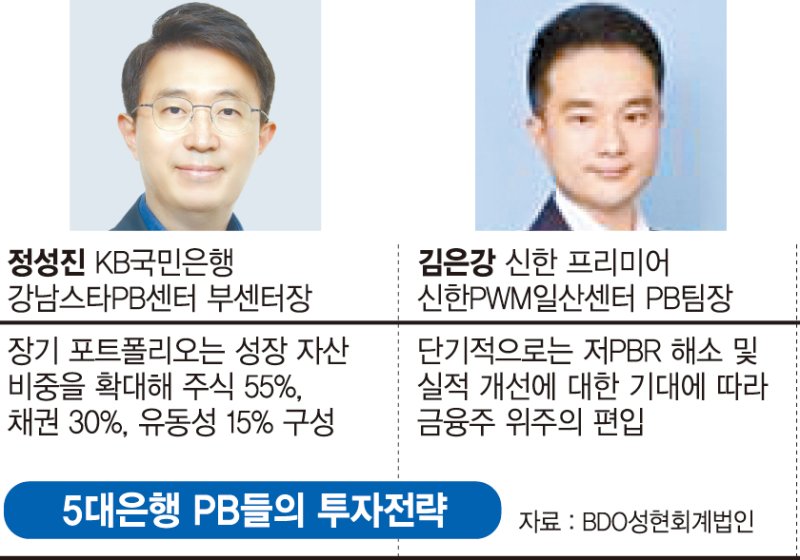
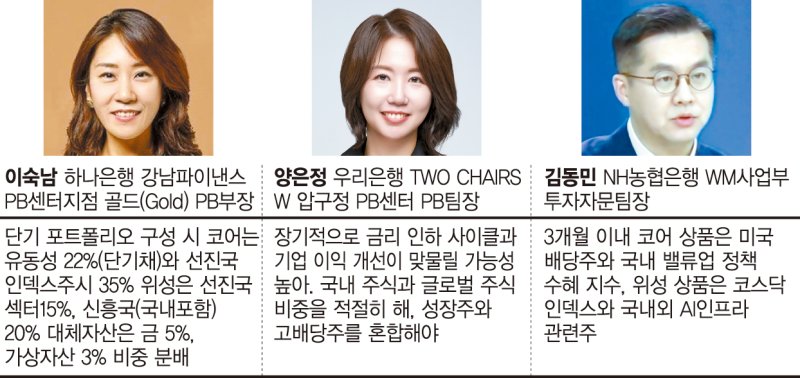
The Korea Composite Stock Price Index (KOSPI) has been rising so quickly that previous target levels have become almost meaningless. Wealth management experts at the five major commercial banks in South Korea are urging investors to rebalance their asset portfolios. In the short term, they recommend increasing exposure to semiconductor, financial, and biotech stocks, while securing sufficient liquidity over the longer term. On the 22nd, asset management specialists at KB Kookmin Bank, Shinhan Bank, Hana Bank, Woori Bank, and NongHyup Bank (NH Bank) all agreed that investors should raise the share of financial stocks in their portfolios in the near term.
Lee Sook-nam, Head of Gold Private Banking at Hana Bank’s Gangnam Finance PB Center Branch, said, "With the commercialization of artificial intelligence (AI), demand for data centers is growing, and supply of High Bandwidth Memory (HBM) remains tight, so there is still room for further gains led by large-cap stocks such as Samsung Electronics and SK hynix." She added, "We are also focusing on financial stocks (securities, banks, insurers, and holding companies), which stand to benefit from dividend and value-up policies and the reshuffling of financial assets, as well as on biotech and construction stocks that are linked to the interest-rate cut cycle."
Kim Eun-kang, Private Banking team leader at Shinhan PWM Ilsan Center, also stated, "In the first half of the year, investors should pay attention to undervalued domestic demand stocks such as banks, securities firms, and insurers." He went on, "If expectations for amendments to the Commercial Act of the Republic of Korea lead to a re-rating of low price-to-book ratio (low P/B ratio) stocks, much of the domestic market’s undervaluation could be resolved, and barring any major external shocks, the KOSPI could surpass 7,000 within the year."
Jung Sung-jin, deputy head of the center at KB Kookmin Bank’s Gangnam Star PB Center, likewise argued, "The KOSPI’s rise is not a short-term overheating phenomenon, but rather a reflection of improving corporate earnings and global capital flows." He assessed, "Earnings momentum centered on semiconductors is likely to continue through the first half, leaving room for additional upside." However, he cautioned, "As valuations become more stretched and interest and exchange rate variables come into play, volatility is likely to increase," adding, "Instead of trying to call the top of the index, this is the time to distinguish between upswings and corrections and to review one’s asset-allocation principles."
Kim Dong-min, Head of Investment Advisory Team at the NH NongHyup Bank WM Business Department, commented, "Investors should pay attention to AI infrastructure, power and nuclear energy, humanoid robots, as well as the KOSDAQ Index and KOSDAQ venture funds that are expected to benefit from government policy support."
Regarding the real estate market, which has been shaken by the government’s active intervention, the consensus is that investors need to proceed cautiously, depending on their individual financial situations.
Kim Dong-min advised, "Multi-home owners should gradually sell properties or convert them into rental units, while single-home owners should consider upgrading by purchasing properties listed by genuine owner-occupiers rather than those offloaded by multi-home owners." He added, "Those without a home should move quickly to buy urgent, discounted listings put on the market by multi-home owners."
Experts are also recommending that investors reduce their exposure to gold, silver, and virtual assets over both the short and long term. Jung Sung-jin said, "Gold and silver should be viewed less as return-seeking assets and more as hedging tools that enhance portfolio stability."
Some also argue that investors should prepare for the possibility that virtual assets will be brought into the regulatory mainstream. In the short term, Lee Sook-nam suggested a portfolio allocation of 22% liquidity (including short-term bonds and U.S. short-term Treasury securities), 35% developed markets index stocks, 15% developed-market sectors, 20% emerging economies (including Korea), 5% gold, and 3% virtual assets. For the long term, she recommended increasing the share of liquid assets by 10 percentage points while cutting allocations to developed and emerging market equities by 5 percentage points each.
Yang Eun-jung, Private Banking team leader at Woori Bank’s Two Chairs W Apgujeong PB Center, noted, "Virtual assets are increasingly being brought under formal regulation, but they remain highly volatile." She added, "From a wealth management perspective, it is appropriate to limit them to within 5% of the overall portfolio."
mj@fnnews.com Park Moon-su Reporter