150-Day Temporary Use of 'Section 122'... Buying Time to Build a Tougher Tariff Regime [Trump Raises Tariffs to 15%]
- Input
- 2026-02-22 18:07:32
- Updated
- 2026-02-22 18:07:32
■ '15% tariff' unlikely to clear Congress
In practical terms, it will be an uphill battle for the Trump administration to secure congressional approval after 150 days and make the 15% blanket tariff permanent. The most formidable obstacle is inflation, an issue lawmakers are acutely sensitive to. Slapping a 15% tax on all imports with no exceptions is, in essence, a massive tax hike that directly empties the pockets of U.S. consumers and businesses. If production costs surge for manufacturers that rely on imported raw materials and prices for everyday goods on store shelves spike, inflation—only recently brought under some control—will almost inevitably flare up again. That would quickly translate into voter anger and become a political boomerang that members of Congress can hardly afford to face ahead of the November midterm elections.
The internal calculus within the ruling Republican Party (GOP) is also complicated. Many moderate GOP lawmakers still place a high value on free trade. On this day, some Republican lawmakers issued statements "welcoming" the Supreme Court's decision, prompting Trump to publicly denounce them as "disloyal" and exposing signs of fissures within the ruling camp. Large-scale farming operations, a core base of GOP support, are also the first in line to be hit by retaliatory tariffs from other countries. On top of that, the powerful lobbying clout of major retailers, Big Tech companies, and the automotive industry with global supply chains makes it extremely difficult for Congress to side with the White House, observers note.
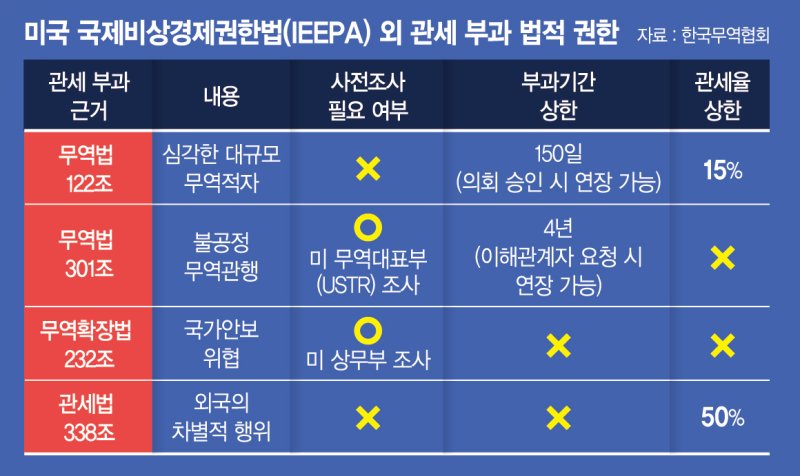
In addition, Section 122 of the Trade Act of 1974 was originally designed as an exceptional and temporary tool to be used only when the United States faces a "serious" balance-of-payments deficit. The fact that Section 122 of the Trade Act of 1974 has never been invoked since the law was enacted in 1974 is another source of political and legal burden.
■ What lies behind the 150-day countdown
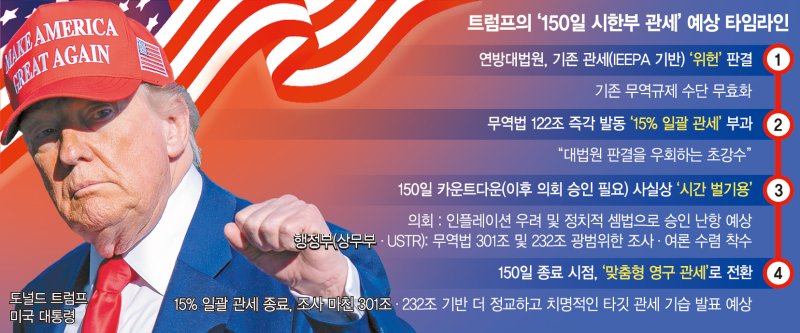
Despite the uncertainty over congressional approval, analysts say Trump took this gamble because of the 150-day window. This period is not just the duration during which tariffs are imposed; it is seen as a golden time to load a new and more powerful trade-restriction weapon to replace the IEEPA authority lost due to the Supreme Court ruling.
For the Trump administration, maintaining leverage in negotiations is an immediate and pressing need. If the vacuum in trade policy created by the invalidation of existing tariffs is not filled, the United States will inevitably lose ground in global trade talks. By keeping the 15% tariff in place for the 150-day validity period and tightening the screws on the rest of the world, Washington aims to send a strong message: "If you do not promptly offer concessions that the United States wants, you will face even greater penalties."
At the same time, behind the scenes, the administration is expected to weave together its own executive authorities that do not require congressional approval to build a new, dense tariff web. The most prominent tools are Section 301 of the Trade Act of 1974, which sanctions unfair trade practices by specific countries, and Section 232 of the Trade Expansion Act of 1962 (Section 232), which restricts imports on national security grounds. These provisions can be triggered unilaterally by the executive branch, but to ensure legal defensibility they require extensive investigations and public comment procedures by the United States Department of Commerce and the Office of the United States Trade Representative (USTR), a process that typically takes several months.
[email protected] Reporter Kim Kyung-min Reporter