KOSPI Nears P/B Ratio of 2, Poised to Break Out of Undervaluation
- Input
- 2026-02-22 18:05:36
- Updated
- 2026-02-22 18:05:36
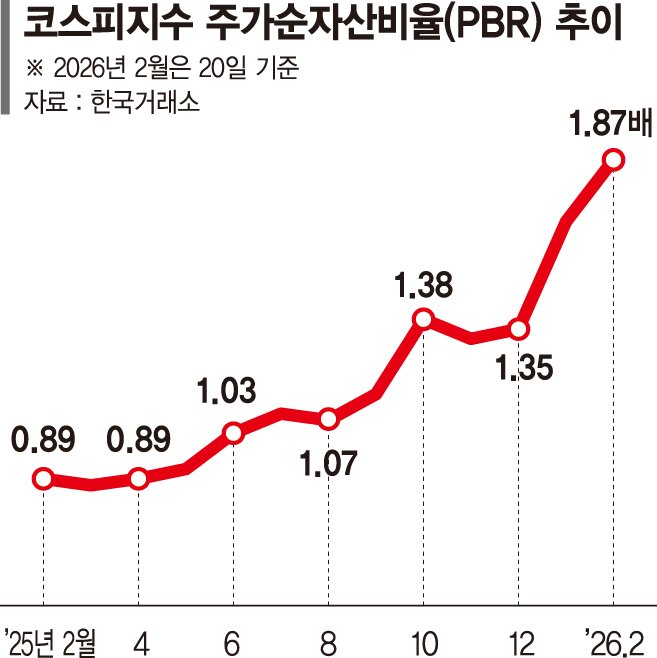
According to the Korea Exchange on the 22nd, the KOSPI’s P/B ratio stood at 1.87 as of the 20th. This is more than double the 0.93 recorded a year earlier and the highest level in 18 years and three months, since November 9, 2007, when it also reached 1.87. However, it still remains well below levels in the U.S. stock market, where the ratio has exceeded 5. The P/B ratio is calculated by dividing a company’s market capitalization by its net assets and is used to gauge whether a stock is undervalued, with 1 often seen as the threshold. From 2022 through 2025, the KOSPI’s P/B ratio failed to rise above 1, meaning Korean companies’ share prices did not even reflect the value of their assets. As a result, the KOSPI’s P/B ratio became a symbolic indicator of the Korea discount.
Experts say the Korean stock market is now moving into a phase where it is shedding the Korea discount. Although the P/B ratio briefly exceeded 2 during boom periods in the early 1990s, early 2000s, and in 2007–2008, they note that today’s situation is structurally different from those past episodes. Jeong Yong-taek, a researcher at IBK Investment & Securities, said, "We are now hearing that the Korea discount is finally being lifted," and added, "Barring an economic crisis, it will be difficult to see the kind of sharp spikes and crashes in the P/B ratio that we saw in the past."
Heo Jae-hwan, a researcher at Eugene Investment & Securities, also stated, "The domestic stock market is at a turning point in breaking away from undervaluation," explaining that "this shows that the status of Korean companies has fundamentally changed."
The move into a phase of easing the Korea discount has been driven largely by improving earnings at semiconductor companies and expectations for amendments to the Commercial Act of the Republic of Korea. Kim Yong-gu, a researcher at Yuanta Securities, noted, "Shareholder-friendly policies under the Lee Jae-myung administration, such as amendments to the Commercial Act, the value-up program, and a stronger Stewardship Code, are underpinning the domestic market’s differentiated strength."
In fact, major blue-chip indices have already surpassed a P/B ratio of 2, including the Korea Value-Up Index at 2.14, the KRX 100 Index at 2.22, the Korea Exchange 300 Index (KRX300) at 2.13, the KOSPI 100 Index at 2.15, and the KOSPI 200 Index at 2.05.
[email protected] Han Young-jun Reporter