Gold and Silver Prices Rebound, but ETFs Lose Momentum
- Input
- 2026-02-22 12:52:07
- Updated
- 2026-02-22 12:52:07
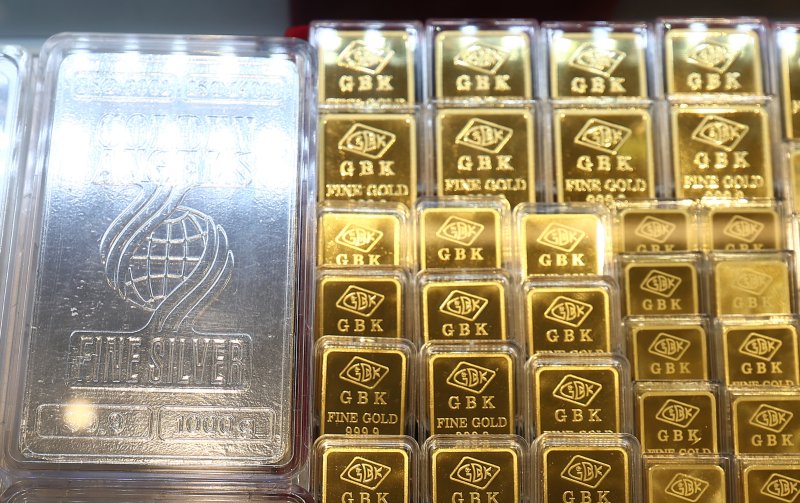
[Financial News] Gold and silver prices, which had been swinging sharply, are now recovering. However, related Exchange-Traded Funds (ETF) are showing signs of stalling. After last year’s surge raised concerns about overheating, increased volatility this year appears to have pushed more investors to the sidelines.
According to the Korea Exchange (KRX) on the 22nd, as of the 19th, the combined net asset value of 12 gold and silver-related ETF products (excluding leveraged and inverse funds) stood at 9.5146 trillion won. It was close to 10 trillion won at the end of last month, but more than 400 billion won has flowed out in just 11 trading days.
Net assets represent the sum of invested capital and the profits generated from managing the underlying securities. They increase when new money flows in and when the prices of the holdings rise.
Gold and silver ETFs continued to grow sharply last month, extending the strong momentum seen last year on the back of rising commodity prices. At the end of last month, the total net assets of the 12 products reached 9.9444 trillion won, up 3.6183 trillion won, or 57.20%, from 6.3261 trillion won at the end of the previous year in just one month.
Gold and silver prices, which had been on a steep climb, wobbled late last month after former Fed governor Kevin Warsh was nominated as the leading candidate for the next chair of the Federal Reserve System (the Fed). On the 30th of last month, gold futures on COMEX on the New York Mercantile Exchange (NYMEX) fell 11.39%, while silver futures plunged 31.37%.
Although the volatile gold and silver prices have since rebounded, the expansion in volatility appears to have strengthened a wait-and-see attitude among investors. As of the 20th, gold futures were trading at $5,080.90, up 7.08% from the end of last month. Over the same period, silver futures also gained 4.85%.
The fact that speculative money poured in as gold and silver prices soared late last year and earlier this year is also cited as a factor making investors more cautious. In the second half of last year, the Relative Strength Index (RSI) for gold and silver exceeded 90, indicating persistent overbought conditions. The RSI is used to gauge overheating, and readings above 70 are considered overbought, meaning the market had far surpassed that threshold.
Oh Jae-young, a researcher at KB Securities, noted, "Gold and silver prices underwent a correction after several months of sustained overbought conditions," adding, "The increase in margin requirements for gold and silver on the Chicago Mercantile Exchange (CME) and the Shanghai Futures Exchange (SHFE), along with the so-called 'Warsh shock,' acted as triggers." He went on to say, "Once the leverage built up by the recent concentration of speculative capital is unwound to some extent through higher margin requirements and price volatility, prices should be able to trend upward over the long term."
Some analysts also expect the commodities supercycle to move from precious metals to base metals. Choi Jin-young, a researcher at Daishin Securities, explained, "Looking back at past periods of abundant liquidity, commodities tended to rise in stages, starting with precious metals, then base metals, followed by energy and agricultural products," and predicted, "This time as well, there is a high likelihood that we will see a similar pattern to the past."
jisseo@fnnews.com Seo Min-ji Reporter