"169% Attrition"... Students Admitted to Samsung Electronics and SK hynix Programs Still Choose SNU and Medical School
- Input
- 2026-02-22 10:32:13
- Updated
- 2026-02-22 10:32:13
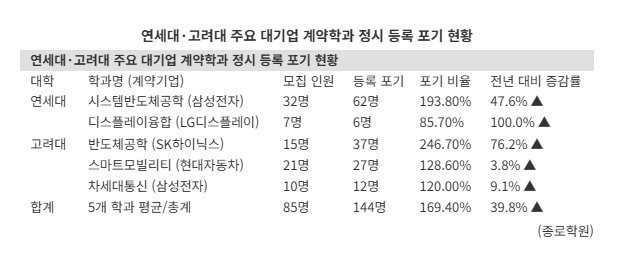
[Financial News] In the 2026 academic year, 144 students who had been admitted through regular admissions to corporate-sponsored departments at Yonsei University and Korea University chose not to enroll, a 39.8% jump from the previous year. This means more than 1.7 times the total number of available seats were ultimately given up. Observers say this reflects an accelerating "chain exodus" among top-tier students, who are prioritizing the Seoul National University brand and the stability of medical-related disciplines over future uncertainties in industry, despite strong business performance at major corporations.
According to Jongno Academy on the 22nd, 144 students declined their regular-admission offers for the 2026 academic year across five corporate-sponsored departments at Yonsei University and Korea University, up from 103 the year before. Compared with the combined intake quota of 85 students at the two universities, the withdrawal rate reached 169.4%, higher than the previous year’s 143.1%.
By university, Yonsei University saw 68 students give up their spots, a 51.1% increase year-on-year, while Korea University had 76 withdrawals, up 31.0%. In particular, the Department of Systems Semiconductor Engineering at Yonsei University, a Samsung Electronics contract program, recorded 62 students who declined to enroll, a 47.6% rise. The Department of Semiconductor Engineering at Korea University, linked with SK hynix, had 37 withdrawals, surging 76.2%. For Korea University’s Department of Semiconductor Engineering, the number of students who walked away amounted to 246.7% of its intake quota of 15, indicating the most severe attrition.
By company, programs tied to Samsung Electronics saw the largest number of withdrawals at 74 students, with a 39.6% increase. Hyundai Motor followed with 27 students, up 3.8%. At LG Display, six students declined to register, representing a 100% increase from the previous year. Analysts say this pattern stems from a chain reaction in which most initial admits in the regular admissions round forgo enrollment, and even additional admits subsequently switch to other universities.
Lim Seong Ho, head of Jongno Academy, stated, "Even though the business performance of major corporations has improved significantly, the final choices of top-tier students are moving in a completely different direction." He analyzed, "Rather than the guaranteed reward of employment at a large corporation, they are placing greater value on the Seoul National University brand and the social stability associated with medical-related disciplines."
Lim went on to say, "Given the current uncertainty about future economic conditions in specific industrial sectors after graduation, students tend to favor paths that allow them to keep more career options open." He added, "Because the corporate-sponsored departments at Yonsei University and Korea University are placed in the first application group, when students also gain admission to Seoul National University in the second group or to Medical and Pharmaceutical Sciences in the second or third groups, there is a structural limitation that makes it very difficult to prevent them from leaving."
In practice, among top-performing students, the name value of a large corporation is proving no match for the perceived stability of the Seoul National University brand or a medical license. Admissions experts predict that chain movements caused by multiple offers will intensify further with the introduction of the Regional Physician System in the 2027 academic year.
Lim concluded, "Judging from the behavior of successful applicants in the 2026 academic year, the popularity of corporate-sponsored departments is being heavily swayed by university brand power and the preference for medical-related disciplines, regardless of overall economic conditions." He added, "Since attrition could grow even larger in future admissions cycles, it is time for a fundamental rethinking of how to strengthen the competitiveness of these corporate-sponsored programs."
[email protected] Kim Man-gi Reporter