Chey Tae-won: "SK hynix operating profit could top $100 billion this year, but volatility is high"
- Input
- 2026-02-22 11:22:09
- Updated
- 2026-02-22 11:22:09
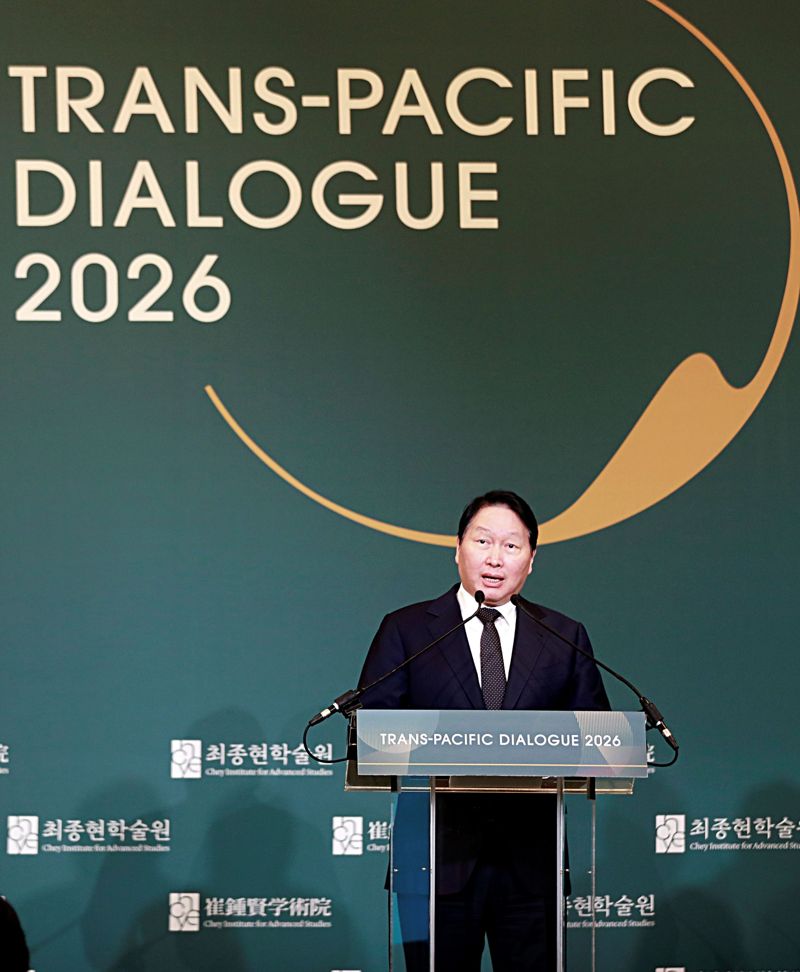
According to Financial News, SK Group Chairman Chey Tae-won projected that SK hynix’s operating profit this year could exceed $100 billion (about 144.85 trillion won). He attributed this outlook to an expected surge in demand for memory semiconductors driven by the boom in artificial intelligence (AI). At the same time, Chey cautioned that losses could also reach $100 billion, underscoring that the current period is marked by extremely high volatility.
In his welcome address at the Chey Institute for Advanced Studies' "Trans-Pacific Dialogue (TPD) 2026," held on the 20th (local time) at Salamander Washington DC in Washington, D.C., Chey said, "We are standing at the dawn of an inevitable transformation. AI is swallowing everything," as he shared this outlook.
Chey went on, "Last year, we projected this year’s operating profit for our semiconductor company (SK hynix) at more than $50 billion (about 72.425 trillion won). That was our forecast as of December last year," adding, "In January, we revised that forecast and said it could exceed $70 billion (about 101.395 trillion won). But when I asked for a new estimate today, they told me $100 billion. That is good news." He also said the company would significantly ramp up production of the "monster chips" that play a central role in the AI industry. In this context, monster chip refers to high-bandwidth memory (HBM). Chey noted, "These days, it is this monster chip that is really bringing in big money for our company." The market margin rate for HBM is known to be around 60%.
However, he stressed that such rosy projections should not be taken for granted, given the extreme volatility. "Conversely, it could turn into a $100 billion loss. The volatility is very high," Chey warned, adding, "New technologies can be one possible solution, but they can also wipe everything out."
He continued, "Next month we might just as well say that the figure has been cut in half," explaining, "I gave that example to illustrate how things are changing from moment to moment, to the point where even making a one-year plan is becoming almost meaningless. Even within a single year, I believe the changes between the beginning and the end will be enormous."
In his address, Chey said, "We are living through a ‘new normal’ era characterized by rapid change and high uncertainty," identifying AI as the key driving force behind this great transformation. "New technologies can offer new solutions, but at the same time they bring with them massive volatility that can tear everything down," he stated. "AI is fundamentally reshaping the industrial structure of the entire world."
Chey also explained that AI is having a major impact on sectors such as energy and finance. "If we fail to meet the power demand required for AI in a timely manner, society as a whole could face a serious crisis," he said. "We must build an energy supply system that is both eco-friendly and stable through new technologies and systems."
He further predicted, "In a situation where AI competition cannot be stopped, only those with the capital and resources to shoulder the enormous cost of AI infrastructure will be able to secure AI solutions and emerge as frontrunners in the race," suggesting that AI infrastructure is having a significant impact on the financial strategies of both nations and companies.
Meanwhile, the Trans-Pacific Dialogue (TPD), hosted by the Chey Institute for Advanced Studies, is a platform where former and current high-level officials from South Korea, the United States and Japan, along with leading global scholars, think tanks and business leaders, gather to discuss international issues. Launched in 2021, it is now in its fifth year. "The changes we are facing now are not just another challenge, but a structural reality that will determine the survival of us all," Chey said. "How South Korea, the United States and Japan choose to cooperate during this transition will shape the order of the future."
soup@fnnews.com Im Su-bin Reporter