Aegis Destroyers Jeongjo the Great, Jeong Yak-yong and Kim Jongseo Gather at HD Hyundai Heavy Industries
- Input
- 2026-02-22 09:00:00
- Updated
- 2026-02-22 09:00:00
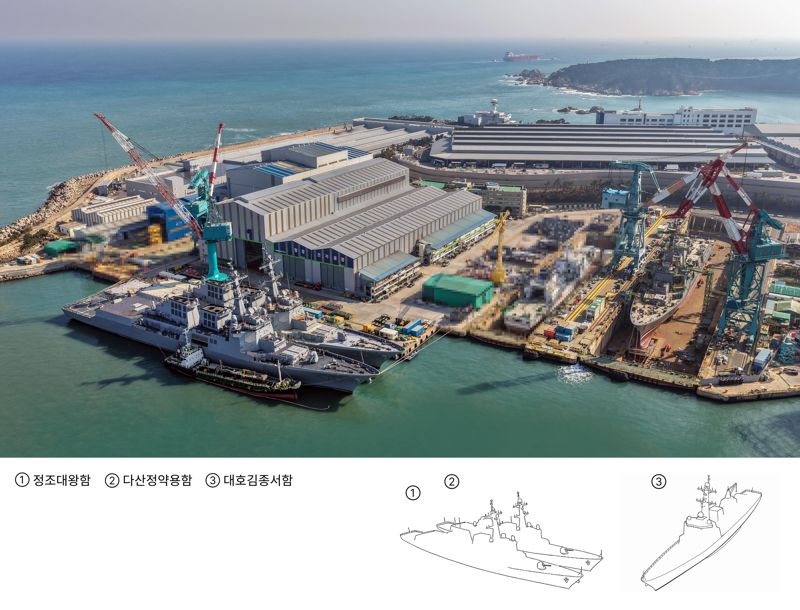
[Financial News] Three of the latest Aegis destroyers named after Jeongjo the Great, Jeong Yak-yong and Kim Jongseo have come together in one place. They have assembled at the Ulsan Shipyard for construction inspections, sea trial evaluations and warranty repairs.
According to HD Hyundai Heavy Industries on the 22nd, three Jeongjo the Great-class destroyers that the company has built or is building—ROKS Jeongjo the Great, ROKS Dasan Jeong Yak-yong and ROKS Daeho Kim Jongseo—gathered at the Ulsan Shipyard on the 19th. HD Hyundai Heavy Industries designated that day as “Aegis Destroyer Day” and invited the commanding officers of the three ships to express its appreciation.
In 2024, HD Hyundai Heavy Industries completed construction of ROKS Jeongjo the Great, the first Jeongjo the Great-class destroyer, and delivered it to the Navy. The second ship, ROKS Dasan Jeong Yak-yong, which is currently undergoing sea trial evaluations, was launched in December last year and is scheduled for delivery to the Navy in December this year. ROKS Daeho Kim Jongseo is now under construction at the Ulsan Shipyard and will go through launching and sea trials before being handed over to the Navy in December 2027.
The latest Jeongjo the Great-class Aegis destroyers are 170 meters long and 21 meters wide, with a standard displacement of 8,200 tons and a top speed of 30 knots (about 55 km/h), making them among the most advanced warships in service today. Compared with the Sejong the Great-class destroyers (7,600 tons), their target detection and tracking capabilities have more than doubled. They are also equipped with interception capabilities, positioning them as a core asset of the Sea-based Three-Axis System designed to counter North Korea’s nuclear and missile threats.
The Aegis destroyer construction capabilities of HD Hyundai Heavy Industries have drawn attention overseas as well. In April and November last year, United States Department of the Navy (DON) Secretary John Phelan and United States Navy (USN) Chief of Naval Operations Admiral Daryl Caudle respectively boarded ROKS Jeongjo the Great and ROKS Dasan Jeong Yak-yong, where they expressed strong interest in the company’s naval shipbuilding technology and production capacity.
On the same day, Joo Won-ho, president of HD Hyundai Heavy Industries responsible for the naval and mid-sized vessel business, invited the three commanding officers—Colonel Jo Wan-hee of ROKS Jeongjo the Great, Colonel Koo Bon-cheol of ROKS Dasan Jeong Yak-yong, and Colonel (promoted) Jang Hyun-do of ROKS Daeho Kim Jongseo—to the VIP reception hall at the shipyard for a luncheon meeting. There, Joo discussed the maritime defense sector with the three captains and conveyed his gratitude to the Navy for its dedication to strengthening the competitiveness of the K-maritime defense industry.
“I am very pleased and deeply moved that three of the latest Aegis destroyers, built with the world’s best technology, have all come together at the Ulsan yard,” Joo said. “It is a symbolic scene that showcases the stature of our country’s maritime defense industry in its 50th year.”
HD Hyundai Heavy Industries is the only domestic shipbuilder that has led the basic design of all current Korean Aegis destroyers—the Sejong the Great-class and Jeongjo the Great-class—and it possesses world-class technological capabilities in the naval sector. Starting with the research and development of ROKS Ulsan, Korea’s first domestically built combat ship, in 1976, the company went on to construct all batches I, II and III of the Ulsan-class frigate, playing a central role in building up the Republic of Korea Navy’s core capabilities. As of this year, it has built a total of 108 naval and special-purpose vessels and has exported 20 warships, the highest number among domestic shipyards.
ggg@fnnews.com Kang Gu-gwi Reporter