Takaichi: "Japan-Korea relations will be further strengthened based on trust between the leaders"
- Input
- 2026-02-20 15:27:50
- Updated
- 2026-02-20 15:27:50
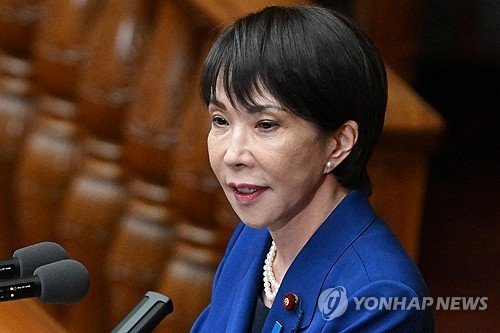
[Financial News, Tokyo = Correspondent Seo Hye-jin] Japanese Prime Minister Sanae Takaichi said on the 20th regarding South Korea, "At a time when its importance is growing in the current strategic environment, we will further strengthen our relationship through frank exchanges of views, based on the relationship of trust between our leaders."
In her policy address to the extraordinary Diet session that day, Prime Minister Takaichi made the remark while referring to last month’s summit with President Lee Jae-myung held in Nara Prefecture.
Pointing to China and North Korea, she said the international order is being severely shaken, and stressed, "The Takaichi Cabinet will pursue a responsible Japanese diplomacy."
She also announced plans to further strengthen the strategy for a free and open Indo-Pacific, including reinforcing supply chains for critical materials.
Identifying the Japan-U.S. alliance as the core of her foreign and security policy, Takaichi said, "If possible, I will visit the United States next month to further solidify my relationship of trust with U.S. President Donald Trump and to further deepen bilateral relations in all areas, including security, the economy and culture."
She went on to say that Japan would work hand in hand with countries that share values such as freedom, democracy and the rule of law, adding that it will deepen multilateral security cooperation, including among Japan, the United States and South Korea, and jointly tackle a wide range of issues with ASEAN and European countries.
On China, with which relations have been strained over remarks about Taiwan, she reaffirmed the existing stance, saying, "Our consistent policy is to comprehensively advance a relationship of strategic, mutually beneficial cooperation and to build a constructive and stable relationship," and, "China is an important neighbor, and since there are many issues and challenges, we will continue communication and respond in a calm and appropriate manner."
Regarding North Korea, she stated, "I want to realize the return of Japanese nationals abducted by North Korea within my term of office," and emphasized that she would not rule out any options, including a summit with Kim Jong Un, President of State Affairs of North Korea, in order to open a breakthrough.
She also mentioned the "responsible proactive fiscal policy" she pledged in the recent House of Representatives election, along with strengthening defense capabilities, enhancing the government’s information collection and analysis functions, constitutional revision, and a temporary two-year cut in the consumption tax on food, declaring her determination to devote herself fully to fulfilling the mission of "making the Japanese archipelago strong and prosperous."
On constitutional revision, including explicitly mentioning the Japan Self-Defense Forces (JSDF) in the Constitution, she said, "I hope that constructive, nonpartisan discussions will accelerate in the Commission on the Constitution of the National Diet, that debate among the public will deepen, and that a proposal for amendment will be realized as soon as possible."
Regarding the strengthening of the government’s intelligence functions, she announced, "We will establish a ‘National Intelligence Council’ within the Cabinet, chaired by the prime minister, and upgrade the Cabinet Intelligence and Research Office into a ‘National Intelligence Agency,’" adding, "We will push ahead with designing systems to prevent improper foreign interference."
On bolstering defense capabilities, she explained that the government will revise the three key national security documents within this year and accelerate its review of the transfer of defense equipment.
On responsible proactive fiscal management, she stressed, "We will break the trend of excessive emphasis on austerity and insufficient investment in the future," and added, "We must not hesitate to inject fiscal resources in order to achieve economic growth."
She went on to say that the government will introduce a budget system managed over multiple years rather than a single year, promote bold investment through long-term funds, and from next month present a "public-private investment roadmap" in areas such as advanced technologies.
She also added that the government will review working styles, including the discretionary working-hour system and telecommuting.
The Japanese prime minister’s policy address to the Diet sets out the government’s basic stance on overall state affairs and is usually delivered at the regular Diet session convened each January.
This year, however, it was delivered at an extraordinary Diet session due to the dissolution of the House of Representatives and the subsequent general election. The extraordinary session, which opened on the 18th, will run until July 17.
The government and ruling coalition are seeking to secure the Diet’s approval of the government budget proposal for fiscal 2026 (April 2026–March 2027) by the end of March next year.
Prime Minister Takaichi on the same day called for "swift deliberations on the budget proposal."
[email protected] Seo Hye-jin Reporter