"Are you that sad?" "Mom, you'll die someday too" – Life questions raised by the play "The Dresser" [This Performance]
- Input
- 2026-02-20 10:23:13
- Updated
- 2026-02-20 10:23:13
[Financial News] "I can’t do it, I just can’t~ What was my first line again?"
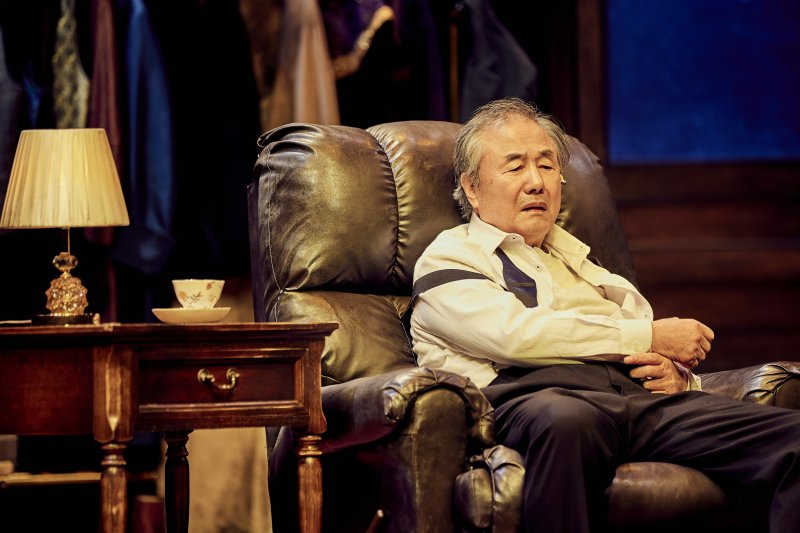
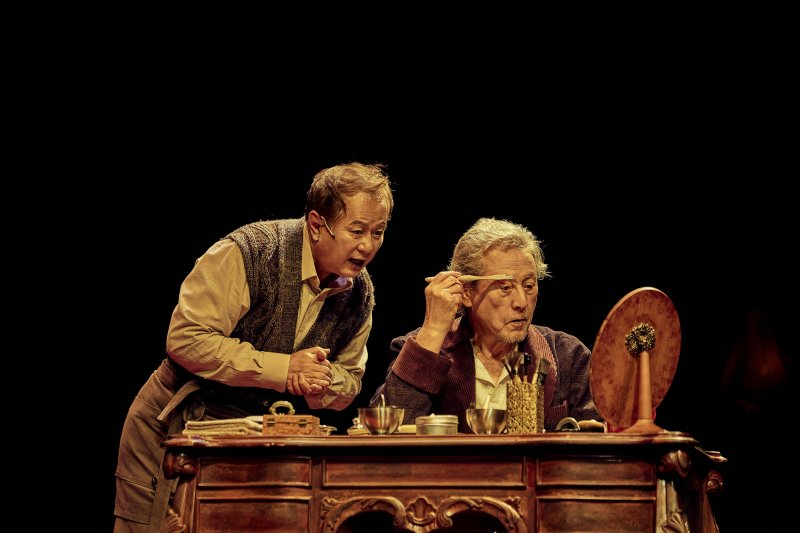
The year is 1942, in the middle of the war, at a provincial theater in Britain. An aging actor known only as "Sir" (played by Park Geun-hyung and Jung Dong-hwan) falls into confusion just before his 227th performance of "King Lear." His longtime dresser Norman (played by Song Seung-hwan and Oh Man-seok) refuses to give up the stage, even as others around them insist the performance be canceled. It becomes unclear whether it is Sir or Norman who cannot let go of the stage. Sensing that this may be his last time, Sir offers heartfelt farewells to those around him, and in the midst of it all, the performance finally begins.
Park Geun-hyung, Song Seung-hwan, Jung Dong-hwan, and Oh Man-seok star in "The Dresser," running through March 1.
The play "The Dresser," now on stage at Daloreum Theater, National Theater of Korea in Jung District in central Seoul, is nearing the end of its run. Continuing through March 1, the production is based on the play by Ronald Harwood, who won the Academy Award for Best Original Screenplay for the film "The Pianist." Harwood drew on his own five years of experience working as a dresser in a Shakespearean company.
A dresser today combines the roles of wardrobe staff and personal dresser, handling costume preparation before and after the show, assisting with makeup, and managing quick changes. In the play, however, Norman is portrayed as far more than a staff member. He is someone who has stayed by Sir’s side for many years, serving him with unwavering devotion.
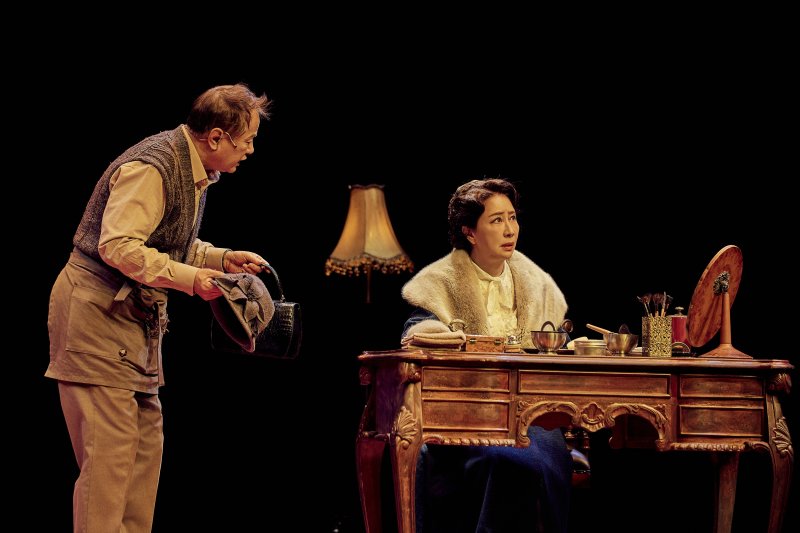
Set in provincial Britain in 1942, at the height of World War II, the story follows a company preparing a production of Shakespeare’s "King Lear." The action unfolds not onstage but mainly backstage and in the dressing room. It captures the process of getting a show up, the tensions between actors and staff, and the charged atmosphere of the theater.
"The Dresser" depicts Sir, who begins to forget his lines and behave erratically before the performance, and Norman, the dresser who uses flattery, persuasion, and even lies to rebuild the crumbling actor into a king once more. Even with too few actors and constant air-raid sirens and bombings, the company fights to keep the show from stopping. Using a play-within-a-play structure, the work overlays the story of "King Lear," who discovers true love only after losing power, with Sir’s reality, leaving a layered and lingering impression.
Life questions raised by the relationship between Sir and Norman
Among veteran actors, there is a saying: "As long as I can remember my lines, I want to stand on stage, even in the smallest role." The stage, in other words, is their reason to live. Sir is no different. At the same time, this endless attachment gives the sense that the balance of power has somehow shifted. He wants to step away from the stage, yet feels bound by a sense of duty not to break his promise to audiences in wartime, as if he himself is now subordinate to the stage. By chance, Norman, who happens to be at his side, becomes the person who hardens that conviction and reality. Because Norman’s position disappears if Sir disappears, their relationship goes beyond a simple hierarchy and resembles a symbiotic, dependent partnership.
In reality, Norman stabilizes the anxious Sir by managing not only his makeup and costumes but even his lines, memories, and emotions, helping him maintain his identity as an actor. Yet it is unclear whether Norman’s devotion is love or obsession, and whether his protection amounts to power or sacrifice.
In the story, Sir leaves nothing to Norman, and Norman’s reaction goes beyond hurt to something close to collapse. Their relationship defies easy definition, and in doing so, it poses countless questions to the audience and lingers in the mind. This is the play’s greatest strength.
After the performance on the 13th, a conversation between a mother and daughter stood out. When the daughter asked her sniffling mother, "Are you that sad?" the mother replied, "I’ll die someday too." Watching Sir slowly close his eyes on stage seems to have left an indescribable emotion in viewers who feel closer to death than to life.
If you were a soon-to-retire "Manager Kim," perhaps the moment when Norman, who has lived entirely for someone else, loses his reason for being would resonate even more deeply. Having "lost the person who defined who he was," how is he supposed to live from now on?
"The Dresser" also contains comedic elements that elicit laughter here and there. It is funny in many moments, yet ultimately it is a tragic human drama that shows why people cannot live without roles. At the same time, it dissects what it means to be an actor and, through artists who keep performing even in wartime, reminds us of the power and persistence of art.
jashin@fnnews.com Shin Jin-ah Reporter