Stabilization Measures Taking Hold? Household Debt Growth Slows After June 27 Real Estate Measures
- Input
- 2026-02-20 12:00:00
- Updated
- 2026-02-20 12:00:00

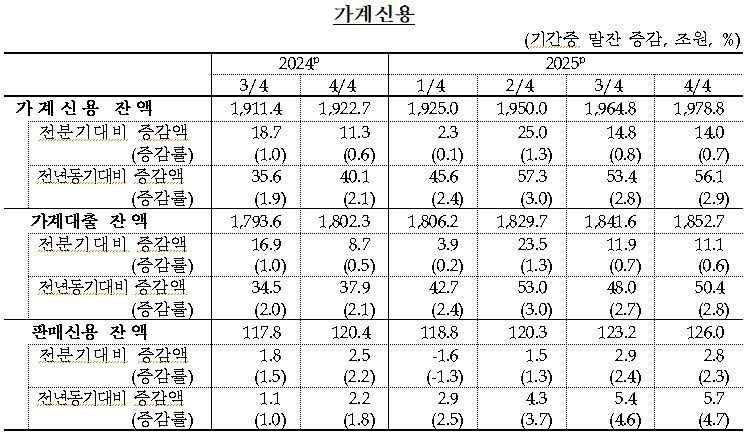
According to the "Provisional Household Credit for the Fourth Quarter of 2025" released by the Bank of Korea (BOK) on the 20th, the balance of Household Credit stood at 1,978.8 trillion won as of the end of December. This represents an increase of 14 trillion won over three months, but the growth was smaller than in the previous quarter, when it rose by 14.8 trillion won. Compared with the second quarter increase of 25 trillion won, the expansion has been cut to nearly half.
The quarter-on-quarter growth rate also fell, dropping from 1.3% to 0.8%, and then down again to 0.7%.
Lee Hye-young, head of the financial statistics team at the BOK, said, "Additional designations of the Area Subject to Adjustment, Speculative Overheating Districts, and Land Transaction Permit Zones, as well as differentiated lending limits on mortgage loans based on housing prices, were key factors in reducing the pace of growth." She added, "Unsecured credit loans also declined after the June 27 Real Estate Measures capped loan limits at each borrower’s annual income."
Although the absolute level is close to 1,980 trillion won and has once again hit a record high, Lee noted, "This year, the government has stressed strict management of household lending from the very beginning, and banks have moved up the implementation of higher lower bounds for risk weights (RW) on mortgage loans. With this tighter management stance continuing, household debt is unlikely to grow sharply."
However, total Household Credit in 2025 still increased by 56.1 trillion won from a year earlier, a 2.9% rise compared with the end of the previous year. Lee added, "Housing transactions, which tend to lead mortgage loans, have inched up, and we are seeing financial institutions resume more active business at the start of the year and securities firms expand margin lending. This means uncertainty remains high."
Household Credit is an indicator that combines all household loans across the financial sector—including commercial banks, mutual finance institutions, and specialized credit finance companies—with sales credit such as credit card payments. It is used to gauge the overall conditions and scale of credit supplied to ordinary households.
Within Household Credit in the fourth quarter, the balance of household loans was 1,852.7 trillion won. This was an increase of 11.1 trillion won from the end of the previous quarter, but the gain was smaller than in the third quarter (11.9 trillion won) and the second quarter (23.5 trillion won).
Among these, household loans from deposit banks rose by 6 trillion won, down from an increase of 10.1 trillion won. A major factor was that the increase in mortgage loans shrank from 10.9 trillion won to 4.8 trillion won. By contrast, household loans from non-bank depository institutions grew by 6.5 trillion won, up from 4.7 trillion won, and mortgage loans in this sector expanded from 1.9 trillion won to 4.1 trillion won.
Overall, the increase in mortgage loans across all household lending fell 41.1%, from 12.4 trillion won in the previous quarter to 7.3 trillion won.
However, mortgage loans at other financial institutions, including insurance companies, decreased by 4 trillion won compared with the end of the previous quarter. This was a larger drop than in the previous quarter, when they fell by 3.2 trillion won. At the same time, the increase in other types of loans expanded from 3.1 trillion won to 5.1 trillion won, causing total household loans at these institutions to swing from a 100 billion won decline to a 1.1 trillion won increase. Policy loans such as insurance policy loans are also believed to have played a role.
The increase in sales credit edged down from 2.9 trillion won to 2.8 trillion won, bringing the balance to 126 trillion won. The rise itself was driven by greater credit card use toward the end of the year. In fact, personal credit card spending grew from 203.2 trillion won in the third quarter to 204.3 trillion won in the fourth quarter.
[email protected] Kim Tae-il Reporter