"KOSPI Headed for 7,900, Floor Still Around 5,000 Even After a Correction"... Global Investment Banks Also Float 'KOSPI 7000' Scenario
- Input
- 2026-02-20 08:27:27
- Updated
- 2026-02-20 08:27:27
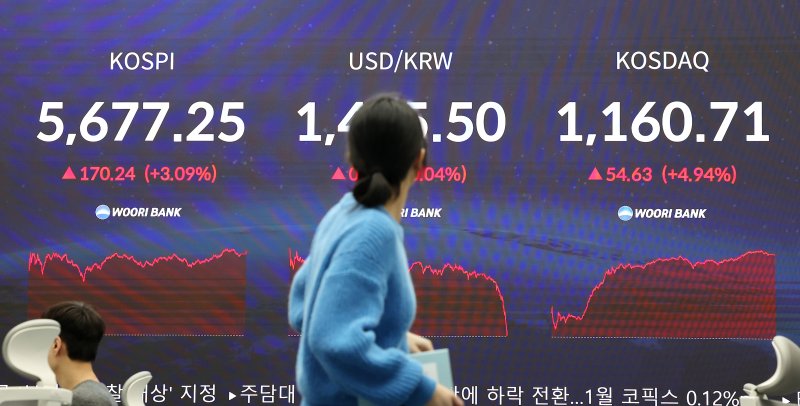
[Financial News] Backed by improving earnings at the two leading semiconductor stocks, the KOSPI has broken through the 5,600-point mark for the first time in history. Against this backdrop, new forecasts are emerging in the securities industry that the index could reach as high as 7,900 within a year.
The once-dreamlike 5,000-point KOSPI now seen as a downside support level
According to the Korea Exchange (KRX) on the 20th, the KOSPI first broke through the 4,000-point level on October 27 last year, then surpassed 5,000 on January 22, roughly three months later. Since then, it has continued to trend upward and, as of the previous day, has captured the 5,600-point peak.
Even as U.S. stock markets have been in a consolidation phase this month, the KOSPI has climbed with virtually no pullback. As a result, brokerages are now setting the lower bound of the index during any short-term correction at around 5,000 points. The 5,000-point level, which only a few months ago was dubbed a "dream index," is rapidly becoming a solid downside support zone.
Daishin Securities expects the KOSPI’s support level in the first half of this year to be around 5,000 points. Yuanta Securities also raised the lower end of its KOSPI forecast to 5,000 on February 13. Kim Yong-gu, a researcher at Yuanta Securities, explained, "Unless a disruptive variable emerges in the global macroeconomy or in the semiconductor industry cycle, it is fair to say that the era of a 4,000-point KOSPI has receded into history."
The previous day, the KOSPI closed at 5,677.25, up 170.24 points (3.09%) from the prior session’s 5,507.01. During intraday trading, the index surged to 5,681.65, surpassing the previous intraday record high of 5,583.74 set on February 13, the last trading day before the holiday. Analysts attribute the rally to abundant liquidity combined with improving fundamentals.
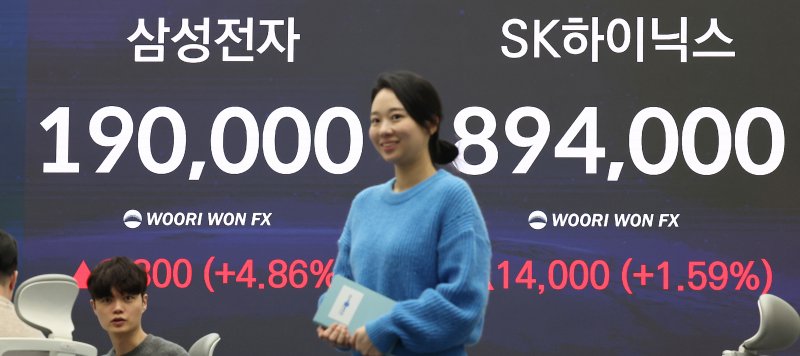
While the initial spark for the index’s rise came from strength in New York’s tech-heavy markets, investors see the main driver as improved "earnings power" centered on semiconductor stocks. In the previous session’s rally, Samsung Electronics broke through 190,000 won intraday for the first time, and SK hynix reclaimed the 900,000 won level. The two names, which rank first and second in KOSPI market capitalization, led the index’s surge side by side.
Brokerages raise upper targets for the KOSPI... JPMorgan also lifts forecast to 7,500
In line with these moves, expectations in the securities industry are being revised sharply upward. Hana Securities has raised the upper end of its 12‐month KOSPI target to 7,900, the highest forecast among domestic brokerages so far. The firm also lifted its 2025 KOSPI net profit forecast from 330 trillion won to 457 trillion won, and its 2027 estimate from 367 trillion won to 521 trillion won.This reflects the view that KOSPI earnings forecasts need to be re-rated, as projected net profits for the semiconductor sector have been sharply revised up from 137 trillion won to 259 trillion won between late last year and this year. Semiconductor stocks now account for roughly 96% of the KOSPI’s aggregate net profit forecast.
Lee Jae-man, a researcher at Hana Securities, noted, "The price‐earnings ratio (PER) of the semiconductor sector is currently 6.7 times, while the average peak PER in years when net profit increases for more than two consecutive years is 12.1 times." He added, "If we apply that PER to the sector’s 12‐month forward net profit, there is theoretically 74.8% upside potential from current share price levels."
Major securities firms are also raising the upper band of their KOSPI targets one after another, lending further weight to the prospect of a "KOSPI 7000" era. On February 5, NH Investment & Securities set a 12‐month forward KOSPI target of 7,300, arguing that government policies aimed at easing the Korea discount—such as planned amendments to the Commercial Act of the Republic of Korea—are leading to a structural improvement in the overall stock market.
Foreign investment banks are likewise optimistic about further upside in Korean equities, citing the global semiconductor boom cycle. In a recent report, JPMorgan assumed a KOSPI bull‐market scenario and raised its index target to 7,500. Citigroup also sharply upgraded its KOSPI target from 5,500 to 7,000.
[email protected] Kim Hee-sun Reporter