Daegu and North Gyeongsang Provincial Councils hold expanded leadership meeting on administrative integration
- Input
- 2026-02-19 15:43:09
- Updated
- 2026-02-19 15:43:09
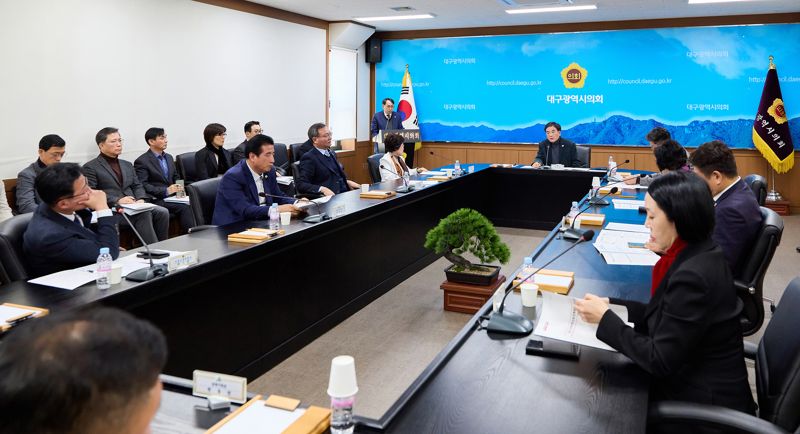
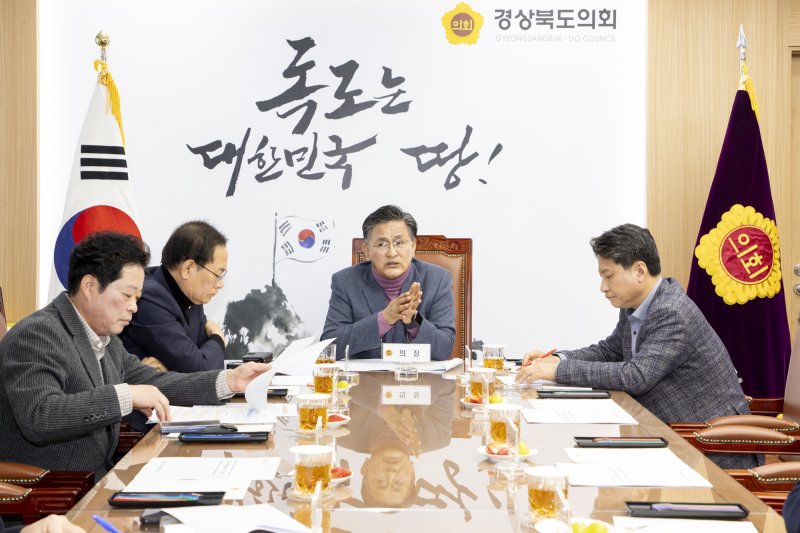
Daegu and North Gyeongsang provincial councils are accelerating efforts to prepare follow-up measures, including holding emergency expanded leadership meetings on the Daegu–North Gyeongsang Administrative Integration Special Act.
The Daegu Metropolitan Council announced on the 19th that it had held an emergency expanded leadership meeting on the 12th regarding the revised draft of the Daegu–North Gyeongsang Administrative Integration Special Act that passed the Security and Public Administration Committee. At the meeting, members discussed the key issues in the special act and the council’s response strategy.
The expanded leadership criticized the city for failing to consult and discuss the matter in advance, saying, "The main content of the Daegu–North Gyeongsang Administrative Integration Agreement, which passed the Daegu Metropolitan Council plenary session in December 2024, and the Daegu–North Gyeongsang Integration Special Act that has now passed the Security and Public Administration Committee are vastly different." They added, "Even city council members, who are both representatives of citizens and direct parties to the integration, do not fully understand the details and have not received a proper explanation even once."
They recalled that the original integration plan was discussed on the premise of substantially transferring central government authority and introducing mandatory special provisions to expand local autonomy. However, they expressed deep concern that in the revised draft many provisions have been watered down into optional clauses that merely state authorities "may" act, thereby weakening the effectiveness of the promised transfer of powers.
Ha Jung-hwan, chair of the House Steering Committee, pointed to the imbalance between the number of council members in North Gyeongsang (60) and Daegu (33). He noted, "A single city council member has enormous power to change important decisions," and explained, "Because North Gyeongsang has far more council members than Daegu, the structure inevitably forces Daegu to be dragged along by the province in major decisions and resource allocation."
He went on to urge, "If the number of Daegu and North Gyeongsang council members is not made equal, we will inevitably go down in history as those responsible for the disappearance of Daegu. Concrete alternatives and proactive measures must be prepared to adjust the number of council seats."
Council chair Lee Man-gyu also remarked, "Isn’t the key issue the 20 trillion won in financial support?" He stressed, "It will be difficult to gain public consent if the focus is solely on passing the special act without sufficient explanation and consultation with the council."
He added, "If the integration is not built on clear conditions and principles, opposition is inevitable."
Earlier, on the 14th, the North Gyeongsang Provincial Council also held an emergency joint meeting of its leadership and standing committee chairs. They shared the review outcome of the Daegu–North Gyeongsang Integration Special Act bill that passed the Security and Public Administration Committee and discussed how to respond next.
The special act bill originally consisted of 335 articles. During the committee’s review, 256 articles were accepted, meaning about 76% were reflected. New special provisions were then added, and the bill was finalized with 391 articles in total.
Kim Dae-il, chair of the Budget and Accounts Committee, pointed out that the special act fails to specify the location of the integrated special city’s seat of government, even though this is crucial for developing the underdeveloped northern region.
Vice chair Bae Jin-seok argued that the integration of the executive branch’s organizational structure must come before forming the integrated council. Education Committee chair Park Chae-ah separately called for the integration support funds to be used efficiently.
House Steering Committee chair Lee Chun-woo emphasized the need to draw up detailed plans to prepare for the July plenary session and to coordinate with the Daegu Metropolitan Council. He called on the Council Secretariat to make thorough preparations.
Council chair Park Sung-man stated, "Since the bill has passed the Security and Public Administration Committee, the plenary session is expected to vote on it within this month if the schedule proceeds as planned." He added, "We must quickly submit the unreflected parts to the relevant central ministries and work together to make this a turning point for Daegu and North Gyeongsang to overcome the crisis of regional decline."
He further commented, "We will make sure that preparations proceed without a hitch so that the council of the integrated special city, the other pillar of the Integrated Special City, can be launched as a representative body that faithfully reflects the voices of special city residents."
[email protected] Reporter Kim Jang-uk Reporter