"Warning Martial Law" vs. "Unconstitutional Insurrection": First Trial Verdict for Yoon Suk Yeol Due Today
- Input
- 2026-02-19 07:55:56
- Updated
- 2026-02-19 07:55:56
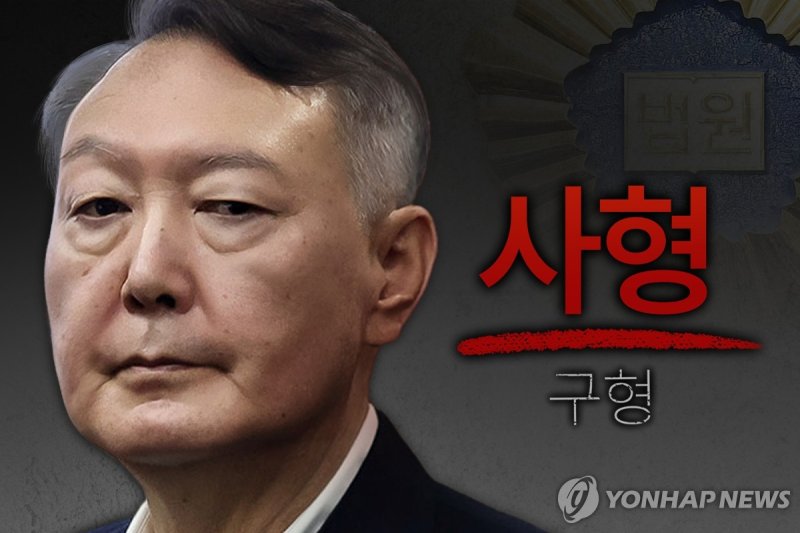
[Financial News] The Seoul court will hand down its first-instance ruling on February 19 on former President Yoon Suk Yeol, who has been charged as the ringleader of an insurrection. As Yoon has stated that he intends to appear in court, the likelihood of an indefinite postponement has become slim.
It remains uncertain whether the panel of judges will sentence him to death, as requested by the prosecution. Yoon’s legal team has consistently argued that the emergency martial law was merely a "warning" measure without any unconstitutional or illegal elements. Many in the legal community believe that, considering parity with sentences for other defendants, life imprisonment is more likely than the death penalty. However, they also expect that a guilty verdict will be hard to avoid due to the unconstitutionality of the martial law proclamation.
■ Yoon: "Warning Martial Law" vs. Legal Community: "The Proclamation Itself Is Unconstitutional"
According to the legal community, Criminal Division 25 of the Seoul Central District Court, presided over by Judge Ji Gui-yeon, will deliver the first-instance verdict today for former President Yoon, who has been indicted on charges of leading an insurrection and abusing his authority by obstructing the exercise of rights.
Yoon’s side has repeatedly characterized the emergency martial law as a "warning" measure. They argue that the Democratic Party of Korea had paralyzed state affairs by using its majority in the National Assembly, and that the president exercised his exclusive constitutional power to declare martial law in order to alert the public to this situation. They further contend that deploying military and police forces to institutions such as the National Assembly and the National Election Commission (NEC) was intended to maintain order, not to restrict access or control those bodies.
However, many legal experts predict that the court will not accept this line of argument. They point to the martial law proclamation issued after the declaration as the decisive factor. Even if one sets aside procedural flaws in the Cabinet deliberation, they say the proclamation itself already contains unconstitutional and unlawful defects. A lawyer who previously served as a presiding judge commented, "The core basis for determining insurrection is the martial law proclamation," adding, "The proclamation is so blatantly unconstitutional and illegal that it satisfies the elements of insurrection."
Earlier rulings that have already recognized key legal principles are also expected to weigh heavily on the case. Yoon’s team argued that he did not fall within the investigative authority of the Corruption Investigation Office for High-ranking Officials (CIO). However, Criminal Division 35 of the same court, presided over by Judge Baek Dae-hyun, previously acknowledged that the CIO had jurisdiction to investigate.
Courts have already twice concluded that the emergency martial law amounted to insurrection. Criminal Division 33 of the same court, presided over by Judge Lee Jin-gwan, which sentenced former Prime Minister of the Republic of Korea Han Duck-soo to 23 years in prison, and Criminal Division 32, presided over by Judge Ryu Kyung-jin, which sentenced former Minister of the Interior and Safety Lee Sang-min to seven years, both ruled that the December 3 Emergency Martial Law constituted insurrection. In particular, in Han’s trial, the court condemned the emergency martial law as an "insurrection from above."
■ Greater Weight on a Life Sentence
The special prosecutor team has asked the court to impose the death penalty on Yoon. They argue that he conspired in advance to declare the emergency martial law and that, given its unconstitutional and illegal nature, the court should not impose the statutory minimum sentence.
On the other hand, many analysts expect the court to opt for life imprisonment. They cite the fact that, although Yoon, former Minister of National Defense Kim Yong-hyun and others attempted to have politicians such as then Democratic Party of Korea leader Lee Jae-myung and former People Power Party leader Han Dong-hoon arrested, the plan was never actually carried out. Observers also note that, unlike in the insurrection case involving former President Chun Doo-hwan, no one was injured or killed during the various unconstitutional and unlawful actions, including the deployment of troops to the National Assembly. A lawyer who previously served as a public prosecutor remarked, "It is true that the December 3 Emergency Martial Law was unconstitutional and illegal, but there are clear differences from the trial of former President Chun Doo-hwan," and added, "For that reason, it is realistically difficult to foresee the death penalty being imposed."
Some also emphasize that, as in the ruling against former Prime Minister Han, the "post-crime circumstances"—that is, the outcomes that did not occur but nearly did, and the potential consequences—will be crucial. For example, if the standoff between military forces and civilians had escalated further, the "possibility" that casualties could have occurred may become a key factor in determining the sentence. Another lawyer who previously served as a presiding judge noted, "The consequences that could arise from emergency martial law, and the results that did not actually occur but almost did, are extremely important," adding, "The factual findings cited in the Han Duck-soo trial are likely to have a significant impact here as well."
■ Little Chance of a Postponement
Yoon’s defense team said on the day before the ruling, "All related written submissions have been completed," and conveyed that he intends to appear in court for the sentencing.
Whether he would appear in person had been a matter of intense public interest. If Yoon chose not to appear and submitted a written statement explaining his absence, the presiding judge could accept it and postpone the sentencing date. Although the court technically has the option of ordering that Yoon be brought from the detention center by force, this is considered unlikely given his status as a former president. Even if the court wanted to proceed with sentencing in his absence, it would first have to go through a separate procedure to decide on that course.
The biggest variable affecting any delay is the regular reshuffle of judges scheduled for February 23. Presiding Judge Ji Gui-yeon, who is in charge of the insurrection-ringleader case, is among those subject to reassignment. If the presiding judge is replaced, a new panel of judges would have to conduct a "renewal of trial proceedings," meaning they must review the entire case record from the beginning, which would inevitably push the schedule back significantly.
[email protected] Jung Kyung-soo Reporter