[Editorial] KEPCO’s record profit driven mainly by high industrial power rates
- Input
- 2026-02-18 19:33:34
- Updated
- 2026-02-18 19:33:34
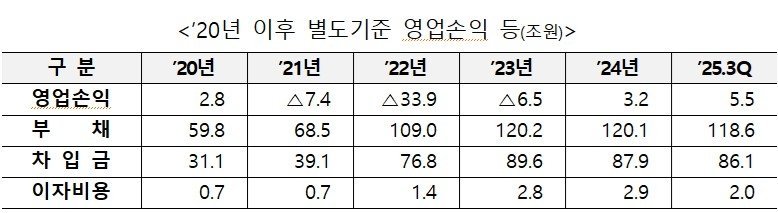
There are several reasons behind KEPCO’s improved performance. First, global energy prices have stabilized. Second, nuclear power plants are running at higher capacity. KEPCO purchases electricity from its generation subsidiary, Korea Hydro & Nuclear Power (KHNP), and when the utilization rate of low-cost nuclear plants rises, its profitability improves. Last year, KHNP’s nuclear power utilization rate reached 84.6%, the highest level in ten years since 2015.
It is a positive development that the Lee Jae-myung administration is pursuing nuclear energy policy proactively instead of being bound by environmental arguments. The government recently announced plans to build two additional nuclear reactors, and KHNP has said it will raise the nuclear utilization rate to 89% this year. Going forward, nuclear policy must not swing back and forth. A decline in nuclear utilization leads to deficits at KEPCO, and those losses ultimately become a burden on the public.
A third factor is higher electricity rates. Even as international energy prices were soaring from 2021 to 2023, the government did not raise electricity tariffs. The stated intention may have been to ease the burden on households, but the result was enormous losses at the state-owned KEPCO. It is hard to deny that political populism, driven by concern over voter sentiment, played a role.
After that, the government implemented several rate hikes, but it raised industrial tariffs far more than residential ones. This effectively shifted the public’s burden onto companies. Since 2022, industrial electricity rates have been increased about 70% over seven rounds of hikes. There were even times when residential rates were frozen while only industrial rates went up. Industrial power now costs 185.5 won per kWh, significantly higher than the residential rate of 149.6 won.
Major economies around the world place greater priority on supplying electricity to industry than to households. Japan subsidizes industrial energy costs with public funds. Germany has introduced a price cap system for industrial users. A simple comparison shows that Korea’s industrial power rates are still lower than in many advanced countries, but that is only because Korea’s overall electricity tariff structure is kept relatively low across the board.
Even if KEPCO is expected to post a large surplus, it is still far from full financial normalization. KEPCO’s management difficulties pose a risk to both national security and the broader economy. Excessive political interference in electricity pricing must stop. In other words, rates should be set according to market principles. This will inevitably increase the burden on the public, but the government should focus on stabilizing prices by expanding nuclear power and similar measures.
The current situation, in which industrial electricity rates are far higher than residential rates, needs to be corrected. Only when companies thrive can the economy grow and the nation develop. Very low electricity prices can also encourage wasteful energy consumption. The government should actively consider targeted rate support for power-intensive high-tech industries such as semiconductors.