"Effectively a Permit System"... Expanded Protest-Free Zones Around Presidential Office Seen as Infringing Basic Rights
- Input
- 2026-02-19 13:39:53
- Updated
- 2026-02-19 13:39:53
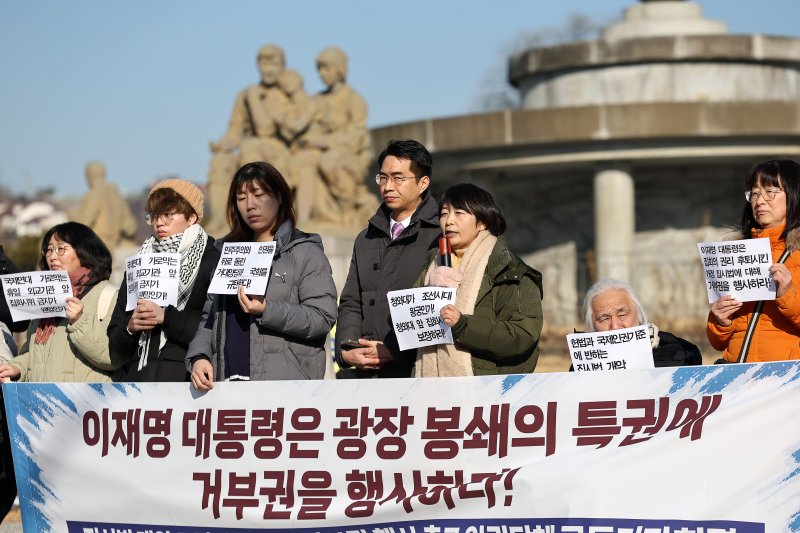
According to Financial News, controversy is mounting after the National Assembly recently passed an amendment to the Assembly and Demonstration Act that restricts rallies within 100 meters of Cheong Wa Dae. The amendment formally allows protests near the Presidential Residence and other key official residences, but only when certain conditions are met. Critics argue that the vague wording could excessively limit the freedom of assembly and demonstration.
According to civic groups on the 19th, the National Assembly plenary session passed the amendment to the Assembly and Demonstration Act on the 29th of last month. The core of the bill is to generally ban outdoor assemblies and demonstrations within 100 meters of the Presidential Residence and the official residences of the Speaker of the National Assembly, the Chief Justice of the Supreme Court of Korea, and the President of the Constitutional Court of Korea, while allowing exceptions only when specific conditions are satisfied.
The key change is a new proviso clause that permits outdoor assemblies and demonstrations near the Presidential Residence and the residences of the Speaker of the National Assembly, the Chief Justice of the Supreme Court of Korea, and the President of the Constitutional Court of Korea when certain requirements are met. Protests will be allowed only if they are deemed unlikely to interfere with the official duties of those living in the residences, unlikely to grow into large-scale gatherings, and unlikely to disrupt the functioning of the residences or official compounds.
This revision follows a 2022 decision of unconstitutionality without nullification by the Constitutional Court of Korea regarding the blanket ban on protests near the Presidential Residence. Under the current Article 11, Paragraph 3 of the Assembly and Demonstration Act, outdoor assemblies and demonstrations are prohibited within 100 meters of the boundaries of the Presidential Residence and the official residences of the Speaker of the National Assembly, the Chief Justice of the Supreme Court of Korea, and the President of the Constitutional Court of Korea.
The provision came under constitutional review after a person identified as A, who had been indicted for organizing a rally near Cheong Wa Dae in August 2017, requested a constitutional review of the law. At the time, the Constitutional Court of Korea ruled that the law was unconstitutional without immediate nullification, stating that it "designates a broad area near the Presidential Residence as a protest-free zone," and ordered the legislature to revise the law by May 31, 2024. Because the deadline passed without legislative action, the provision lost its effect.
To address this legislative vacuum, lawmakers revised the provisions restricting assemblies and demonstrations. Taking into account the constitutional status and role of the president, they also newly designated the presidential office as a protest-free zone. This is the first time since the 1963 revision of the Assembly and Demonstration Act that the presidential office has been added to the list of places where protests are banned.
However, academics and civic organizations warn that the latest revision could severely shrink the space for freedom of assembly and demonstration. By adding the presidential office to the existing list of banned locations, they argue, the law narrows the scope for protests to an excessive degree.
Han Sang-hee, a professor at Konkuk University Law School, said, "Using the pretext of correcting a legislative omission to ban assemblies within 100 meters of the presidential office amounts to democratic backsliding," adding, "Because this amendment poses a serious risk of substantively infringing the freedom of assembly, it constitutes a grave restriction on fundamental rights."
The proviso clause that allows protests when certain conditions are met is also drawing criticism. Although the current system is based on prior notification, observers warn that the abstract and vague criteria could enable the police to exercise broad discretion, effectively turning it into a de facto permit system.
Attorney Kim Sang-eun of Minbyun noted, "The law says protests may be allowed as an exception, but the grounds for that exception are abstract and unclear," and continued, "The authority to make that judgment lies with the local police station, and under this structure there is ample room for restrictions or bans to be issued without clear standards."
Some predict that once the amendment takes effect, the number of rallies in the affected zones will inevitably decline. Last year, 5,612 assemblies were reported within the jurisdiction of Jongno Police Station in Seoul, of which 124 were registered around Cheong Wa Dae Sarangchae.
In response, 24 civic organizations, including Minbyun and People’s Solidarity for Participatory Democracy (PSPD), have submitted a nine-page opinion letter to Cheong Wa Dae. They argue that the revised Assembly and Demonstration Act fundamentally infringes the constitutionally guaranteed freedom of assembly and risks functioning as a practical "permit system" for protests, and they urge the president to exercise his power to request reconsideration of the bill. The groups stated, "We believe the amended Act directly contradicts the intent of the Constitutional Court’s earlier decision of unconstitutionality without nullification and violates the principle of minimal infringement. It also betrays the spirit of the 'Revolution of Light,' in which citizens overcame a crisis of insurrection through peaceful candlelight rallies."
[email protected] Jang Yu-ha and Seo Ji-yoon Reporter