President Lee tells Jang Dong-hyuk: "No one is questioning my parents' rural home, and I have no intention of telling anyone to sell"
- Input
- 2026-02-18 01:32:32
- Updated
- 2026-02-18 01:32:32
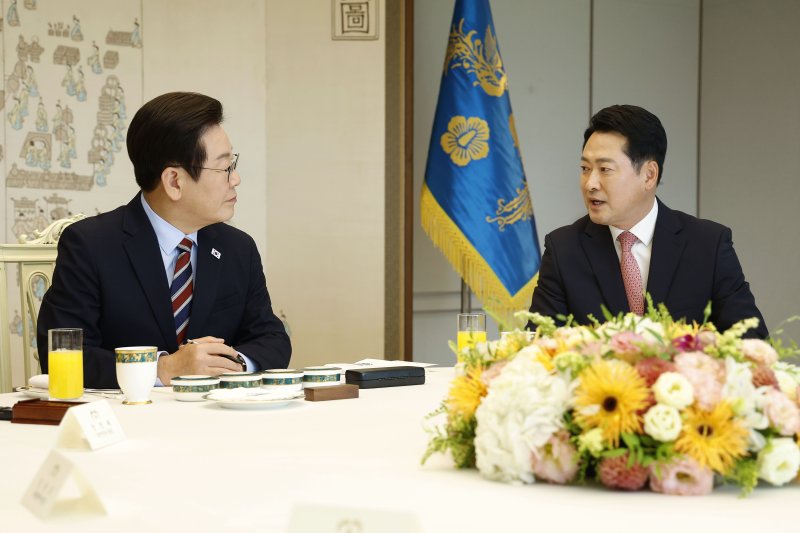
According to Financial News, President Lee Jae-myung on the 18th responded to People Power Party leader Jang Dong-hyuk’s criticism that he was "branding multi-homeowners as a social evil." Lee stated, "No one takes issue with rural homes where parents live, privately owned vacation houses, or second homes in areas at risk of depopulation that have nothing to do with housing shortages and related social problems," adding, "The government has absolutely no intention of telling people to sell such homes." By drawing a line after Jang invoked his "elderly mother’s residence" in protest, Lee sought to refocus the debate on distinguishing speculative or investment-driven multiple homeownership from legitimate cases.
In a post on X (formerly Twitter) the same day, Lee prefaced his remarks by saying that owning multiple homes, in itself, cannot be categorically condemned as a social evil. However, he went on to fault the system that made multiple homeownership profitable and the politics that allowed it to persist. "In a capitalist market economy where individuals enjoy the freedom to act within their own responsibility and to earn money in every way permitted by law, we cannot denounce the mere act of owning multiple homes, so long as it does not violate laws and regulations, as a social evil," he wrote.
At the same time, Lee stressed that politics must, through the design of regulations, tax policy, and financial systems, ensure that "undesirable" forms of multiple homeownership become a burden rather than a benefit. He wrote, "Those in politics who oversee laws and institutions must, through regulation, taxation and financial policy in the legislative and administrative process, make it disadvantageous rather than profitable, so that people are discouraged from owning multiple homes."
He particularly criticized the political establishment, which should be making undesirable multiple homeownership a burden, for doing the opposite. Instead of curbing special treatment for multi-homeowners, he argued, they "not only tolerate preferential treatment for multiple homeownership, but even fuel speculative buying of multiple homes, and in some cases go so far as to engage in conflicts of interest by seeking excess profits from their own multiple properties." He continued, "If we must single out a social evil to condemn, that condemnation should not fall on multi-homeowners who exploit bad systems, but on the politicians who created and implemented those bad systems."
Lee also drew a clear line regarding the controversy over allegedly "forcing people to sell." "Whether to sell or buy is up to market participants," he said. "It is not the government’s role to tell people to sell or buy based on appeals to morality. The government’s role is only to create conditions under which selling or buying becomes advantageous." He added, "A government that derives its authority from the people will, through the powers entrusted to it in taxation, regulation and finance, thoroughly claw back any privileges granted to 'undesirable' multiple homeownership, and will strictly impose and enforce responsibilities and burdens commensurate with owning multiple homes."
At the end of his post, Lee added, "Lumping together undesirable, investment- or speculation-driven multiple homeownership with legitimate multiple homeownership to draw battle lines is a wrongful act that exploits law-abiding multi-homeowners."
Earlier, People Power Party leader Jang Dong-hyuk had criticized Lee after the president posted a question about regulating multi-homeowners. Jang said, "Demonizing multi-homeowners and playing a numbers game to stoke public resentment is cheap politics," and pushed back by citing examples such as "a rural home where my elderly mother lives." Among the six homes Jang currently owns are a farmhouse in Boryeong, South Chungcheong Province, where his mother lives, and an apartment in Jinju, South Gyeongsang Province, where his mother-in-law resides.
Lee’s latest post is widely seen as a direct rebuttal to Jang’s claims, shifting the focus of the multi-homeownership debate away from individual morality and squarely onto the responsibility of those who design public policy.
[email protected] Seong Seok-woo Reporter