NPS chief: "If we raise contributions and returns, the fund will not be depleted within the 21st century"
- Input
- 2026-02-16 14:00:35
- Updated
- 2026-02-16 14:00:35
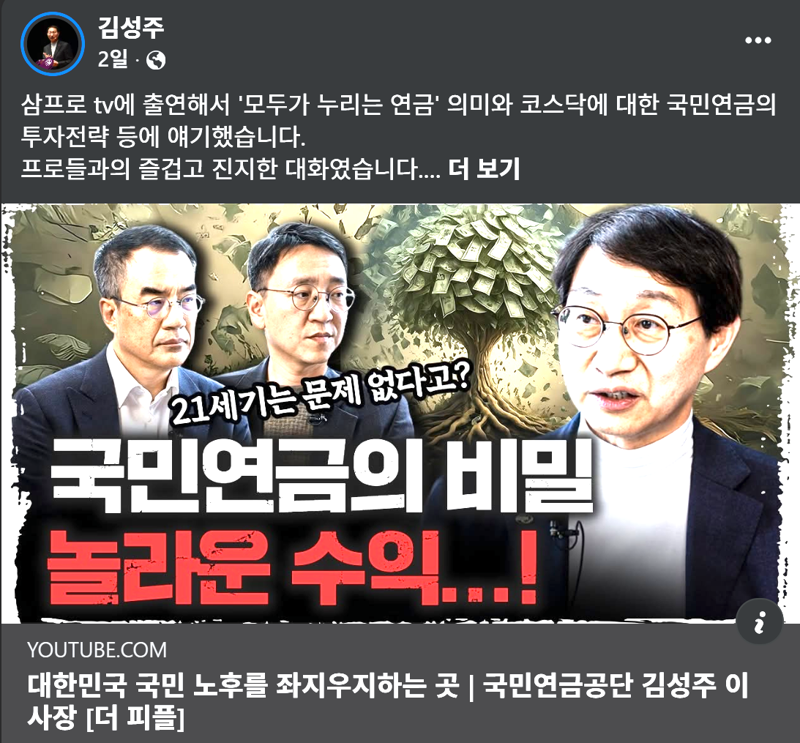
According to the financial industry on the 16th, Kim Sung-joo, chairman of the National Pension Service (NPS), appeared on the YouTube channel Sampro TV. In response to concerns that "people in their 20s and 30s may end up only paying into the National Pension Service and see the fund run out," he said, "We will build a national pension system that can operate without concerns about fund depletion until the end of the 21st century, for the next 74 years." Kim added that this would require additional parametric reforms.
Kim noted that earlier parametric reforms had already pushed back the projected depletion date of the fund. He stressed, "The average rate of return is 4.5%. If we raise it by 1 percentage point to 5.5%, the depletion date is delayed until 2071. If we increase it a bit further, we can create a structure that will remain sustainable until the end of this century."
Kim expressed confidence that if three conditions are met—higher contribution rates, improved investment returns, and greater government support—the national pension fund can be maintained through the end of this century. "The public has already agreed to higher contribution rates," he said. "There are roughly 10 million people who fall into coverage gaps in the current National Pension Service. For every citizen to benefit, the government must provide more active support. It needs to subsidize contributions for low-income groups," he pointed out.
Kim also underscored the importance of the National Pension Service’s independence and responsible management under the stewardship code. As the background for strengthening the fund’s independence, he cited the past state capture scandal. "We are overcoming the trauma of the past state capture scandal and are thoroughly guaranteeing the independence of fund management from political pressure," he explained. He added that the NPS "does not stop at simply holding shares, but engages in private dialogues and exercises voting rights against companies that undermine shareholder value." This signaled a further strengthening of shareholder activism.
[email protected] Reporter Park Moon-soo Reporter