Lee asks, "Is it desirable for People Power Party to favor multi-homeowners? I don't think they are that unreasonable"
- Input
- 2026-02-16 09:38:22
- Updated
- 2026-02-16 09:38:22
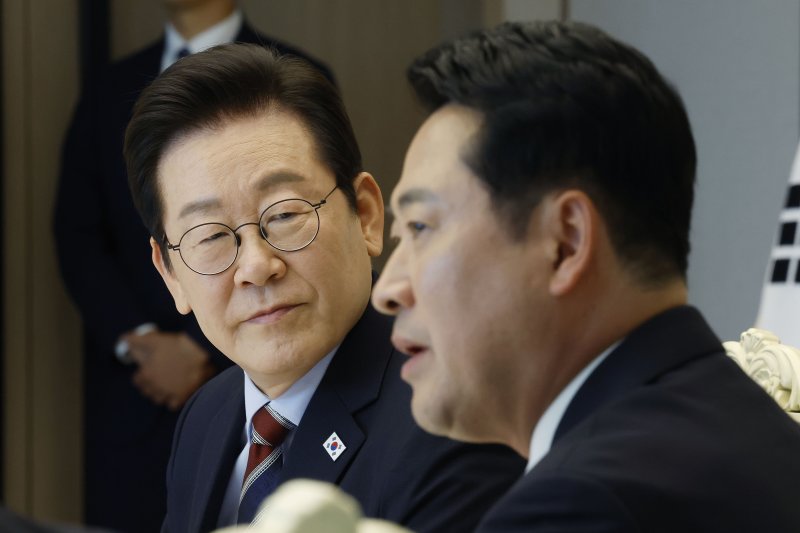
According to Financial News, on the 16th President Lee Jae-myung directly confronted the People Power Party over regulations on multi-homeowners, asking, "In South Korea, where a small land area is combined with heavy concentration in the Seoul metropolitan area and strong real estate speculation factors, do they really think it is desirable for a small number of people to own multiple homes purely for investment or speculation?" He added, "I cannot believe they are so lacking in common sense."
In a post on X (formerly Twitter) the same day, President Lee wrote, "A house can be an investment vehicle, but fundamentally it is a means of residence." He continued, "When some people buy up homes they will never live in just to make money, the supply of homes for actual residence becomes insufficient, and housing prices and rents rise to irrational levels. This leads to all kinds of social problems, including people shunning marriage and childbirth, a decline in our industrial international competitiveness, and the risk of a 'lost 30 years.' Even if we cannot go so far as to call owning multiple homes for investment or speculation illegal or gravely immoral, it is at the very least clear that it is not something to be praised or encouraged."
He went on, "It is obvious that the negative effects far outweigh any positive ones. Therefore, as a matter of national policy, we must not only roll back the unjust privileges granted to multi-homeowners in areas such as taxation, finance, and regulation, but also impose a certain level of responsibility and burden on them for the social problems created by multiple-home ownership. That is what is fair and consistent with common sense."
President Lee also stated, "It is truly regrettable that the People Power Party, which cannot be unaware of the serious harms caused by multiple-home ownership, the injustice of granting privileges to it, and the need not only to abolish such privileges but also to strengthen regulations, is leveling what is close to nitpicking criticism against policies to curb multi-homeownership. These policies are aimed at stabilizing housing for homeless ordinary citizens and young people and at eradicating ruinous real estate speculation, yet they cite reasons that are hard to accept."
President Lee also rejected the argument that "because multi-homeowners supply rental properties, if they sell more of their homes, jeonse and monthly rents will rise." He stressed, "First of all, if the number of multi-homeowners decreases, the number of people without homes — that is, the demand for rentals — will decrease by that much, so this argument does not hold. Given the national importance and public nature of the housing issue, it is preferable for the public sector to take on as much of the housing rental function as possible."
Directly naming People Power Party leader Jang Dong-hyuk, President Lee said, "I would like to take this opportunity to ask," and then posed the question, "Does the People Power Party believe that multi-homeowners should not be regulated, that they should be protected, and that their existing privileges in areas such as finance and taxation should be maintained?"
Along with his post, President Lee shared a news article titled, "Opposition: 'President Lee, sell your Bundang apartment and buy stocks' — Ruling party: 'Jang Dong-hyuk owns six homes.'" The article reported that the People Power Party had criticized Lee for owning an apartment in Bundang, saying in effect, "You should first sell your own apartment immediately and invest in stock funds," while the Democratic Party countered by pointing out that "Leader Jang Dong-hyuk owns six homes."
[email protected] Seong Seok-woo Reporter