Trump confirms second carrier deployment to Middle East, says Iran must "feel fear"
- Input
- 2026-02-14 07:00:02
- Updated
- 2026-02-14 07:00:02
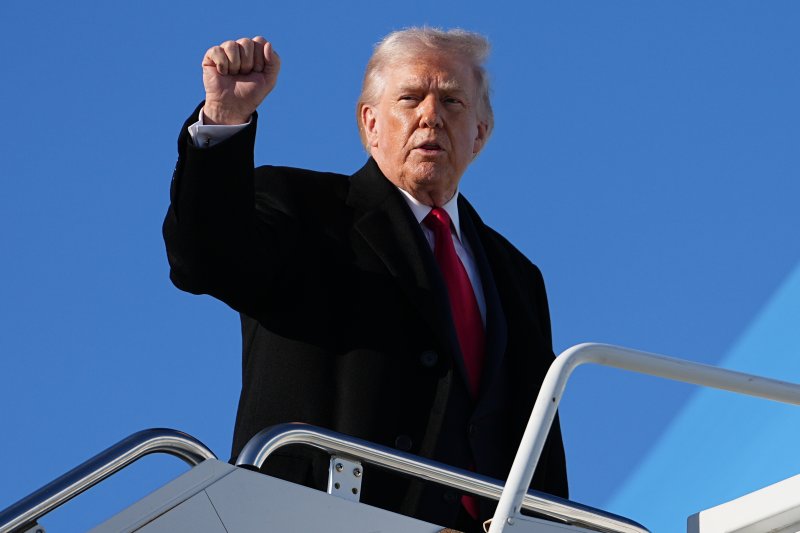
According to Financial News, U.S. President Donald Trump, who this month resumed denuclearization talks with Iran after an eight‐month hiatus, has confirmed that he is sending a second aircraft carrier strike group to waters near Iran, following last month’s deployment. He argued that the United States must be prepared for a breakdown in the talks and stressed that instilling fear in Iran is necessary to reach an agreement.
Trump on second carrier deployment: "Preparing for collapse of nuclear talks"
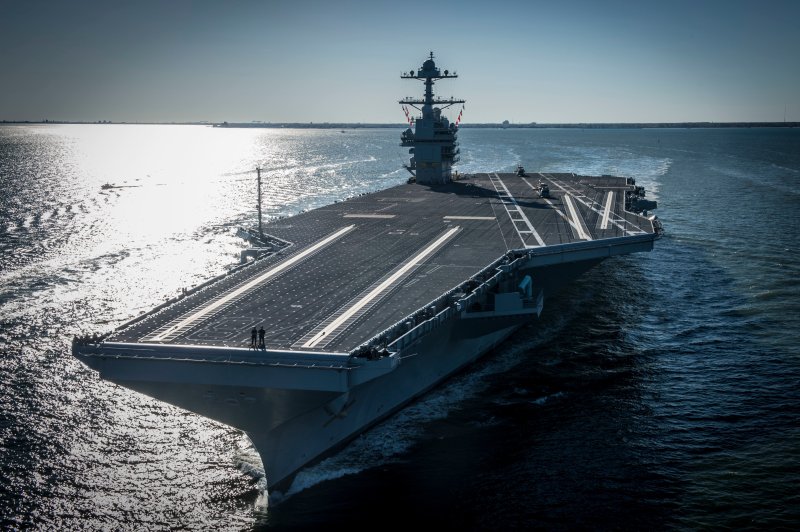
Citing France 24 and other foreign media, reports said Trump told reporters at the White House on the 13th local time that the second carrier strike group "will be leaving very soon" when asked whether the deployment was real. He said it would be needed "in case the talks fall apart" and added, "If necessary, we will use it, and we have it ready." He also emphasized that it represents "a very powerful force." Trump said he thinks the negotiations with Iran "will be successful," but warned, "If not, it will be a very bad day for Iran."The previous day, the New York Times, citing four U.S. military officials, reported that the crew of the aircraft carrier USS Gerald R. Ford (CVN-78) is not expected to return to its home port until April or May and that the ship is moving to the Middle East. The carrier left Norfolk, Virginia, in June last year and arrived near the Mediterranean, but later shifted to the Caribbean as U.S. pressure on Venezuela intensified. Last month, in connection with anti‐government protests in Iran, Trump hinted at possible military intervention and redirected the USS Abraham Lincoln (CVN-72), then in the Indo-Pacific region, to the Middle East.
The move comes about a week after the United States and Iran resumed denuclearization talks. Negotiators from the two countries restarted nuclear talks in Oman on the 6th but failed to reach an agreement. Back in 2015, Iran and six powers — the United States, the United Kingdom, France, Germany (the E3) and others — concluded the Iran nuclear deal, formally known as the Joint Comprehensive Plan of Action (JCPOA), under which economic sanctions would be lifted if Iran abandoned nuclear weapons. However, in 2018 during his first term, Trump unilaterally withdrew from the deal, claiming it did not adequately restrain Iran, and reinstated economic sanctions.
After beginning his second term last year, Trump held five rounds of one‐on‐one denuclearization talks with Iran between April and May, but they produced no tangible results. In June, the U.S. military assisted Israel in bombing Iranian nuclear facilities. Last month, as anti‐government protests spread in Iran, Trump sent a carrier strike group to the region and demanded that Tehran give up nuclear weapons. On the 3rd of this month, the Iranian government said via social media that it was prepared to resume nuclear talks with the United States.
Pressuring Iran to return to the nuclear deal, ramping up psychological warfare
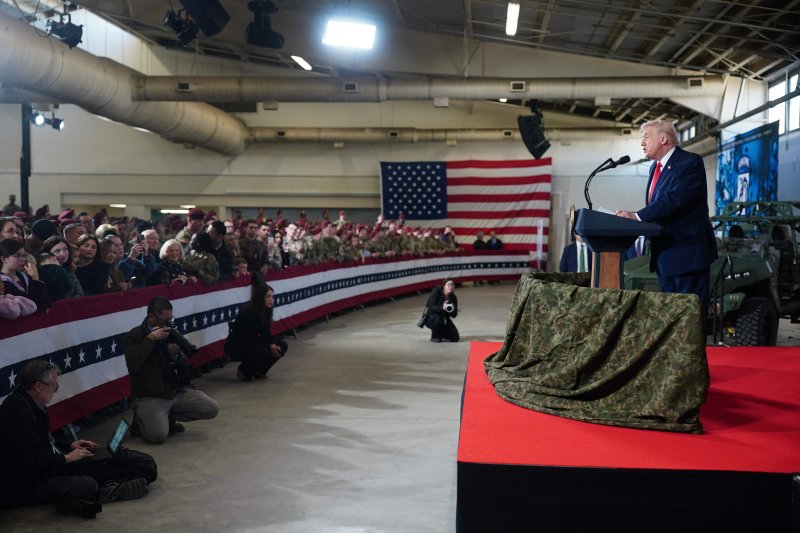
After answering questions from reporters on the 13th, Trump flew to Fort Bragg, the largest U.S. military base, in North Carolina. In a speech at the base, he brought up Iran and said, "I really want to see whether we can reach an agreement," adding, "They have been a very difficult counterpart to negotiate with." Referring to last June’s bombing of Iranian nuclear facilities, code‐named Operation Midnight Hammer, Trump said, "I thought we were going to get a deal last time. They wanted that too. What we did was Midnight Hammer." He went on, "Sometimes you have to make them tremble with fear. That is the only thing that really brings a situation under control."Fort Bragg is home to U.S. Special Operations Command, and this was Trump’s second visit to the base since June last year. The visit was intended to commend the service members who took part in last month’s operation to attack Venezuela and capture President Nicolás Maduro.
In his speech, Trump boasted that the United States possesses the world’s most advanced weapons, technology and warriors. "Last month," he said, "some of the finest soldiers in history, who are here today, proved that again when they successfully captured Maduro and handed him over to the U.S. justice system." He added that the United States had used a secret weapon called the "discombobulator" during the Venezuela operation. "They talk about the discombobulator," Trump said, "because they were not able to fire a single shot." He also noted, "The Russian equipment didn’t work, and the Chinese equipment didn’t work either. Everyone is trying to figure out why it didn’t work. Someday they will know, but in any case, it didn’t work."
In an interview with NBC this month, Trump declined to go into detail about the discombobulator, saying, "I can’t talk about it," but added, "I will tell you what it does. It makes their equipment not work at all." He did not disclose the weapon’s official name, type or any other technical specifics.
[email protected] Park Jong-won Reporter