Medical Professors’ Group Says Education Review Must Come Before Enrollment Increase
- Input
- 2026-02-13 13:42:52
- Updated
- 2026-02-13 13:42:52
Earlier, through the Health and Medical Policy Deliberation Committee, the government decided to increase the annual enrollment quota of 32 medical schools outside Seoul by an average of 668 students between 2027 and 2031. The government projects a shortage of 4,724 doctors by 2037 and has announced that it will add a total of 3,542 medical students over the same period, including 490 additional students in the 2027 academic year.
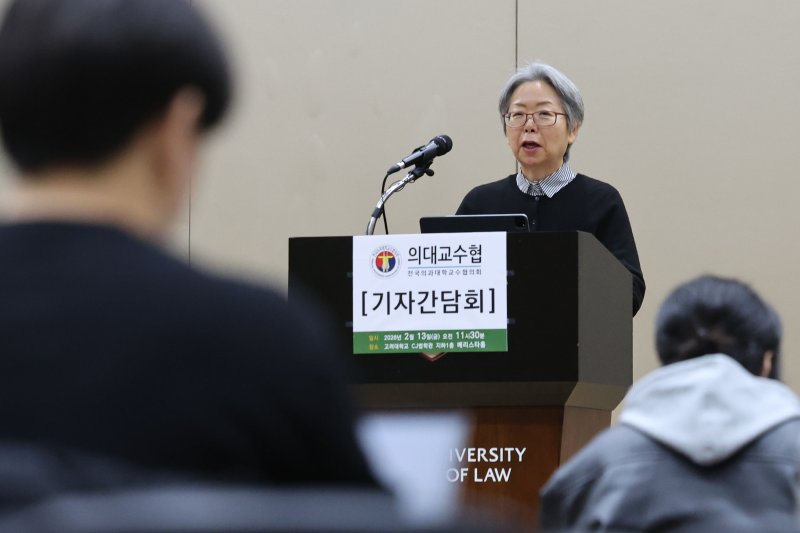
However, the association pointed out that “the legal standards presented by the government are only the minimum conditions for what is ‘possible,’” adding, “The quality of education that the public expects should be judged by whether it can actually be sustained in practice, beyond those minimum criteria.”
The association divided the elements of education quality into four categories: the actual number of students to be educated, the teaching competence of faculty, plans for lectures and practical training, and the capacity to provide patient-contact education and residency training.
It particularly stressed that the number of students on leave, those who have repeated a year, and those returning to school are key variables that determine overcrowding in educational settings. According to the association, 1,586 students from the 2024 and 2025 cohorts are currently on leave, and 749 of them are scheduled to return in the 2027 academic year alone.
“Even if we factor in only these returning students, there is a risk of clashing with the educational capacity limits already discussed by the committee, even without any additional enrollment increase,” the association warned. “If decisions are based solely on the official enrollment quota, bottlenecks may occur in lecture halls and practice rooms.”
The association also argued, “If ensuring education quality is the guiding principle for deliberation, then the government must disclose year-by-year scenarios, including the actual number of students to be taught—taking into account leaves of absence and returns—faculty composition, and each university’s operational plans.” It added that concrete plans are also needed to guarantee the quality of patient-contact clinical training and to expand training infrastructure.
The association made clear that it does not categorically oppose increasing enrollment itself. “We do not deny the need to discuss enrollment numbers,” it stated, “but if education quality is the basis for policy, then that quality must be verified in a measurable way.”
It went on to say, “The government should release the raw data used for its projections and the materials used to validate policy scenarios for 2027–2031, and first conduct a realistic analysis that reflects variables such as leaves of absence and returns.” It emphasized, “This is not a precondition for opposition, but the minimum level of verification needed to uphold the principles of deliberation.”
Meanwhile, for the government’s projections on the supply and demand of doctors and its expansion plan for medical school enrollment to align with the actual capacity of educational institutions, it appears unavoidable that more detailed data will need to be disclosed and subjected to verification procedures going forward.
[email protected] Kang Jung-mo Reporter