"Breeding Corporate Raiders" vs. "Enhancing Shareholder Value": Hearing on Mandatory Cancellation of Treasury Shares
- Input
- 2026-02-13 14:15:55
- Updated
- 2026-02-13 14:15:55
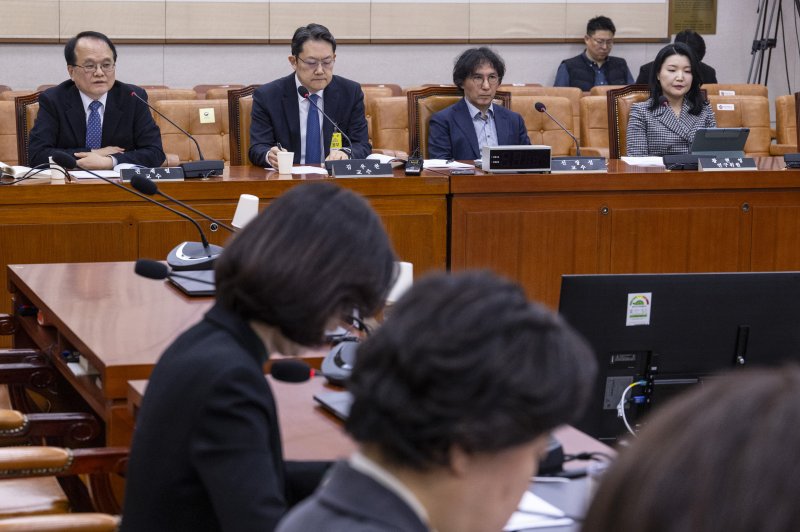
At a public hearing convened to discuss the third Commercial Act amendment bill, which includes a clause on mandatory cancellation of treasury shares, opinions were sharply divided between those calling it a measure for "enhancing shareholder value" and those warning it is a "law that breeds corporate raiders." With the hearing now concluded, the Democratic Party of Korea plans to move quickly to review the bill and aims to pass it during the February provisional session of the National Assembly.
The Subcommittee on Bill Review No. 1 of the Legislation and Judiciary Committee of the National Assembly held a public hearing on the 13th to discuss the third Commercial Act amendment bill, which would make the cancellation of treasury shares mandatory. Testifying for the Democratic Party of Korea were Kim Woo-chan, a professor at Korea University Business School, and Hwang Hyun-young, a research fellow at the Korea Capital Market Institute. Testifying for the People Power Party were Kwon Jae-yeol, a professor at Kyung Hee University Law School, and Shin Jang-seop, a professor at the National University of Singapore.
Experts who voiced opposition first argued that mandatory cancellation of treasury shares has no precedent overseas. They warned that companies would lose a key tool for defending management control and could be left exposed to hostile mergers and acquisitions (M&A) by activist hedge funds.
Kwon said, "The mechanical application of a cancellation obligation carries the risk of overregulation that fails to take into account differences between companies and circumstances." Shin added, "There is no country in the world where cancellation is the principle—this is a 'Galapagos' regulation," and argued that it would go down as "a law that breeds corporate raiders."
The third Commercial Act amendment bill would require that the acquisition, holding, and disposal of treasury shares be decided by a resolution of the general meeting of shareholders. Opponents argued that this would prevent management from responding swiftly to support the share price. They also contended that if cancellation becomes mandatory, companies would be unable to design management strategies involving M&A, restructuring, and similar measures.
Supporters, on the other hand, stressed that treasury shares are being diverted into a private tool for strengthening the controlling shareholder’s grip on the company.
Kim said, "Management has engaged in swaps of treasury shares to reinforce control, while diluting the voting and dividend rights of existing shareholders," likening it to a local election where "a candidate, seeing no chance of winning in their own district, brings in friends to register their residence there and then tries to win based on that." Hwang pointed out, "Disposal of treasury shares is being used to serve the interests of the largest shareholder or to bolster control, and this undermines shareholder value."
They also rejected the claim that mandatory cancellation of treasury shares would leave management control unprotected. Kim argued, "The amendment is very flexible: in principle, treasury shares are to be cancelled, but this cannot happen if shareholders do not agree." Hwang emphasized, "The amendment bills set out broad exceptions, so companies are not unconditionally required to cancel their treasury shares."
Lawmakers from both the ruling and opposition parties on the Legislation and Judiciary Committee also clashed during the hearing.
Seo Young-kyo of the Democratic Party of Korea said, "Opposing the cancellation of treasury shares is like trying to turn the Korea Composite Stock Price Index (KOSPI) backwards." Her party colleague Kim Yong-min called the measure "the starting gun for normalizing the capital market." In contrast, Na Kyung-won of the People Power Party argued, "Starting with mandatory cancellation of treasury shares is like burning down the house to catch a flea," while fellow People Power Party lawmaker Cho Bae-sook criticized the idea that "problems can be resolved simply by obtaining a resolution from the general meeting of shareholders" as "idealistic."
The Legislation and Judiciary Committee is now expected to begin formal deliberations on the third Commercial Act amendment bill. The Democratic Party of Korea has repeatedly expressed its strong determination to pass it during the February provisional session of the National Assembly. Referring to the hearing, Kim said, "We will review the bill as swiftly as possible and ensure that it passes during the February provisional session."
[email protected] Lee Hae-ram Reporter