U.S. Investment Special Act Stalled by Political Wrangling as Special Committee’s First Meeting Collapses
- Input
- 2026-02-12 15:29:28
- Updated
- 2026-02-12 15:29:28
[Financial News] As the Democratic Party of Korea pushed through a package of judicial reform bills, including an increase in the number of Supreme Court justices and the Constitutional Complaint Act bill, the drive to swiftly pass the "Special Act on the Management of Strategic U.S.-Korea Investments (U.S. Investment Special Act)" has also hit a snag.
The People Power Party argues that, just as the Democratic Party forced through the Judicial Reform Bill, it could also unilaterally pass the U.S. Investment Special Act without bipartisan agreement, so safeguards must be put in place in advance to prevent this.
The Democratic Party counters that the special committee itself was created by agreement between the ruling and opposition parties, calling the People Power Party’s claim "nonsense." It insists that partisan strife should be kept out of the process and that the special act must be handled quickly in the national interest.
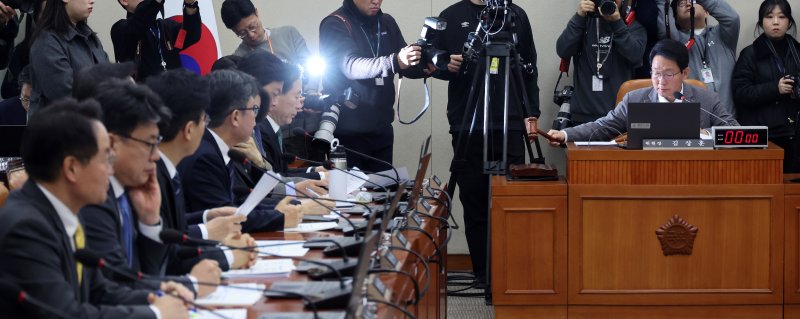
The National Assembly’s Special Committee on the U.S. Investment Special Act held its first full meeting on the 12th, but the session broke down after just 30 minutes. The committee had planned to appoint its chair and party secretaries and then receive policy briefings from the Ministry of Economy and Finance and the Ministry of Trade, Industry and Energy, but it ended up replacing the in-person briefings with written reports.
Lawmakers from both parties on the special committee first clashed over the Democratic Party’s move a day earlier to unilaterally pass the judicial reform package at the National Assembly Legislation and Judiciary Committee. Park Soo-young, a People Power Party lawmaker serving as the opposition secretary on the committee, said, "I am outraged by the way they rammed through a bill introducing a four-tier court system and increasing the number of Supreme Court justices," adding, "No matter how much we discuss this in the special committee, there is no guarantee it will not be pushed through unilaterally." He argued that, because the Democratic Party could also force through the U.S. Investment Special Act on its own, mechanisms are needed to restrain such a move.
Democratic Party lawmakers held a press conference condemning the breakdown of the special committee. Heo Young of the Democratic Party said, "With each passing day, companies are suffering losses of 30 to 40 billion won per day due to tariffs," and pointed out, "In a month, this could mean damage to the national interest in the hundreds of billions or even trillions of won. If the People Power Party delays this law by acting unreasonably, there will be negative consequences, and the public will bear the cost."
Jung Il-young said, "We must pass the special act before the United States publishes the 25% tariff reimposition in its Government Gazette," raising his voice. The People Power Party also agrees on the need to pass the special act swiftly before it is published in the Government Gazette. However, if confrontation over the Judicial Reform Bill and related issues between the ruling and opposition parties continues, delays in deliberating the special act appear inevitable.
The two parties also clashed over committee chair Kim Sang-hoon’s decision to unilaterally switch the meeting to a closed session. The People Power Party said the government’s policy briefings involved sensitive information and should not be leaked, and therefore announced that the meeting would be held behind closed doors. The Democratic Party objected that there had been no prior consultation, insisting the meeting should be recessed and the decision on whether to close it made through talks between the party secretaries.
After the recess, Kim told reporters, "Since the special committee on U.S. investment is scheduled to operate until March 9, I will make sure there is no problem in passing the special act." A public hearing on the special act is scheduled for the 24th, after the Lunar New Year holiday, and other planned events are also expected to proceed without change. The ruling and opposition parties remain at odds over the extent of parliamentary oversight of U.S.-related investments and the level of disclosure of information on U.S.-Korea tariff negotiations.
[email protected] Lee Hae-ram Reporter