"Are We Really Having the Olympics Right Now?" The Lure of Copyright Money That Kills Even Memes Signals a Ratings Flop [A Weekend Sip of the Olympics]
- Input
- 2026-02-14 07:45:50
- Updated
- 2026-02-14 07:45:50
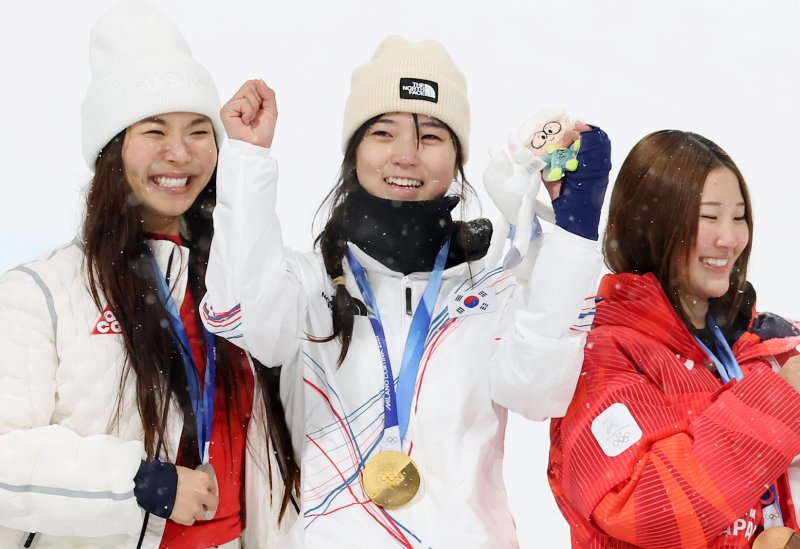
"Why does Italy hold the Olympic Games in the middle of the night?" Do you remember which meme that was?That meme suddenly came to mind, so I tweaked it into an Olympic version. As a reporter who’s been sleep-deprived every day watching the Winter Olympic Games that come only once every four years, I’m putting my usual weekend performing-arts column on hold during the Games.[A Weekend Sip of the Olympics]to share some Olympic talk with you instead. No matter how boring or low-buzz they may seem, the Olympic Games are still the Olympic Games.
[Financial News] Back when I was a sports reporter, the so-called "big year" that comes every four years was something I faced with both fear and excitement. Here, "big year" doesn’t mean the UEFA Champions League (UCL) trophy, but a year when all the mega-events—the Winter Olympic Games, the FIFA World Cup, and the Asian Games—take place. 2018 was such a year, with the 2018 Winter Olympics in Pyeongchang, the 2018 FIFA World Cup in Russia, and the 2018 Asian Games in Jakarta and Palembang. So was 2022, with the 2022 Winter Olympics in Beijing, the 2022 FIFA World Cup in Qatar, and the 2022 Asian Games in Hangzhou. Four years on, this year is another big year. Kicking off with the Milan–Cortina 2026 Winter Olympic Games, the 2026 FIFA World Cup and the 20th Asian Games Aichi-Nagoya are waiting their turn.We watch dopamine-triggering shorts and then tune in to the live broadcast... but this time, there are no shorts to watch?
The landscape in 2026 looks markedly different from the past. That may be because the age of so-called "new media" has accelerated, dramatically reshaping the media environment. We are, unmistakably, in the era of short-form content. According to Nasmedia’s "2024 Internet User Survey," more than 90% of Koreans use social networking services (SNS), and people in every age group from their teens to their 50s mainly consume sub‐one‐minute short-form videos—such as YouTube Shorts or Instagram Reels—as their primary content channel.
For quite some time now, highlight edits that extract only the "essence" have been far more effective at triggering people’s dopamine than long, continuous live broadcasts. Those clips then drive viewers back to the full broadcast, creating a virtuous cycle. Think of the "glasses senior" reaction GIF of the women’s curling team that gave birth to the catchphrase "Young-mi!" at the 2018 Winter Olympics, or the "chick" meme from the 2024 Summer Olympics in Paris that turned Shin Yu-bin into an advertising icon. Those memes significantly boosted buzz around the Games.
In that sense, the real kindling that ignites Olympic fever is no longer the TV in the living room, but the GIFs and memes that explode from the smartphones in our hands. Yet at these Games, that kindling feels far too damp to catch fire. It has already been a week since the opening ceremony, but unlike in the past, there isn’t a single meme going viral online. In other words, there is almost no content being remixed and recirculated.
IOC’s relentless "copyright violation" crackdown
The reason is simple. Platforms like social media, which serve as the main channels for spreading memes and reaction clips, are seeing round‐the‐clock crackdowns on "copyright violations." Users complain that not only are all Olympic Games videos and short looping clips being removed, but even posts that simply re‐share Olympic‐related content that Yuna Kim uploaded to her own social media accounts are immediately deleted as "copyright infringement."
If you edited Olympic Games footage into a clip and posted it on X (formerly Twitter) or another social platform, only to have it deleted and reported for copyright infringement, the culprit was most likely the International Olympic Committee (IOC). You can see how strict the IOC’s copyright enforcement is just by looking at the official X account of the National Hockey League (NHL). Because they are not allowed to use Olympic Games footage, they have been posting what look like hand‐drawn images to promote upcoming Olympic Games matches.
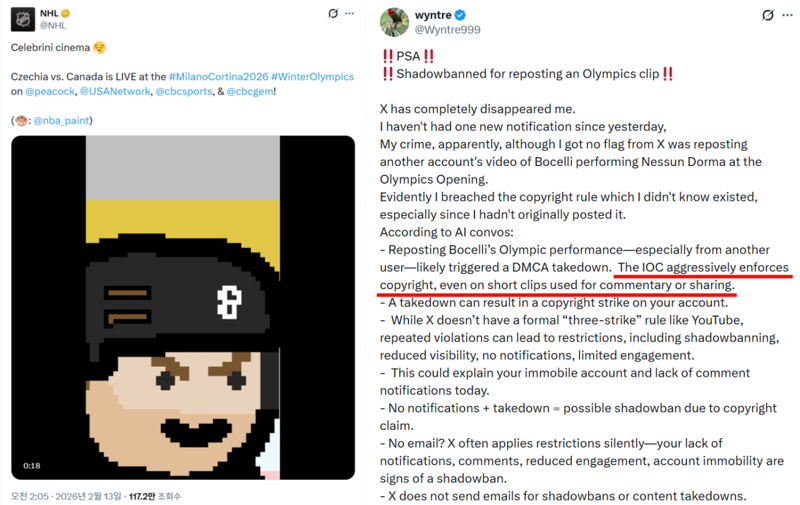
In fact, during the 2024 Summer Olympics in Paris, the IOC reportedly sent thousands of Digital Millennium Copyright Act (DMCA) takedown requests to Google to prevent copyright infringement. Because of this, communities like Reddit and X have long seen criticism along the lines of, "What kills Olympic fever isn’t poor performances by the athletes, but the IOC’s copyright takedown notices."
Of course, taking Olympic Games footage, turning it into GIFs or other secondary content, and distributing it without permission is clearly a copyright violation. The IOC holds all commercial rights to Olympic Games broadcasts, stock footage, and video archives, and it is ruthless and strict in enforcing those rights. For years, the IOC has maintained a hard‐line stance, tracking down even a single GIF file containing the Olympic Games logo and suspending accounts. It has also acted aggressively to protect the broadcast rights it sells to TV networks around the world. Even at previous Games, countless GIFs and clips were reported and deleted as copyright violations.
Crackdowns at the speed of light... sleepless AI watchdogs are now on patrol
So what’s different this time? What users are pointing to is the sheer speed at which posts are "getting cut" compared with past Games—practically at 5G speed. This has fueled suspicions that "someone in Korea is monitoring and reporting posts in real time," and led some to cast a wary eye at Joongang Tongyang Broadcasting Company (JTBC), which holds the exclusive domestic broadcast rights, and its new media partner Naver Corporation as possible "copyright watchdogs." But a more convincing explanation is that the IOC has enlisted the power of Generative Artificial Intelligence (Generative AI) to carry out even more thorough enforcement.
It is not hard to imagine that advances in AI have made it much faster and easier for the IOC to detect and remove copyright‐infringing content. Industry observers also say that platforms such as YouTube, Instagram, and X are applying far more stringent filtering than before to protect copyrights, again by making full use of AI technology. Thanks to these advances, sleepless AI watchdogs are now monitoring social media around the world 24 hours a day. It seems that even the Olympic Games—long celebrated as a "global festival" built on pure human physical competition—are gradually being permeated by the influence of AI.
[email protected] Kim Hee-sun Reporter