A split-second doze came at a high price: Drowsy driving alarms sound ahead of Lunar New Year
- Input
- 2026-02-12 16:11:02
- Updated
- 2026-02-12 16:11:02
[Financial News] Traffic accidents caused by drowsy driving continue to occur every year, steadily resulting in casualties. The risk is expected to grow even further during the Lunar New Year holiday, when long hours behind the wheel coincide with heavier traffic. Experts warn that drowsy driving is as dangerous as drunk driving and urge drivers to exercise particular caution.
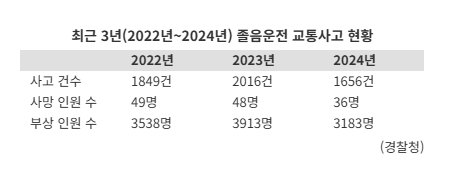
According to data titled "Status of drowsy-driving traffic accidents over the past three years" that Financial News obtained from the Korean National Police Agency (KNPA) on the 12th, there were a total of 5,521 drowsy-driving crashes between 2022 and 2024. By year, there were 1,849 crashes in 2022, 2,016 in 2023, and 1,656 in 2024. In other words, more than 1,000 drowsy-driving accidents occurred every year.
The scale of human damage was also significant. Over the same period, more than 3,000 people were injured each year, and dozens of people died annually. This shows that drowsy-driving crashes often go far beyond minor fender-benders and frequently lead to serious casualties.
Accidents are continuing to occur on the ground. Last month in Dangjin, South Chungcheong Province, an SUV driven by a man in his 20s who had dozed off plowed into a gas pipeline construction site, leaving a flagman with fractures and sending him to the hospital. In the same month, on a road in Gapyeong County, a driver in his 70s nodded off, crossed the center line, and collided with an oncoming SUV, resulting in his death.
Experts say that the structural underestimation of drowsy driving is a key reason such accidents keep happening. They explain that these crashes are especially dangerous because, in the brief moment when a driver loses control of the vehicle, the car can easily cross the center line or slam into another vehicle at high speed, leading to severe casualties.
Choi Jae-won, a professor at the Korea Road Traffic Authority (KoROAD), said, "Driving consists of three stages: seeing, judging, and operating. In drowsy driving, the most crucial function—seeing—fails, so in many cases the vehicle goes straight into a collision before the driver even has time to hit the brakes," and warned, "In terms of fatality rate, it is more dangerous than drunk driving."
Experts advise that drivers should be especially careful about drowsy driving during the Lunar New Year holiday, when large-scale travel for family visits is expected. According to The Korea Transport Institute (KOTI), about 27.8 million trips are expected to be made during the special traffic management period for this Lunar New Year holiday. As most domestic travel is projected to be by passenger car, an increase in traffic volume is unavoidable.
During major holidays, long-distance driving, concentrated traffic, and prolonged congestion tend to repeat, creating conditions in which driver fatigue easily accumulates. This makes adherence to preventive measures more important than anything else. If you are planning a long trip, you should get sufficient sleep the night before to manage your condition. While driving, you can open the windows to ventilate the cabin, drink water, or chew gum to induce a temporary arousal effect. Because many people travel with family during the holidays, it also helps if passengers frequently check the driver's condition and ease drowsiness through conversation.
A police official requested, "Because drowsiness can strike without warning, drivers should not take their fatigue lightly. When driving continues for more than an hour or two, it is important to take regular breaks by using drowsy-driving rest areas and similar facilities."
Meanwhile, the Seoul Metropolitan Police Agency (SMPA) will implement a "strategic deployment plan" during the Lunar New Year holiday, concentrating and forward-deploying mobile police units in four key public-safety areas: protecting vulnerable groups, preventing random knife attacks driven by abnormal motives, maintaining basic public order, and other livelihood-related policing.
Expecting the number of people staying in Seoul to increase during the holiday due to foreign tourists and reverse holiday travel, the agency plans to deploy up to five mobile units per day, totaling about 300 officers. It will step up patrols and inspections around major transport hubs, tourist attractions, commercial districts, and businesses that handle large amounts of cash, such as jewelry shops and currency exchanges, in an effort to minimize any gaps in public safety.
[email protected] Kim Ye-ji Reporter