Special Committee on U.S. Investment Act Stalls at First Meeting amid Judicial Reform Backlash
- Input
- 2026-02-12 10:35:39
- Updated
- 2026-02-12 10:35:39
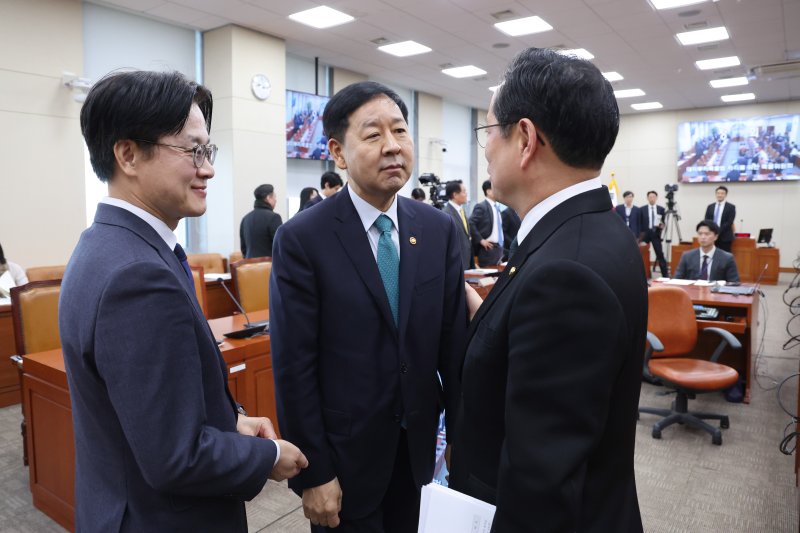
According to Financial News, the fallout from the Democratic Party of Korea’s push to pass a bill to increase the number of Supreme Court justices and the Judicial Petition Act has brought even the Special Committee on the U.S. Investment Special Act to a halt. The committee was urgently formed to review a special act in response to U.S. President Donald Trump’s announcement that tariffs would be raised again, but the very first meeting broke down in about 30 minutes. With political conflict intensifying over the ruling party’s judicial reform package, concerns are growing that the process could be further delayed.
The special committee held its first plenary session on the 12th, planning to elect a chair and secretaries from both parties and then receive policy briefings from the Ministry of Finance and Economy and the Ministry of Trade, Industry and Energy. However, the meeting soon fell apart.
First, opposition secretary Park Soo-young of the People Power Party objected to the Democratic Party of Korea’s move a day earlier to force through the bill to increase the number of Supreme Court justices and the Judicial Petition Act at the National Assembly Legislation and Judiciary Committee. His protest was aimed at what he described as the ruling party’s unilateral management of the legislature. Park said, "I am outraged by the way they rammed through a bill that introduces a four-tier court system and increases the number of Supreme Court justices," and added, "There is no guarantee that, no matter how much we discuss it here in the special committee, the bill will not simply be pushed through unilaterally." He then proposed, "Let’s recess the meeting, reach an agreement on how to stop this one-sided approach by the ruling party, and then resume."
In response, ruling party secretary Jeong Tae-ho of the Democratic Party of Korea argued, "The special committee should proceed with its work as planned, while political issues should be discussed by the floor leaders of both parties." He stressed, "The public will find it hard to accept bringing other political disputes into the special committee."
After that, committee chair Kim Sang-hoon of the People Power Party said the government’s policy briefing involved confidential matters and should not be leaked, and announced that the session would be moved behind closed doors. However, the Democratic Party of Korea objected, saying there had been no prior consultation between the secretaries and insisting that the plenary session be recessed first and that any decision on going into a closed session be made through talks between the secretaries.
The meeting was switched to a closed session by the chair’s authority but was immediately recessed. The plan is to decide whether to resume after consultations between the secretaries. Speaking to reporters, Chair Kim said, "The U.S. investment special committee is scheduled to operate until the 9th of next month, so we recessed after making clear our intention to ensure there will be no problem in handling the special act." He added, "We were unable to proceed with the government’s policy briefing as planned, but we treated the presentation of reference materials as a substitute."
[email protected] Lee Hae-ram Reporter