"Semiconductor complexity is rising steeply" — How SK hynix plans to respond
- Input
- 2026-02-11 15:13:11
- Updated
- 2026-02-11 15:13:11
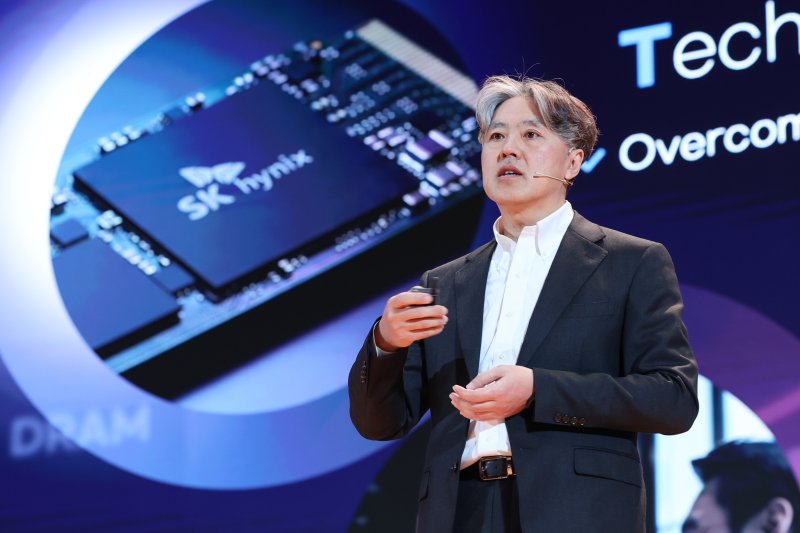
In his keynote address on "Inflection Point of Memory Technology" at Semicon Korea 2026 at the COEX Convention and Exhibition Center in Gangnam-gu, Seoul, Lee assessed that "the memory semiconductor industry has entered a period of structural transition" and stressed the importance of using artificial intelligence (AI) and cooperating at the ecosystem level. He pointed out that as DRAM moves into sub-10-nanometer-class processes and NAND evolves into stacks of more than 100 layers, the technological difficulty is rising sharply. In response, he explained, SK hynix has been modularizing key processes to build a "technology platform" that can be used across multiple generations, while sharing roadmaps with its partners.
A representative example is its collaboration with Nvidia. Lee explained that SK hynix has introduced AI into its materials discovery process, cutting the time needed to identify a single material to one-four-hundredth of the previous level. In a joint process project with Nvidia, the company also managed to reduce the number of wafers required to one-tenth.
He also outlined the future direction of technology. For DRAM, he projected that scaling will go beyond traditional limits with the introduction of bonding technologies, followed by vertical channel structures and eventually 3D DRAM that stacks cells. NAND has already shifted to a 3D structure, but as the number of layers increases, channel length grows and current limitations emerge. To address this, he said, the industry is reviewing structural innovation, process improvements, and even the development of new channel materials.
Lee stated, "To respond to the technological inflection points ahead, innovation in both structure and materials is essential," adding, "For implementing vertical gate (VG), 3D DRAM, and ultra-high-layer NAND, the need to introduce new materials alongside structural changes is growing." He believes AI-based collaboration can offer a differentiated solution. "As R&D becomes more complex, it requires far more people and resources than before," he said. "AI-based collaboration can serve as a new and distinct way to solve these challenges." He went on, "Data management and AI models, which are core elements of AI-based R&D, are not tasks for a single company alone but shared challenges that the entire semiconductor ecosystem must tackle together," adding, "SK hynix will build an AI ecosystem that can be shared with partners and organically link it with existing collaboration frameworks to overcome technological limits and lead the future semiconductor market."
[email protected] Reporter Cho Eun-hyo Reporter