‘60 Trillion Won Ghost Coin Scandal’ Exposes Lax Oversight by Financial Regulators and Weak Internal Controls at Bithumb [Crypto Briefing]
- Input
- 2026-02-11 13:23:39
- Updated
- 2026-02-11 13:23:39
[Financial News] The roughly 60 trillion won worth of erroneous Bitcoin (BTC) payouts at virtual asset exchange Bithumb have been traced to a basic failure of internal controls during a system upgrade.
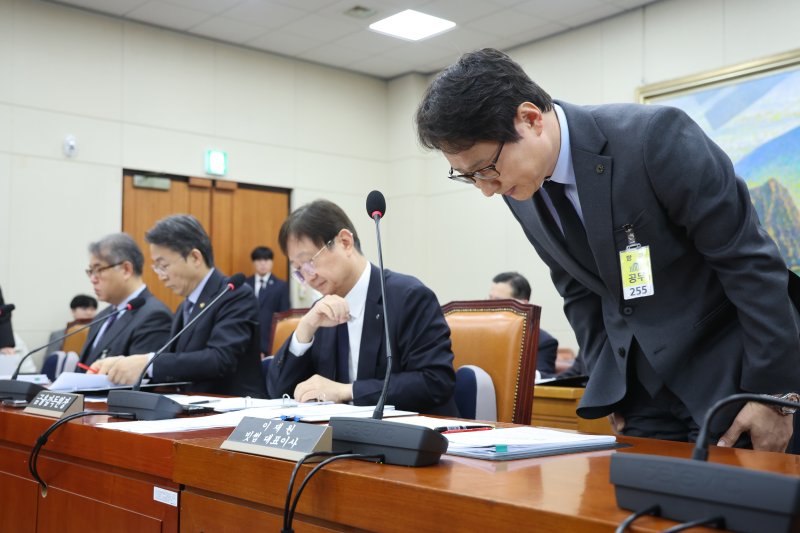
On the 11th, the National Assembly’s Political Affairs Committee held an emergency inquiry and sharply criticized vulnerabilities in Bithumb’s IT systems and the lax supervision by authorities such as the Financial Services Commission (FSC) and the Financial Supervisory Service (FSS). In response to the incident, financial regulators have begun work on institutional reforms, including imposing internal control obligations on virtual asset service providers that are comparable to those on financial companies.
The core question at the inquiry was why Bithumb’s internal control system failed to function. CEO Lee Jae-won stated, “The incident occurred during efforts to upgrade the exchange’s operating system, when the previously installed multi-approval payment system was omitted,” and admitted, “We also acknowledge that we failed to separate the account used for event payout limits at the design stage.”
The erroneous payouts from the incident that began on the 6th amounted to 620,000 BTC, worth about 60 trillion won at prevailing prices. That is 15 times more than the roughly 42,000 Bitcoins Bithumb actually holds, meaning vast quantities of so-called “ghost coins” were created on its books. When Democratic Party of Korea lawmaker Park Sang-hyuk asked, “In theory, could as many as 10 million BTC have been mis-credited?” Lee replied, “In theory, yes,” effectively conceding that the system’s defensive safeguards were inadequate.
The complacent supervisory framework of the financial authorities also came under fire. Since the Act on the Protection of Virtual Asset Users took effect in July 2024, Bithumb has undergone multiple inspections, yet the internal control weaknesses that triggered this incident were not identified in advance.
Democratic Party lawmaker Kim Nam-geun pointed out, “Other exchanges such as Upbit operate real-time reconciliation systems that run every five minutes, but Bithumb was only checking once a day,” and pressed, “Why did the financial authorities allow such a gap to persist?” In response, Financial Supervisory Service Governor Lee Chan-jin acknowledged, “Under current law, there is a structural limitation in that internal control standards are not legally enforceable,” but added, “We switched to an on-site inspection of Bithumb on the 10th and are closely examining potential violations of Anti-Money Laundering (AML) obligations and other issues.”
The government has defined this case as “a grave incident that has undermined trust in the virtual asset market” and unveiled a set of tough reform measures. In a policy report, FSC Vice Chair Kwon Dae-young said, “We will make it mandatory for exchanges to establish internal control standards equivalent to those of financial institutions, and we will reflect in the phase-two bill a plan to impose strict liability for damages on exchanges in the event of an IT incident, regardless of fault.”
Key measures include: mandatory periodic verification by external institutions of virtual asset holdings; encouraging the adoption of a real-time proof-of-reserves (POR) reconciliation system; and strengthening the suspicious transaction reporting (STR) framework for large-value trades. In particular, the government is expected to actively consider introducing technical safeguards such as a payment obligation verification system (POL), which was highlighted by Democratic Party lawmaker Min Byung-deok and others.
The post-incident cleanup is also expected to be difficult. Bithumb has yet to recover 1,788 of the 620,000 BTC that were mis-credited and then sold, worth about 13 billion won. Bithumb has explained, “We have restored consistency by first repurchasing the unrecovered amount using the company’s own assets,” but disputes are likely to continue over the exact scope of compensation for investors who suffered losses from the sharp price drop (panic selling) and forced liquidations immediately after the incident.
[email protected] Kim Mi-hee Reporter