"Tighter lending failed to bite"... Household loans up 1.4 trillion won in January
- Input
- 2026-02-11 12:00:00
- Updated
- 2026-02-11 12:00:00
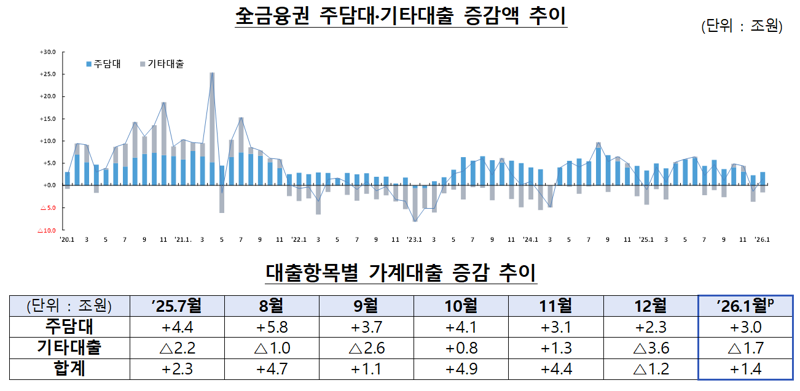
According to the "Trends in Household Loans for January 2026" released by the financial authorities on the 11th, household loans across all financial institutions increased by 1.4 trillion won in January. The government has been pressing ahead with strong lending controls, including caps on the total volume of mortgage loans, to stabilize real estate prices. Nevertheless, loans expanded, led by mutual finance institutions.
By sector, household loans at banks fell by 1 trillion won in January from the previous month. The pace of decline slowed compared with the 2 trillion won drop in December last year, but the downward trend continued. In particular, banks’ own mortgage loans, which had decreased by 1.4 trillion won in December, shrank by 1.7 trillion won in January, with the decline widening. However, policy mortgage products such as Didimdol, Butimok and Bogeumjari Loan increased by 1.1 trillion won, with the rise larger than the 900 billion won gain in the previous month.
Household loans at non-bank financial institutions increased by 2.4 trillion won in January. That is more than three times the 800 billion won rise recorded a month earlier. Loans at mutual finance institutions totaled 2.3 trillion won, with the increase expanding from 2 trillion won in the previous month. Household loans at insurance companies and specialized credit finance companies decreased by 200 billion won and 20 billion won, respectively. The savings bank sector, which had seen a 500 billion won decline in December last year, swung to an increase of 300 billion won.
The financial authorities assessed, "In January, household loans increased overall because, although bank household loans continued to decline as in the previous month, the scale of growth in household loans at non-bank financial institutions expanded." They added, "This was the result of financial companies resuming full-scale sales activities at the start of the year and an increase in group loans centered on the secondary financial sector, including mutual finance institutions such as the National Agricultural Cooperative Federation (NACF) and community credit cooperatives."
They went on to stress, "In February, when financial companies fully ramp up their sales activities and seasonal moving demand for the new school term is added, the scale of household loan growth could expand further and volatility could increase. Therefore, we ask all sectors to strengthen monitoring of household loan trends and to exercise the utmost care in managing household lending."
The Ministry of the Interior and Safety said, "We take very seriously the continued increase in household loans at the Korean Federation of Community Credit Cooperatives, centered on mortgage loans, since last year," adding, "In line with the government-wide stance of strengthening household debt management going forward, we will further tighten oversight of household lending at community credit cooperatives."
Having far exceeded its household loan volume target, the Korean Federation of Community Credit Cooperatives halted loans arranged through loan brokers starting on the 19th. It is unusual in that an "autonomous regulation" measure, which is typically implemented at year-end to manage lending volumes, is being applied at the beginning of the year. The move is intended to curb the so-called "balloon effect," in which lending by mutual finance institutions increases as bank loans are restricted. The federation has not specified when it will resume such lending, and an indefinite suspension within this year is expected.
mj@fnnews.com Park Moon-su Reporter